Archive for July, 2014

The Salt on the Level

The Salt on the Level . . .

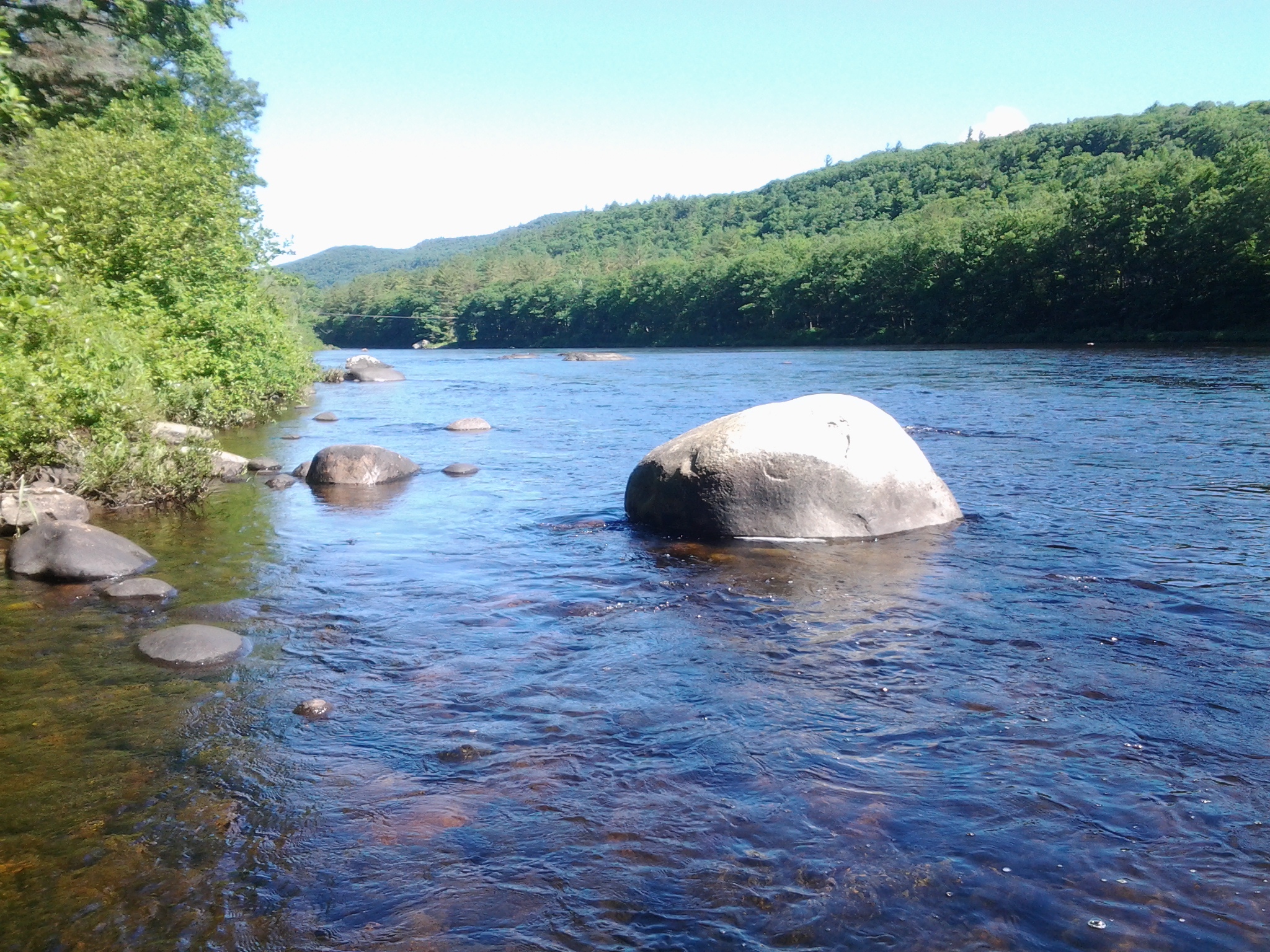
Hudson River High Tide (photo taken 07 2014)

Hudson River High Tide
(photo taken 07 2014)

The Salt. I have been trying, toying in earnest, to infuse my tenkara with diversity through variety in waters flowing and still, freshwater and . . . salt.

The Salt; Saltwater: Some older classics of the printed literature hold titles such as “Dock Fish” in which a sense of history can be linked to the facet of the sport perhaps best named saltwater panfishing. During this second decade of the 21st Century, add the urban angle in Manhattan, USA, and that offers two fishes of note: black sea bass (Centropristris striata) and bluefish (Pomatomus saltatrix), in particular the yearlings known regionally as “snappers” (pronounced “snappas”).

The Black Sea Bass
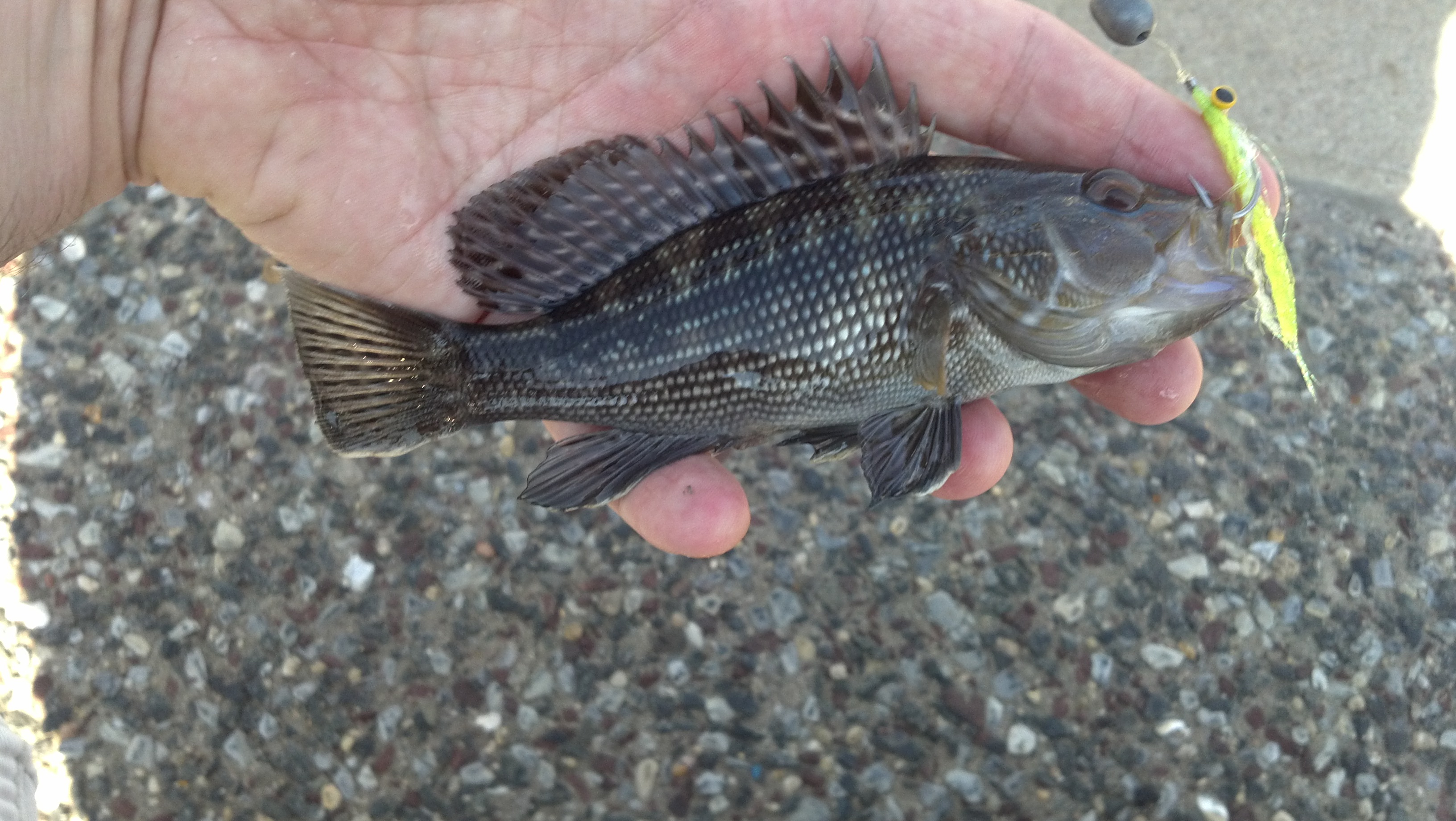
Black Sea Bass (photo taken 07)

Black Sea Bass (photo taken 07)

The black sea bass (those I have lost and caught and released) on the tenkara rod have coerced me to believe this is a saltwater sporting equivalent to the green sunfish found in freshwater streams. Previously I extolled on the green sunfish. The black sea bass is just as worthy.

The black sea bass is by classification a grouper, a smaller one, hardier to cold temperatures, a member of the family more well-known by its southern relations that range in color, pattern, and in size up to a 70s fly Volkswagen beetle.

The black sea bass exhibits broad shoulders, a flank thickness like the green sunfish, dressed in pearled black scales that hold an iridescence that glows bright blue around and along the lateral line. Vermiculation of a similar color resembles that of the green sunfish. The size encountered off my Manhattan dock(s) range from six to twelve inches. Only the very few largest are potentially one in the hermaphroditic phase, an interesting fact of this fish, which sets in at around specimens of ten inches or longer, in weight reaching eight to ten pounds.

Fish take a fly firmly and quiver shake in resistance. Bright weighted streamers, a chartreuse variety of Cllouser, can be cast, sunk, twitched on a line twelve feet in length supplemented by a leader of similar length tipped by the fly. Such a pattern on a swing with slow pulses of the wrist will take fish during one or two parts of a tide, often on incoming, but not always. One certainty, speed up the presentation of the fly to be intercepted by another hard hitter.

The Bluefish

First Fish! (photo taken 07 2014)

First Fish!
(photo taken 07 2014)

Closer to the surface cruise little toy soldier pods of juvenile bluefish chasing fry and rainbait schools. The schools of bluefish cutting baitfish like class come in and go out on quick waves that rarely last longer than two caught fish. Several hours of fishing will provide one half dozen waves of two minute bites on most occasions.

There also are changing skies to contemplate and inquisitive tourists, in between, plus a smorgasbord of aviation and ship sightseeing.

Fly patterns remain consistent with those best for the black sea bass. Simple half-and-half Clouser patterns tied for skinny water. Cinderworm patterns are normally ignored, although any dartible streamer of white can do. Sizes 6 through 8 are small enough for the tight-lipped bite of both fishes.

Hooks require a line. Level Line, not traditional tapered, is advised to be used. The Salt. I attach twelve feet to a small swivel and add a straight leader of monofilament in 5 or 6 lb. test. I want the leader to be breakable in case I hook into a piling of wood; an admittedly occasional hazard.

Hudson River Low Tide (photo taken 07 2014)

Hudson River Low Tide
(photo taken 07 2014)

Close fishing to the docks works best when peak tides and solunar tables meet. Check predictions on the website Tides4Fishing and study saltwater access nearest you. Tenkara may work on croakers and bergalls and many other fishes of The Salt that can fit into a pan if you force them, by hook.
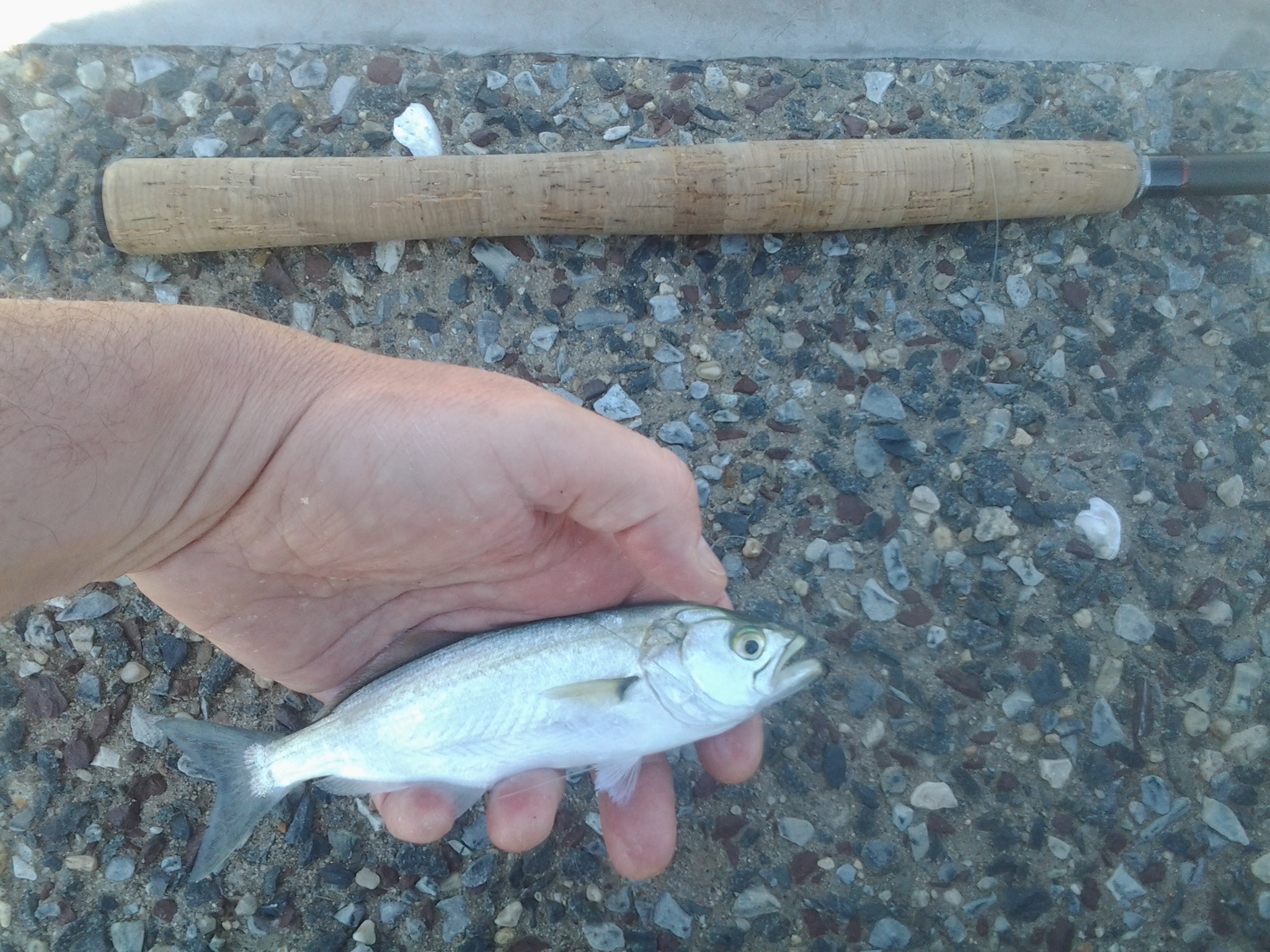
Panfish, or Handfish? (photo taken 07 2014)

Panfish, or Handfish?
(photo taken 07 2014)

– rPs 07 25 2014

Postscript: Tides4Fishing http://www.tides4fishing.com/

Leave a Comment

Happiness

Happiness . . .

Green Sunfish along a New Jersey road. (photo taken 07 10 2014)

Green Sunfish along a New Jersey road. (photo taken 07 10 2014)

That little brook beside the road, a scene repeated across this globe creased by moving water. My most often wonder as a child until now is what may swim toward the artificial fly within this flow or that flow.

This one, near Passaic, New Jersey, poured forth in runs shin deep along the green edge of a Jazz Age duplex neighborhood bordered by a small park. This run of preserved water flowing through a garden city urban setting offered up on a sunny July afternoon a final treasure, finality found in a firm belief:

One Rod. One Line. One Fly.

One Fish!

Green Sunfish, Lepomis cyanellus, is my favorite freshwater tenkara tackling opponent that does not fall under the separate heading of Salmonid.

Lepomis cyanellus, the fins of this fish often exhibit a commonality with the east coast’s native char, Salvelinus fontinalus. Both fish possess rusty fins edged precisely in white.

The mouth of the green sunfish, like the rock bass and the redbreast sunfish, presents an elongated jaw like the largemouth and the smallmouth bass. Coloration, in addition to the fins, may exhibit barred or mottled jade. Sky blue vermiculation often decorates the cheeks and pronounced jawline.

I dedicated an entire chapter to the green sunfish in my most recent book, Small Fry: The Lure of the Little. One included claim of experience included the observation this species will take the wet fly when swung or pulsed beside submerged ledges of rock. Stretches of this little back alley run runs deeper along a smooth rounded ledge, casting shade at high sun and the rest of the day throughout. New Jersey bedrock: carved by water.

Additional shade here is often provided by Norway Maple trees. This introduced species, a popular planting during earlier generations, holds broad leaves that can cast a lush cover of shade over a city sidewalk and its parallel greenway brook. Numerous green sunfish dared forth from the ledges under tree shade cover and savaged passing offerings with the voracity of brookies swarming a floating beetle pattern just as it lands on a foothill creek flanked by hemlocks.

The length of the two fish runs in parallel fashion, ranging between three and eight inches in small streams. A plump green sunfish of six inches marks my personal best so far caught and released from this Passaic-area creek. This fatness counts in the strength department. The rounded green sunfish body holds more bulk against a tenkara rod’s tenderer, Lillian-tipped, rod tip.

Between dapping and pocket picking between banks set ten feet apart, successful narrow casts can be made. I practice my bow and arrow here, too. A careful bow flip can land beneath the branches where frequently a larger brooding fish often holds. Tenkara rods cover this variety of water well.

Outings spent in intense fishing, green sunfishing in a tight quarter, will leave most anglers exercised after a summer day’s length. Happiness comes from the experience, perhaps accompanied by ice cream with a fishing amigo, with which one enjoys also a cooling sunset. Fireflies began a cold, incandescent dance beneath the tree canopies as Sol submerged behind cumulus cloud and the tree line standing behind living city water.

A tenkara lesson learned with the green sunfish pointing the way.

Happiness.

– rPs 07 14 2014

Leave a Comment

New Beginnings, New Starts

New Beginnings, New Starts . . .

Hudson River Casting Platform (photo taken 06 22 2014)

Hudson River Casting Platform (photo taken 06 22 2014)

Summer Begins: “Schooled at Meadow and Hudson”

1.

Sounds like the subtitle infers something happened at the intersection of two streets. Sounds of people meeting and laughing interrupted by a sporadic clunk when and where some individual gets burned, yet learns street smarts.

The tenkara party continues to grow although, for me, the fishing fly life has become the quiet sport. The pupil piscator has been schooled at Meadow (Lake) and Hudson (River).

One spring June afternoon was made available and spent under sky around the brackish Meadow Lake in Flushing Meadows Corona Park, Queens. Stories from here, heretofore, had come conflicted between hearsay and a past issue of The New Yorker, dated August 22, 2005, which in part relayed one portrait of mi amigo, Edwin Valentin, in a quest with two other anglers for a caught, perhaps photographed, New York City snakehead on the deadline of a feature reporter.

My Snakehead Spring; I have lived through such times, too, experienced a parallel coincidence pair on a matter urban angling. I decided to inquire through my experience further. The 7 train left me a walk’s distance around the National Tennis Center and the grounds of the 1964 New York World’s Fair. The scene appeared clear, without the makeup of sunlight angle streams. The view appeared direct and in that bare way consistent under an unbroken nimbus cloud lid that did open near day’s end, eight hours later, when the sun set off in an electrum burst at the bottom of a darkening blue sky.

Nimbus Grip at Meadow Lake (photo taken 06 11 2014)

Nimbus Grip at Meadow Lake (photo taken 06 11 2014)

Windy this place remained, even after the last of the sun’s light. Barnacles encrusted a few pieces of old construction wood. These planks and a green great wall, a phragmite monopoly, walled in the water in all but a dozen tight places.

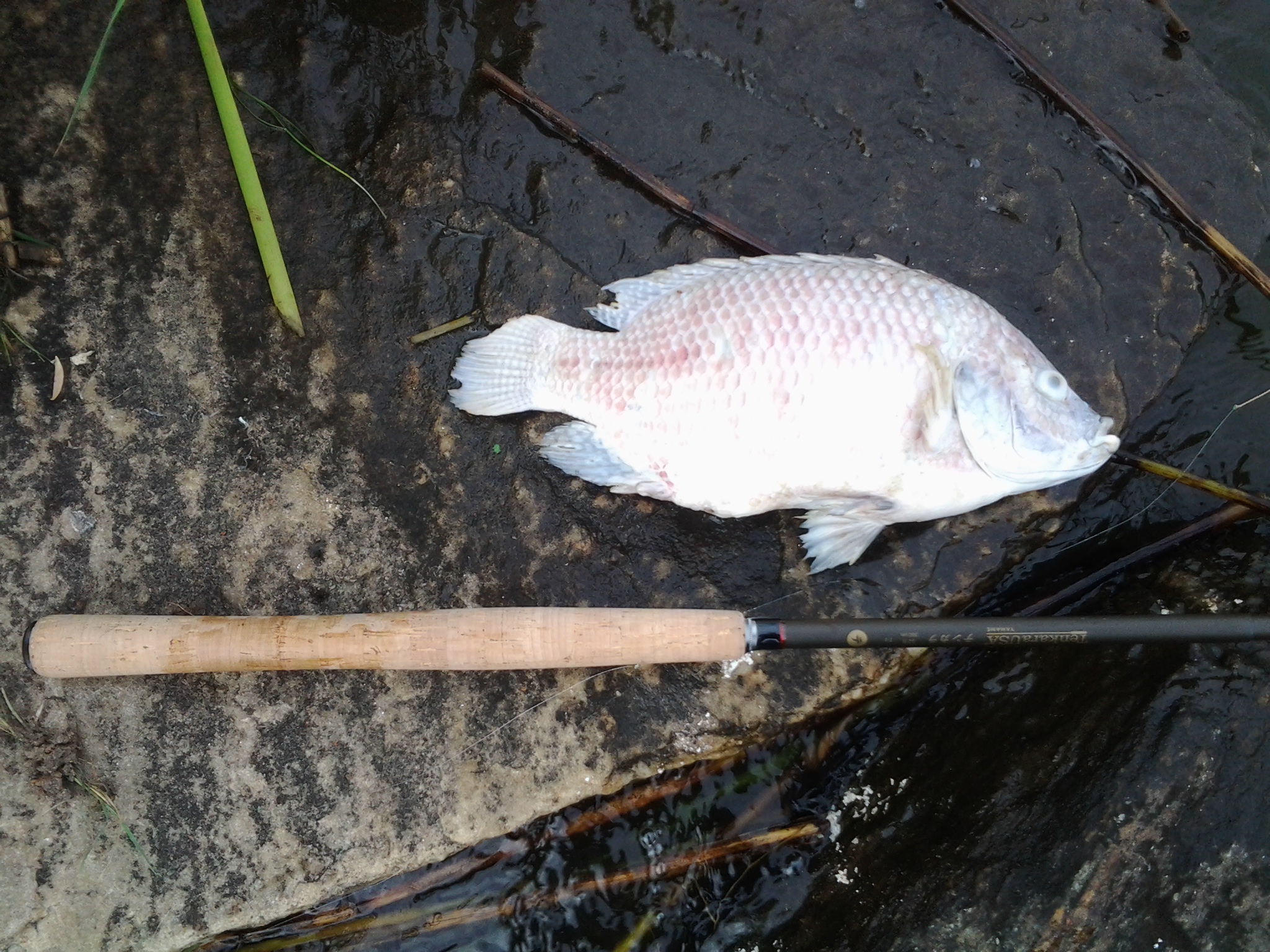
Snakehead? No, tenkara instead touched tilapia , , , one dead, a few living, seen grazing in the visible lake shallows along with carp of my favorite proportion; those the size of largemouth bass.

Yamame and Tilapia (photo taken 06 11 2014)

Yamame and Tilapia (photo taken 06 11 2014)

This is one salt lake that certainly merits more attention and shall receive more.

2.

The commercial fly life remains brisk. That’s where the block party has been going down. Tippet material, especially 6X, sells daily. I feel the standard tenkara 5X may be scaled down by one or two with most good fish played to satisfaction. Time and fish are all the necessities required to test such lines.

Two bright Sunday morning hours on the second day of summer did present a sole challenge within the wide, swift, Hudson River near Lake George.

A recalcitrant trio of brook, rainbow, and brown, this being one of the few areas in New York that possesses the potential for all three species netted on a given outing, felt near. A few glimpses of shadows defying current snaked under my sight. Was that first hang-up of a Peacock Herl Prince, the snag concluded below the water, near the cobblestone, without an explanation, actually a quick head snap of 6X under a trout take? The loose point of tippet returned clean snipped.

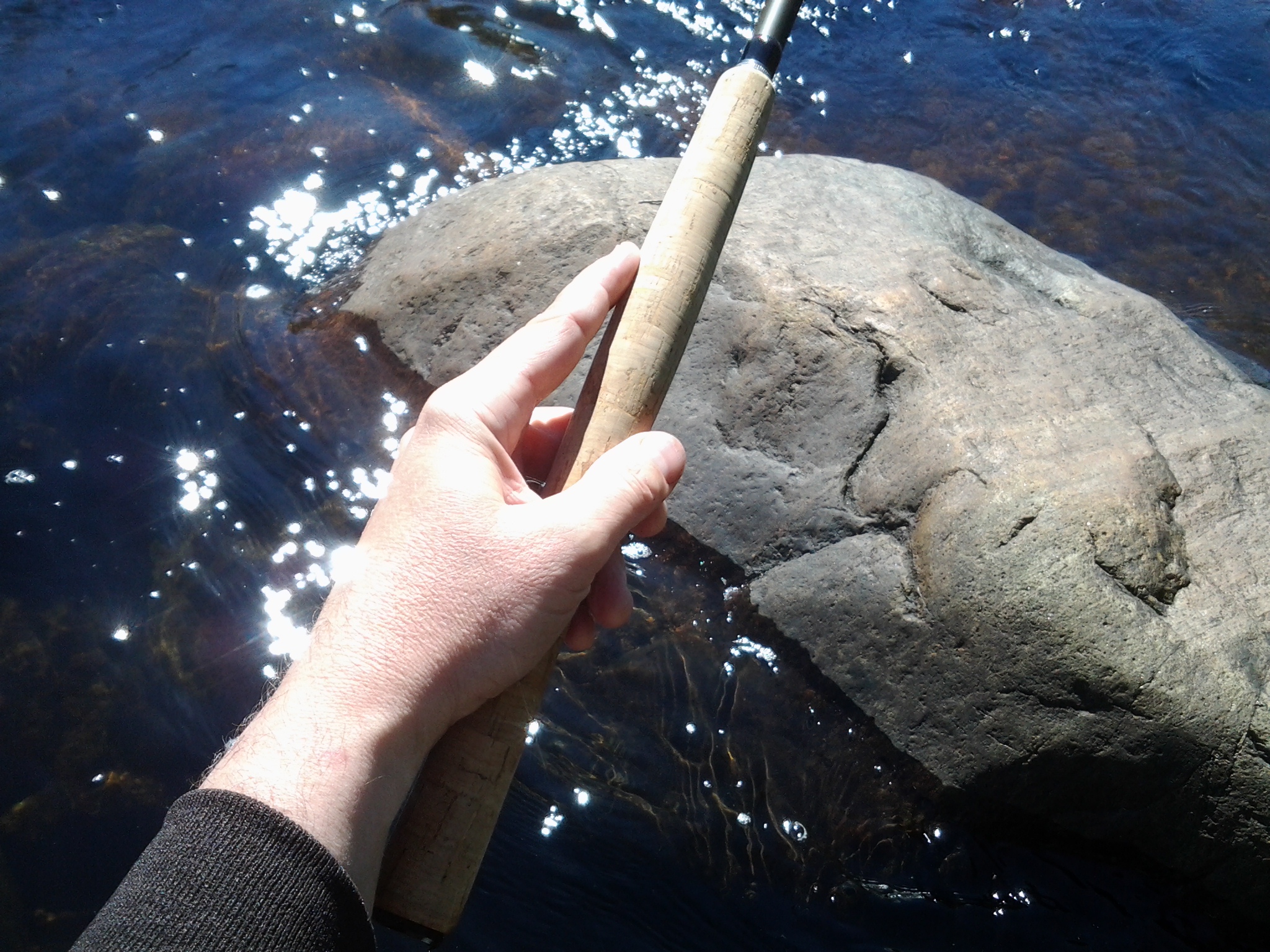
I did find the wading worthy enough for a staff. Without one, I somewhat stumbled up through a loose boulder garden. Plenty of slots and seams presented more prime soft hackle water than the time I had allotted to me. My best gave a few opportunities to hold the stick, high behind a granite monolith’s teardrop holding trout station, long enough for a short series of photos.

Bright Grip on the Hudson (photo taken 06 22 2014)

Bright Grip on the Hudson (photo taken 06 22 2014)

July Starts. “Tenkara Cameo”

Tenkara queries attract like minds. My July has been peppered with conversation several times a week with new faces on topics tenkara. Kebari practice remains close to the vise. There is time enough for deer hair and thread and the occasional bird feather. Peacock Herl is my A decoration. The wraps of iridescence are a pleasure; I never tire from the repetition, close knitted on a wet nymph fly hook.

Beginnings, some months, like this month, bear good news in the form of good press. Mid Atlantic Fly Fishing Guide, found complimentary in fly shops I have visited, gave me good news in the form of a cover appearance and a new story – “Brooklyn on the Fly” – on the pages of the new August 2014 issue. My Tenkara USA Ebisu rod makes two photo cameo appearances.

Mid Atlantic Fly Fishing Guide (August 2014)

Mid Atlantic Fly Fishing Guide (August 2014)

– rPs 07 09 2014

Leave a Comment

Design a site like this with WordPress.com
Get started