— rPs 11 14 2015
Archive for Tenkara Reading
“Lucky”
“Lucky” . . .

Free Parking
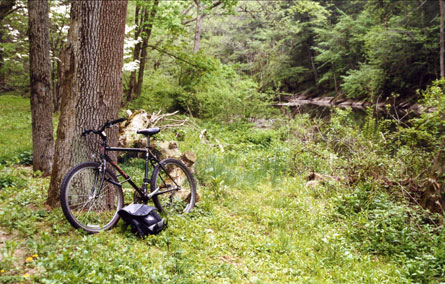
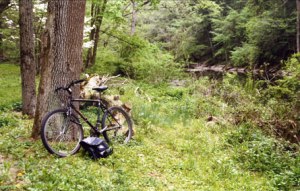
John Mutone loved two wheels to explore the bluffs and meadows of the Wiisahickon Valley.
(photo from Small Fry: The Lure of the Little by ron P. swegman)
Times gripped hand to hand are so deservedly storied that one just has to spill the secret into an ear, or onto a page, in order to keep the living images swimming in the full color flow of good memory.
The fish reflected silver and gold, red and black pebbled along its length: Salmo trutta; a brown trout. Why this one trout? All deserve to be celebrated more than most in this point of view. The answer may be traced to the person and place that made this fish a tale.
John, “Johnny!” is a competitive soul set at level BMX vertical drop hopper. Loud, happy, always holding a paperback in his hand. The other hand would hold up a water bottle or blunt. The guy could juggle roles and boom out in a voice matched with hardwood carpenter’s hands. He could fish, too, quick and precise casts of the fly rod.
Regular, he arrived disciplined as a clock, to drop in before drop off. I sat beside the 19th Street big window alone at a table spaced for three. My luck of place and time: John’s true tale came to my attention; I had been lucky enough to be reading alone at that table when his energized vibe entered the room and cleared away a rainy Tuesday evening.
John joined me with a mug of strong French roast and said: “You, of all people, ARE going to appreciate this.” I folded farther news, sat back. “Really? Shoot, or . . . Truit?”
John said his Memorial Day had begun uneventfully at La Colombe. Double Americano to stay. No regulars, including me, he noted.
“The usual urge to linger didn’t creep up and steal the morning.” He turned head on impulse to find a woman dressed in tight grey cashmere go by. His mouth shaped a whimsical sneer of a smile that was brilliant comedy. Everyone else grinned, too.
“I fueled up, circled once around Rittenhouse Square. Empty, man. No deserters. An older lady with a dog.”
North, he shot the short cycle over to Logan Circle where the parade could be viewed. The Calder fountain had been switched on with the unofficial start of the summer tourist season. The three reclining green bronze figures representing Wissahickon Creek, the Delaware River, and the Schuylkill River put him in a fishing mood.
She was with her family in DC. Whoa. No go to anyone else to mountain bike Wiss-ward with a plop into the secret pool in the park. He headed back to the crib and gathered his fishing gear to go.
Solo outing, quiet time, had evolved into a slow, fishless day along the water during one of the coolest spring seasons in his years of memory. The hillsides above the water had gone green, a line of goslings followed behind their mother goose. The river and its fish appeared, by their absence, to be still mired in late March. The list of fishes that normally wake in May water have a slower motivation rate when the thermometer continues to drop into the 40’s and 50’s, as it had that entire month, each and every time the sun sank below the horizon.
By four in the afternoon the incoming tide had reclaimed most of the rocks that make fishing a fly along the bank intermittingly possible. John didn’t bring the kayak and was in no mood to wade. He returned to where he had begun, and there remained just enough bank and time for a fellow shod in sneakers to make a last cast or two.
He checked his line and fly, added a second small bb to sink it more quickly in the deepening water, and sent out a back cast parallel to a current seam. The pattern went with the flow on a wet-fly swing and, once both line and fly were straight and hanging in the current, he began a retrieve with small, slow strips. The sky was becoming overcast, giving the river its most “fishy” of its myriad looks. Yoga with line and staff in motion and contemplation, dig?
The water’s surface reflected dark greens, liquid grays, and stony whites. Just as the fly pattern neared the one rock still partially exposed and dry, John lifted his rod into the high stick position, and there witnessed nothing less than an —
ERUPTION!
An aerodynamic fish launched out of the water, missile profile defying gravity by swimming in the air before his wide eyes, tenaciously chasing an evening meal that happened to be his feathered streamer.
A fish, and a very game fish at that. Action! At last! John had missed the grab yet, somehow, instinctively sent out the fly on an attenuated roll cast that placed the pattern just a few feet down from where the fish had surfaced. He was filled with the thrill, adrenaline surged, and yet.
He felt puzzled, too. The fish in the mental photograph he held was leaner than a bass and had a gold belly, and he swore he had seen spots as thick as a leopard’s, or a very wild trout’s.
“Couldn’t be” one of those. He half spoke out loud and half thought. “Not in the Schuylkill. Not here, man. Really?”
Maybe he had hooked grand –
SLAM!
The fish hit again in the same spot beside the rock, this time below the waterline. John set the hook and was suddenly attached to a taker that raced upriver, making a faster, longer run than most fish of size. The sky was mostly overcast now, an ageing, graying day, and the air and water were unseasonably cool, almost cold –
Trout weather.
Meanwhile, John was battling a fish near a big stone, a fish that felt like a trout. But this was not possible, since he was also facing the skyline of Philadelphia, Philly and that cynical line he had endured at La Colombe, the performance that later gave the conversation a hilarious flavor .
“Hear it once and out the other.”
“Not this time,” Ronnie. “This one keeps. It’s a keeper.”
“No Sure Kill! of a river !” And, to Johny’s amazement, three runs later, he landed a brown trout, a Center City Salmo trutta. And he had brought a camera to provide.
“Proof.”
He snapped as efficiently as he could change a tire on the circuit. “The fly fell out on its own, dude. Like perfect, man.”
John gently, respectfully, revived the trout; a fish that seemed to be less shocked to see and feel John than he was to see and feel it. He had to believe, though; the proof was holding, strong yet winded, between his two submerged hands.
“Lucky.”
John christened the fish.
“I was relieved I had caught it. Catch, and perform the release, not so much for pride, but for pedagogy.”
He hoped he had taught the fish a master class in selectivity. John wanted this one to never, ever, again encounter an angler feathered like the cormorant, or some hot shot named Ronnie who uses feathers bound on a hook.
Many anglers do fish for food to sauté’ or fry. Some even bake. Johny and I both bear witness to having seen most of it all. We saw hookers off the wall holding everything caught. Kept in a bucket. People minding rods beside the gazebo on the bluff across the river. Philly was going to be taking home some plump white perch for a Memorial Day backdoor fry.
“Who would have kept “Lucky” in a bucket?”
“Absolutely everybody, man. That fish would be bathing in steamed butter and onions somewhere.” Johnny just knew.
His keeper was a tale given to a fishing fan who fished only for stories to tell at the café.
John had a new one for sure, so he released his grip on the main character that slowly, almost hesitantly, cruised back to home stone, which now showed less than the tip of an iceberg.
“Lucky! Yes, you are!” John said, for both fish and fisher. “Lucky! Yes! Lucky Memorial Day!”
He was completely aware he was beginning to babble just as the tide was continuing to rise. The Schuylkill hugged him up to the knees and held his admiration; he had not yet considered moving from the “Lucky” spot. John could have stood there until the next day. Such situations often surround the satisfied. Damp was giving way to completely soaked as the reality he had caught a brown trout in Center City Philadelphia sank into permanent memory. Haloed in a soft rain, he at last waded, happy and a bit bewildered, out of “The Sure Cool!” river.
John slapped an envelope onto the worn wood tabletop in between us, breaking the spell of story.
“Open it,” he said with a smile.
I did so, and pulled out a 4×6 color photograph of his big right hand gently gripping a long brown trout. Pictured there also was a single liquid crystal of the river frozen in mid drip and the unmistakable painted gables of Boathouse Row in the blurred impressionist background.
– rPs 10 16 2015
Postscript: for John Mutone. “Ride in Peace, Guy.”
Fall, in Four
Fall, in Four . . .
Autumn has turned in step with a switch. The T-shirt, the staple of summer, becomes a core submerged in fall flannel surfaced by a heavy cotton sweater. The minimal rain or wading jacket covers the rest of the usual required reading of the weather. When you run to the water, sleeves long underneath a second with ones short fit well. Mittens? Not quite yet, but closer.
Time to turn more indoors. The view out a Manhattan window looks onto shaded brick holding ivy, a few trees tired of green, thinning below a blue lens of sky holding hovering glowing vapor trails. Or else the sky presses down, flat and white, with wind gusts up to thirty or so MPH. A spatter of rain sizzles on the glass still half open until late evening. That seasonal switch, again, in kinetic action.
Turned more indoors, a new bookcase gets assembled. Shelves, installed, meant to be filled. Time, then, indoors; time for letters: books, tying manuals, some poems or lyrics or lyric poems as well as stories, some classics matched with new ones.
Fallon’s Angler issue #4 begins the October reading list assured. The short story “Cliffhanger” offers my side of the tale alongside works by the likes of Dominic Garnett, Chris Yates, and the General.
Visit the fallon’s angler website: http://fallonsangler.net/product/fallons-angler-issue-4/
— rPs 10 05 2015
Two Days
Two Days . . .
1.
Clyde E. Drury, Jr. passed away at the age of 85 on July 31, 2015, the Thirty-first of July; a Friday.
Clyde E. Drury, Jr. He edited and introduced the standard annotated edition of The Autobiography of Dr. James Alexander Henshall.
Henshall in ways lasting brought the black basses of North America to codified attention. He was a nineteenth century angling author. Clyde devoted a facet of his long life of service to books of the black bass. His work reached my attention a decade ago as the smallmouth and largemouth bass receive a major role as characters in my two collections of stories. Stories, in part, of the black bass.
His mind was open to my work’s inclusion into his open-ended online bibliography. I consider that a high achievement in my life, as satisfying as knowing my name is included on a CD-ROM affixed to the New Horizons spacecraft that flew by Pluto and Charon in early July. Clyde, who served in the United States Air Force for some two decades, lived to appreciate American aerospace ability completing a survey of the entire Solar System. He witnessed all of the essential moments leading to the Moon and from the Sun itself passed Mercury, Venus, and comets, Mars, and the asteroid Ceres, Jupiter, Saturn, Uranus, Neptune, all of the way on to Pluto and its moons orbiting at the far edge of the planetary property. That thought celebrates life and encourages happiness beyond the loss of a friend.
His span of years marked by service and generosity reached and sustained me for years. When I contacted him first by email, Mr. Drury was kind enough to include my project within his authoritative online bibliography of black bass books. Our mutual affection for the black bass in part brought Small Fry: The Lure of the Little into print in 2009. Our interaction became a friendship, a conversation, a seed sprouted into occasional notes, Holiday Greetings, and mutual appreciation.
A forthcoming print edition of Clyde E. Drury’s collected Books of the Black Bass may be a book written, compiled, conducted in an ongoing manner, composed of a planet of authorial voices. My own was one shared with him through his gifts of direction as well as a bibliography to keep my life busy until I myself am 85, even beyond, maybe.
Thank you for your service, Sir.
Clyde E. Drury Jr.
March 21, 1930 – July 31, 2015
2.
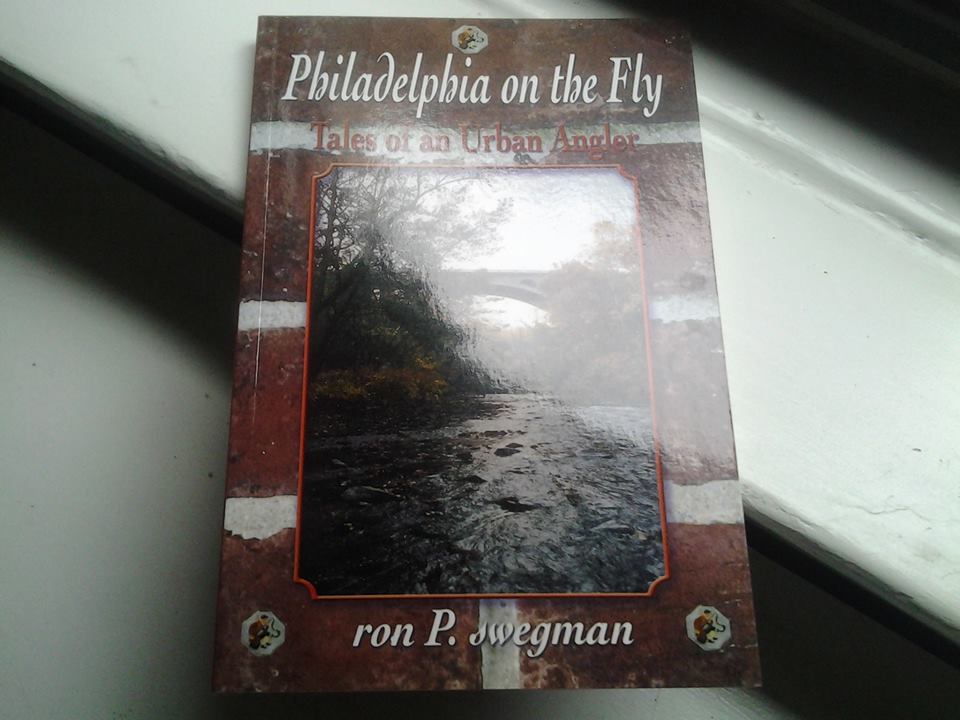
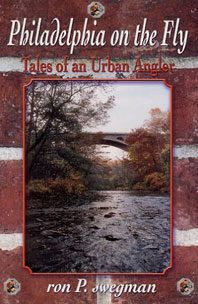
The First of August, a Saturday, the day after Clyde E. Drury, Jr. passed, marked an anniversary milestone having been reached. My first book, Philadelphia on the Fly: Tales of an Urban Angler entered the “Published” category on that date a decade ago and the title remains so. Websites online list the official publication date as August 1, 2005.
Ten years is often quoted as span of time required to integrate mastery of a subject, a sport, a discipline. Perhaps the tenkara rod in my hand is a kind of baton. I shall honor the angling and writing craft, as did Clyde, and keep the illustrated angling book a living, growing body of Literature with a capital L.
The tenkara rod: this tool, this baton, like a pencil to paper. When put to water one encounters pools of stories to be pulled from the clarity. Lines are necessary. Body and mind, combined in tenkara’s case, serve as the real reel. My mountain bike, back cover star of the first edition of Philadelphia on the Fly, still in service ten years later, carries me to the water unless a Manhattan subway shoulders some of the commute, or on a day like today, after writing in rumination, I get up, get shoes on, and go off, running . . .
. . . On The Fly.
– rPs 08 07 2015
Postscript:
The Autobiography of Dr. James Alexander Henshall: The Father of Bass Fishing in America, Annotated Edition. Edited and with an Introduction by Clyde E. Drury
http://www.whitefishpress.com/bookdetail.asp?book=54
Philadelphia on the Fly: Tales of an Urban Angler by ron P. swegman
Bare Months Bluegills
Bare Months Bluegills . . .
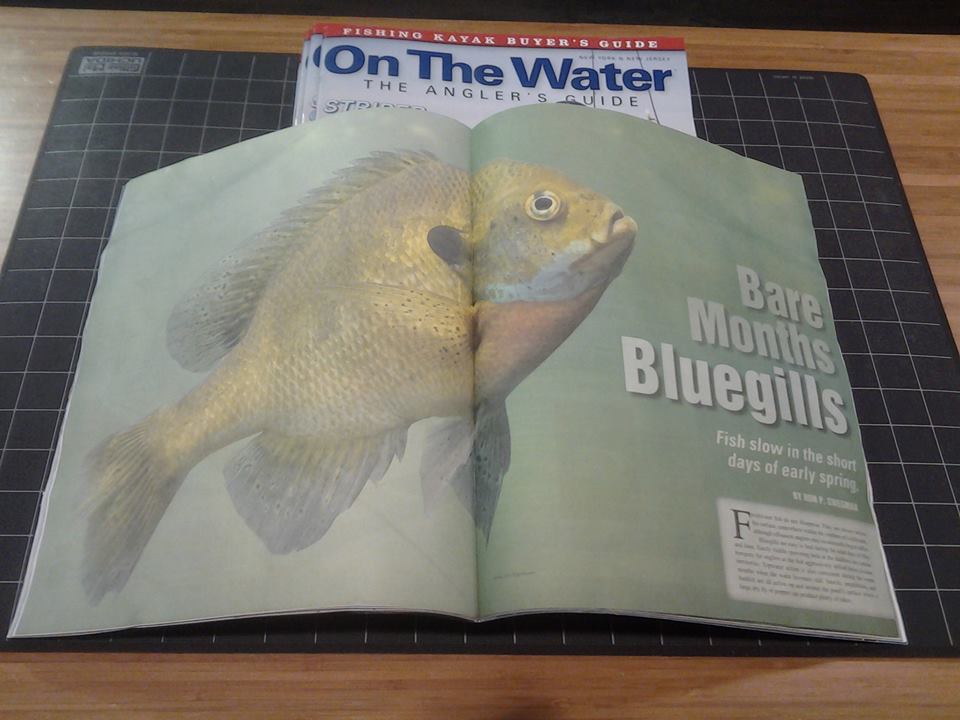
The March 2015 issue of On the Water features my story “Bare Months Bluegills”
Bluegills can be difficult to find and fish for during the bare months, those slivers of time when the ice may be off the water and leaves are still off the trees. Elements of conventional and tenkara fly fishing are included in the piece. My personal tenkara pond fishing technique, which includes elements of high stick nymphing and the Leisenring Lift, are described along with useful nymph patterns that can coax reticent panfish to strike.
— rPs 03 09 2015
Postscipt: The website of On the Water – http://www.onthewater.com/
Gone Fishing, Gift Giving
Gone Fishing, Gift Giving . . .
The deciduous trees are mostly bare now. Gingko and Norway Maple gold covers the hillside grounds and park places as the oaks alone hold onto rustling brown leaves. Cross country runs and hikes to and from local fishing spots have been giving gifts of time and rhythm to compose creative words.
During this same time, my second book, Small Fry: The Lure of the Little, has reached 5 years of age and remains in print. Here is a brief synopsis from the catalog page of The Whitefish Press:
http://www.whitefishpress.com/bookdetail.asp?book=87
Meanwhile, my first book, Philadelphia on the Fly, prepares for its 10th anniversary next year. The fact the book has stayed in print as an active seller gives testament to the importance of place in creative writing. When writing fish stories, a specific place often gives a reader added incentive to read:
Readers in return give incentive to render experience in words, although the act of writing can be an addicting pleasure in itself. I do have a few stores with a tenkara theme in the works. Progress continues as well on Little Hills: a novel. Special times pass when the flow is brisk and clear, when writing about fishing can be as fun as a good day along the water. Yes, even when one is not casting a fly pattern to fish, one can be “Gone Fishing” in the broader sense.
— rPs 12 03 2014
Novel Tenkara
Novel Tenkara . . .
Tenkara infuses writing with rhythm. The result can be, sometimes, a longer form for pure soulful entertainment:
8.
. . . He heard a crow, birds seen as conspicuous black spots adorning the cooler bare branched times. The call from above, the coal black guest from the nest perched attentive on the center point of the house’s gabled third floor. Bird in interaction rocked up and down a few times and spoke again.
“Smart-ass bird! Are you cheering me on, or laughing at me?”
“Caw-Caw-Caw,” the crow replied.
*** *** ***
. . . He took out his frustration by reeling in as hard as he could without knotting up the line. Such little private protests were all he would muster. He was too timid to show anger. Petey was a valuable shield against bullies. Let Petey lead; they shared other fun.
Once, without Petey, he missed school bus and had to wait for PAT Transit to take him down the long inclined face of the hill. A kid his age but bigger, cloaked in a long, untucked white shirt, appeared from behind a parked van:
“Hey! Catch this!”
Football flew forth in his direction. Young Robert, stalled in thought, cringed a bit and stubbed his left index finger in fending off the hammer ball.
“I’m a basketball player,” he yelled in his defense, which he followed with the first and only passable spiral pass of his life. The other kid caught his ball.
All was cool until a Saturday afternoon, when on his way to Center Arcade, he found himself sweating at the same bus top. This time he heard first the sound of a hard ball bouncing on pavement. A pause followed the kid’s appearance from behind another, different van:
“Hey, Basketball Player.”
Rubber burned. Young Robert ran, thus beginning his secured future as a cross country player.
– rPs 11 24 2012
Postscript: (excerpts from Little Hills: a novel by ron P. swegman)