Archive for Tenkara Trips

Harlem Meer, Blue Again

Harlem Meer, Blue Again . . .

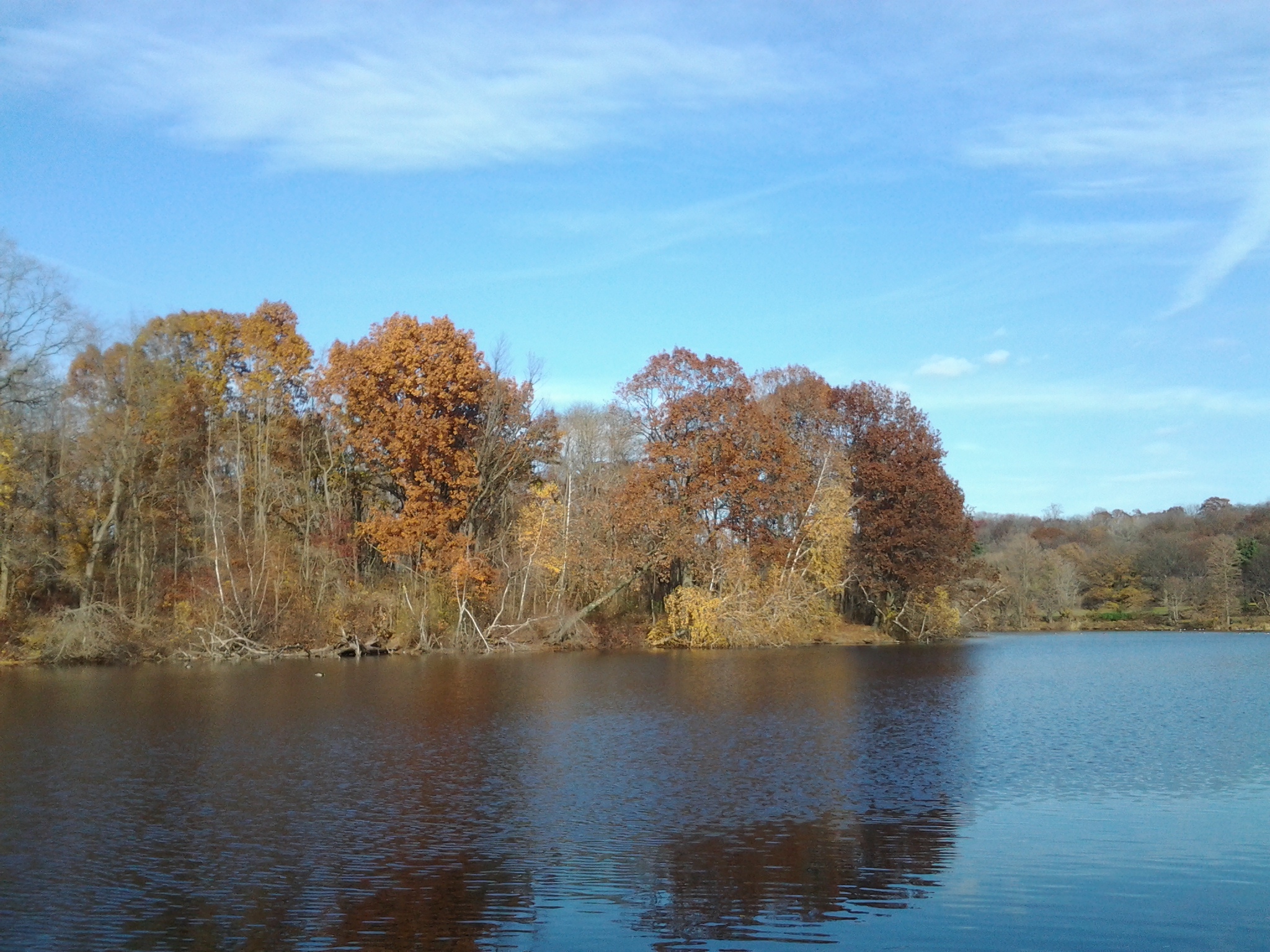
Free at last: Harlem Meer without ice.. (photo taken 03 21 2014)

Free at last: Harlem Meer without ice.. (photo taken 03 21 2014)

The wind was up. The sun set the high cirrus aglow. Harlem Meer reflected deep blue and, occasionally, bare trees. Rippled, the winded surface did not deter the birds. Canada Geese, Mallard Ducks, and Hooded Megansers all utilized the resource. I found myself, too, with colleagues Fergus and Jesse. We three angled urbanely for an entire Friday.

The water was clear and dark, free of weed. Only the bottom, where we worked our offerings, hinted at the ragged rooted bases of plants yet to rise.

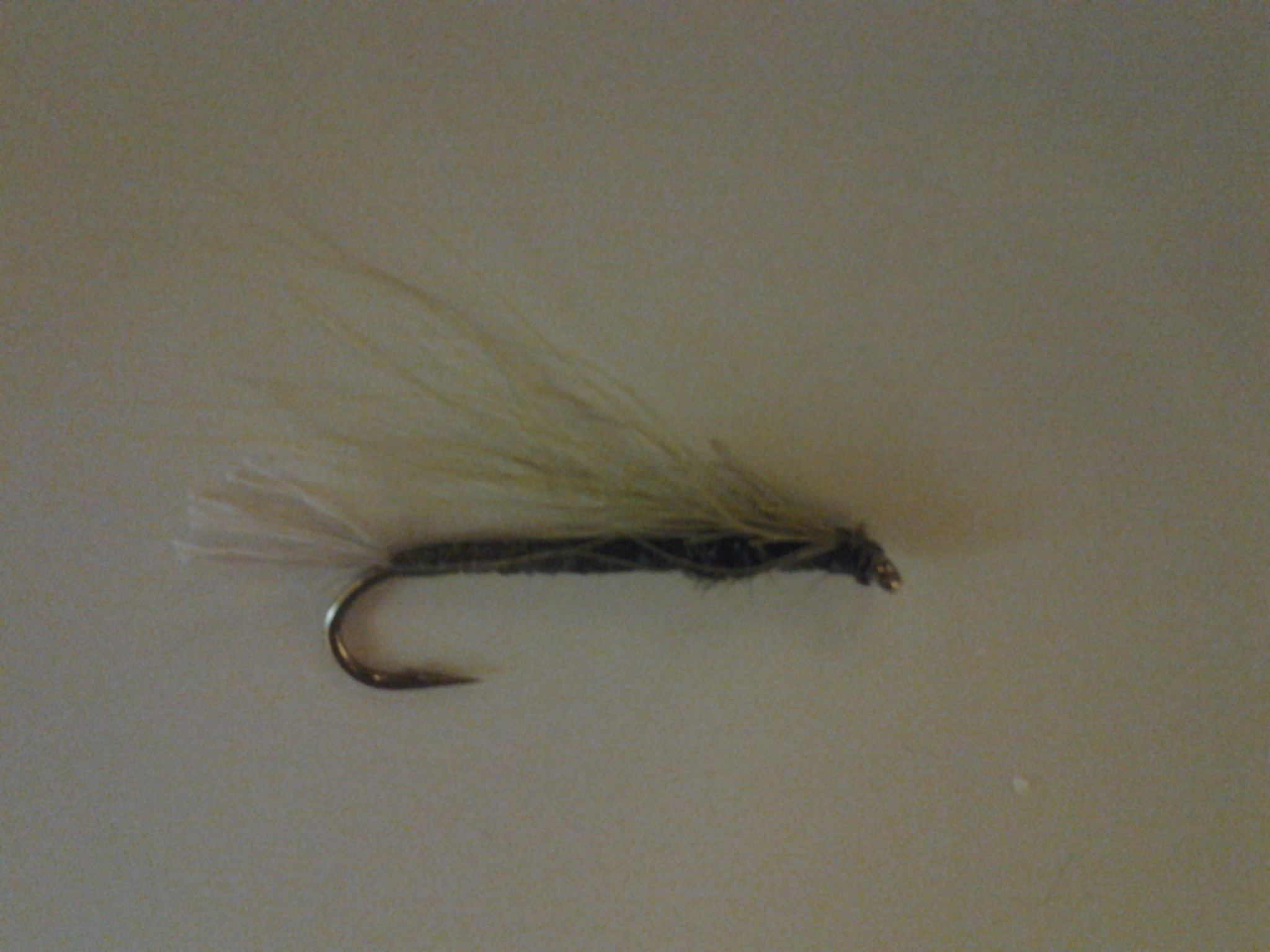
I decided to employ one of my own finished fly patterns:

The Green Guarantee; a bucktail streamer

Green Guarantee: bucktail version.

Green Guarantee:
bucktail version.

Recipe:
Size 6 hook
030 wire for weight
Deer hair for tail
Olive floss for body
Peacock herl for thorax
6/0 Green thread for wrapping

ATURAL DEER HAIR, OLIVE FLOSS, PEACOCK HERL, and OLIVE BUCKTAIL.

Where others using conventional fly fishing outfits and ultralight spinning outfits failed, tenkara succeeded. One fish fell for the delicate dance of the pattern. The limber tenkara tip had provided again.

Crappie as long as your pine handle: Tenkara USA Ebisu and a black crappie. (photo taken 03 21 2014)

Crappie as long as your pine handle:
Tenkara USA Ebisu and a black crappie. (photo taken 03 21 2014)

First black crappie of 2014

The day’s fishing ended on a silent moment. We three stood abreast and watched, as time lapsed in front of us, the bend of a cove letting go the last of its lock of ice.

Harlem Meer, blue again.

– rPs 03 31 2014

Comments (1)

The Luck of “The Spring”

The Luck of “The Spring” . . .

Harlem Meer Still White. (photo taken 03 13 2014)

Harlem Meer Still White. (photo taken 03 13 2014)

I made myself meet the water a few days before this St. Patrick’s Day. I caught and released one fish.

There was a sky full of helicopters, a loose chain of ambulances at emergency, and deep rumbling rolling in from the Northeast. Air, not natural, had burst from the seams and taken down a piece of Manhattan.

My day off: fishing as this was occurring. An awareness of balance, rather than a feel of guilt, charged my exploration of “The Spring” in Winter. Harlem Meer, I would learn later, was a solid white floor surround by the yellow brown fields of March. Lucky Me: I chose first a greener ground of jade where “The Spring” offered water along one of three shorelines, most of the best spread out behind a bankside fence I chose lawfully not to cross.

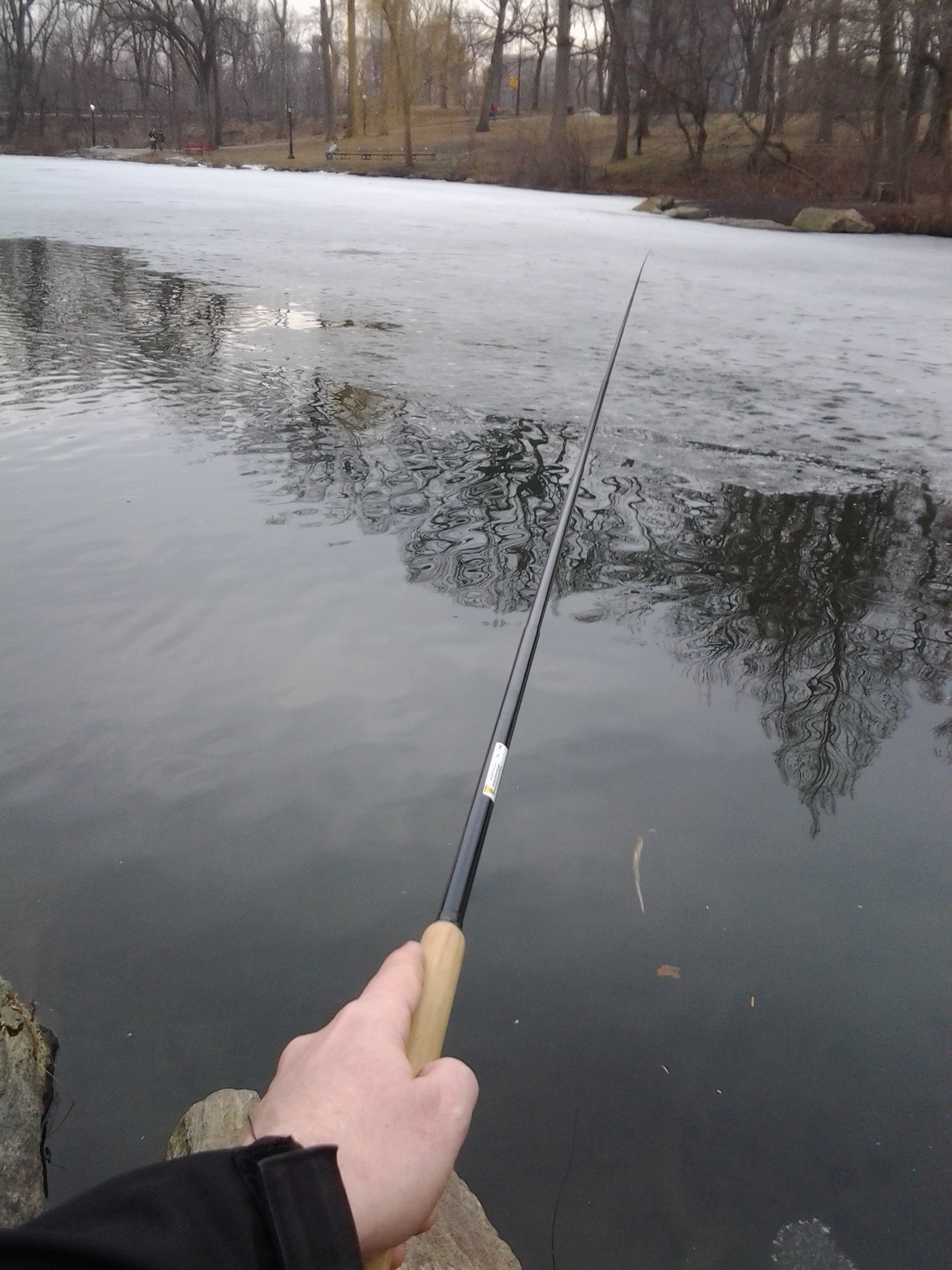
Hemmed within seventy-five feet of width, fifteen feet of breadth, and a depth measuring less than a rod’s length, I fished a Deer Hair, Peacock Herl, and Thread nymph of my own design. Plenty of cool casting onto the ice opened up to me on a 3.5 Level Line. Thin ice is like an immense, monolithic lily pad. Audible slides along the ice with a tug off to the depths make for a great presentation when successful. What works at an even higher level across the fishing spectrum is the same matched with a larger pattern: next an Olive Deer Hair and Floss Bucktail tied in a manner akin to a Mickey Finn, or with a sparse beard like my Green Guarantee, first described on The Global FlyFisher in 2008.

Tenkara on thin ice. (photo taken 03 13 2014)

Tenkara on thin ice. (photo taken 03 13 2014)

Four extended periods of disaster noise sounded in the distance as I began to fish. The rumbles reminded my mind’s ear of the Baghdad air war thunder shown (and heard) on television during both Gulf War I and Gulf War II. The news through the fog of dust and information settled on eight dead, many injured and displaced. A gas leak? Investigation on site has not yet been engaged in full because of debris. There has been that much material mixed with potential survivors, so great care has been taken.

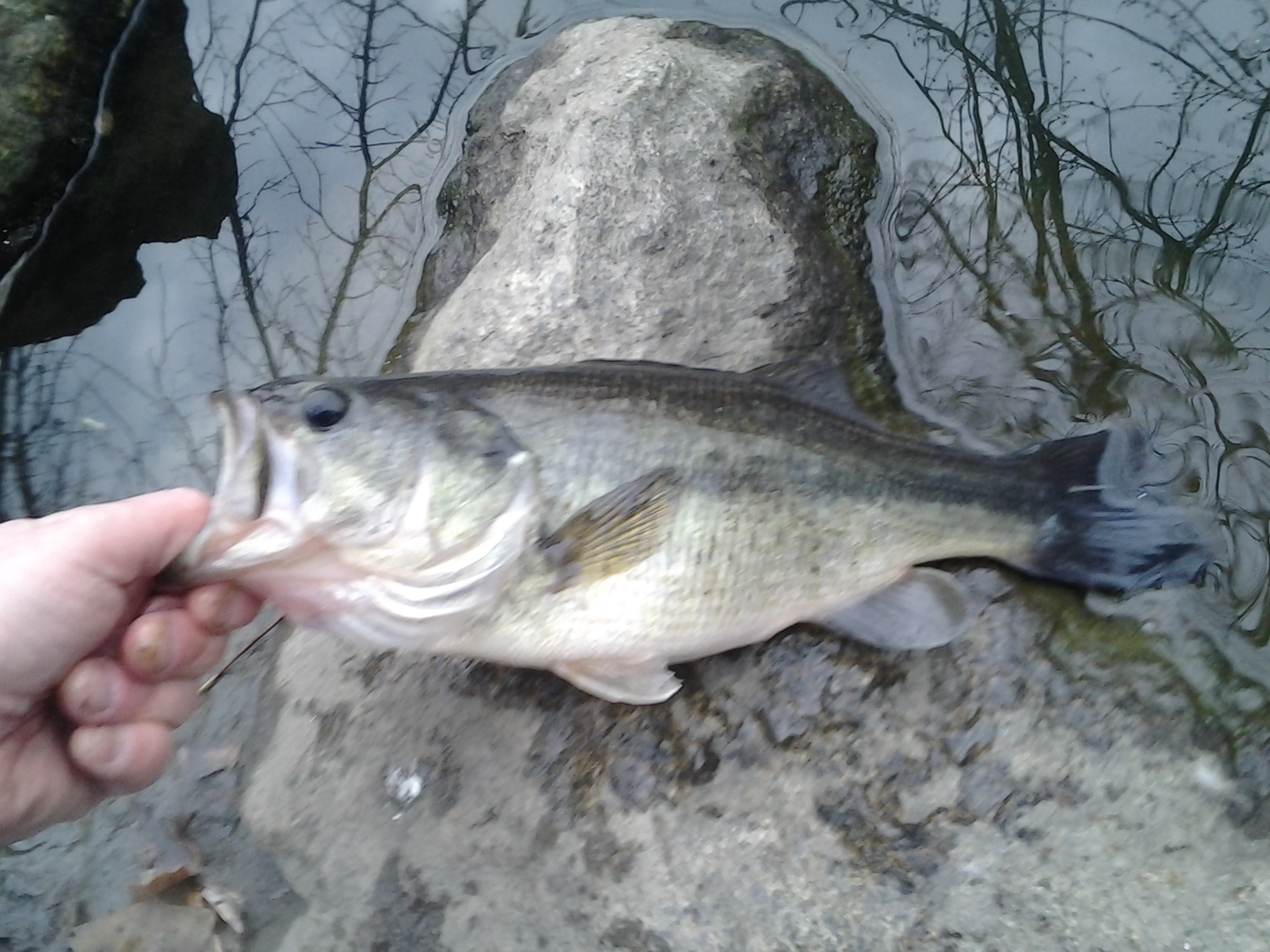
On the top of the hour of one, a better blast sounded on my side. Luck struck. A sudden take a foot below the ice edge began to move. No winter sluggish fish was this; I saw twice in profile a thick bass with a purpose. The silhouette was a rounded female rather than a thin pickle of a male. I feared my tippet might fray as three runs under the ice audibly shaved my line against the blade on the water’s top.

My Ebisu tenkara rod’s entire 5/5 flex was on arch display. I gripped the pine handle as if it were a solid body guitar. Grip locked in, I was able to lead the bass around a fallow pickerel weed garden to shore.

Blurry? Cold, wet hand and big, fast bass! (photo taken 03 13 2014)

Blurry? Cold, wet hand and big, fast bass! (photo taken 03 13 2014)

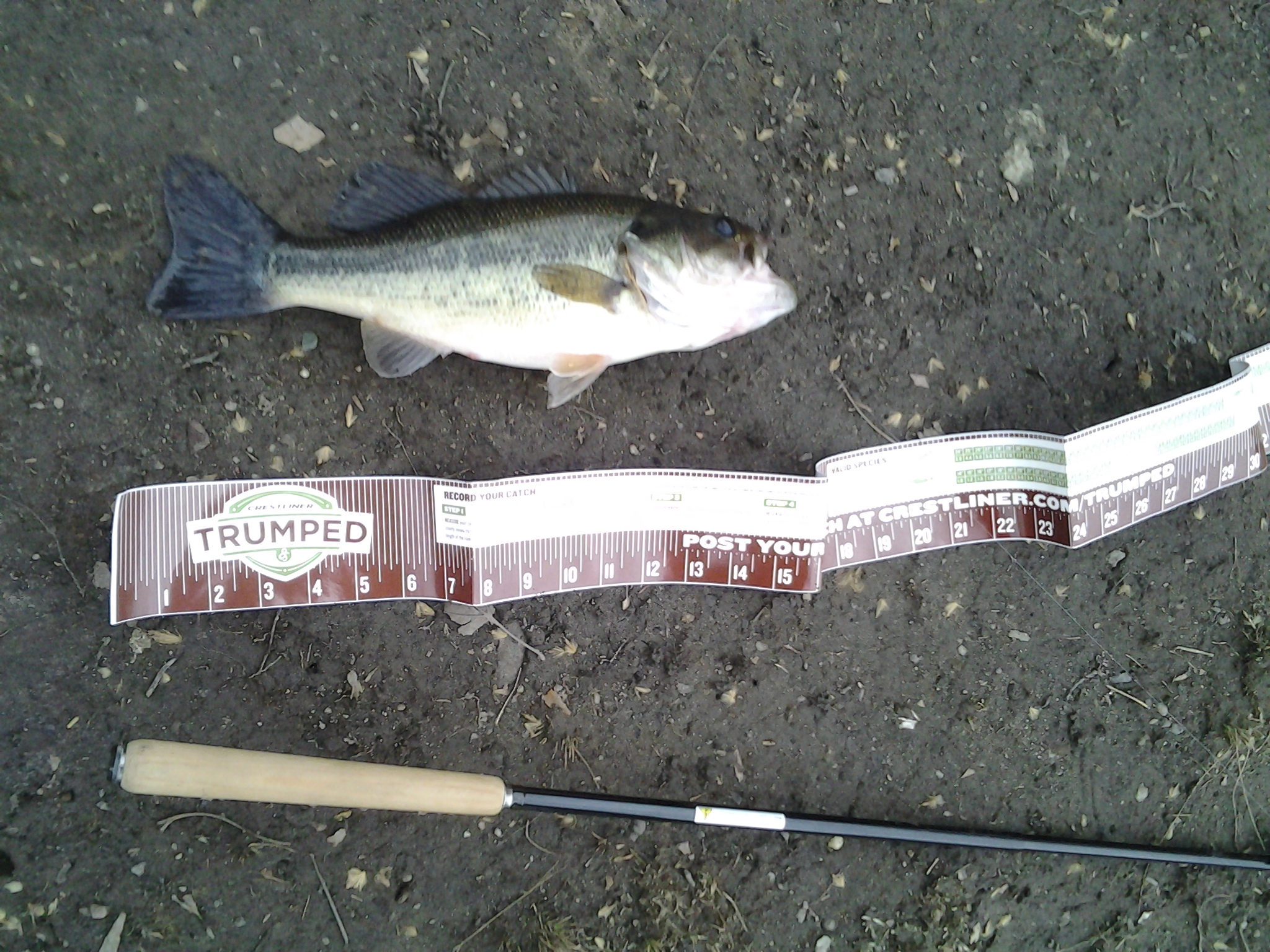
I rarely lay fish on any surface for a photo except sometimes wet grass on rainy days. Skies overcast, air still, the fish remained calm and stretched as most largemouth bass will as it endured a bragging shot on packed damp soil beside my laminated ruler and Tenkara USA Ebisu. Best Honest Estimate: 15 inches, 2 plus pounds, female largemouth bass.
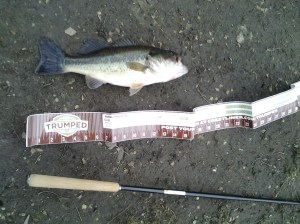
Tenkara can (sometimes) tackle big bass. (photo taken 03 13 2014)

Tenkara can (sometimes) tackle big bass. (photo taken 03 13 2014)

The Luck of “The Spring” . . . an ironic reward, when still in winter.

* *** * *** * ***

Angle 360

Doves dived
The depths of damp spring air.

The lake,
Biifurcated between water and ice,

Reflected,
Bare branches and brick towers.

In park,
Central to the whole reality,

One bass
Followed the ledge, following,

Up above,
Something crawling, scraping.

In went it,
Down into the wet water.

When tugged,
Wink, the line squared the circle:

The One and The Other
Spirited by connection.

.
* *** * *** * ***

My First Fish of 2014

– rPs 03 17 2014

Postscript: Read about the Green Guarantee at The Global FlyFisher by following this link:

http://globalflyfisher.com/writings/small-fry/pic.php?id=4614

Leave a Comment

Autumn Leaves and Crappies

Autumn Leaves and Crappies . . .

Van Cortland Lake in November. (photo taken 11 21 2013)

Van Cortland Lake in November. (photo taken 11 21 2013)

Instinct can coerce an angler into squeezing in a fishing trip despite the alluring pull of a comfortable couch.

That little, wordless voice urged me not to lounge around on my last Thursday off. I sat up, pulled aside a curtain, and looked up into the canopy of the tall ailanthus tree shedding leaves onto our rear courtyard. Three details stood out: the day was slightly warmer than it had been, the blue sky was softened by a thin tissue of cloud, and it was still. No wind rustled the garden for the first time in over a week.

New York’s pond fishing season is waning fast, thus the 1 Train was soon transporting me to the gates of Van Cortland Park in The Bronx. I had not reported from that destination since September of 2012. Would the fishing experience be different?

November is my favorite time for general nature loving. The brown months have almost, yet not quite, settled in for a season. Some colorful tree leaves, like the bright gold pennants of the Norway Maple, still cling to branches in scattered batches. Wildflowers, now dormant, display the pure architectural forms of stem and seed pod. Birds are active and easier to view, but the biting bugs are long gone.

Wetland path surrounded by fallow reeds. (photo taken 11 21 2013)

Wetland path surrounded by fallow reeds. (photo taken 11 21 2013)

Missing, too, were the thick lily pad beds and pickerelweed stands that thrive in the shallows of Van Cortland Lake during spring and summer. Fallen trees, half submerged, and a carpet of leaf litter had emerged as the dominant cover.

Good numbers of yellow perch are present in this lake. I selected a Prince nymph and went into action. The slow technique using a Leisenring Lift modified for stillwater should have been an effective method for luring a few specimens of green barred gold. The result instead was a quiet period of fine casting practice.

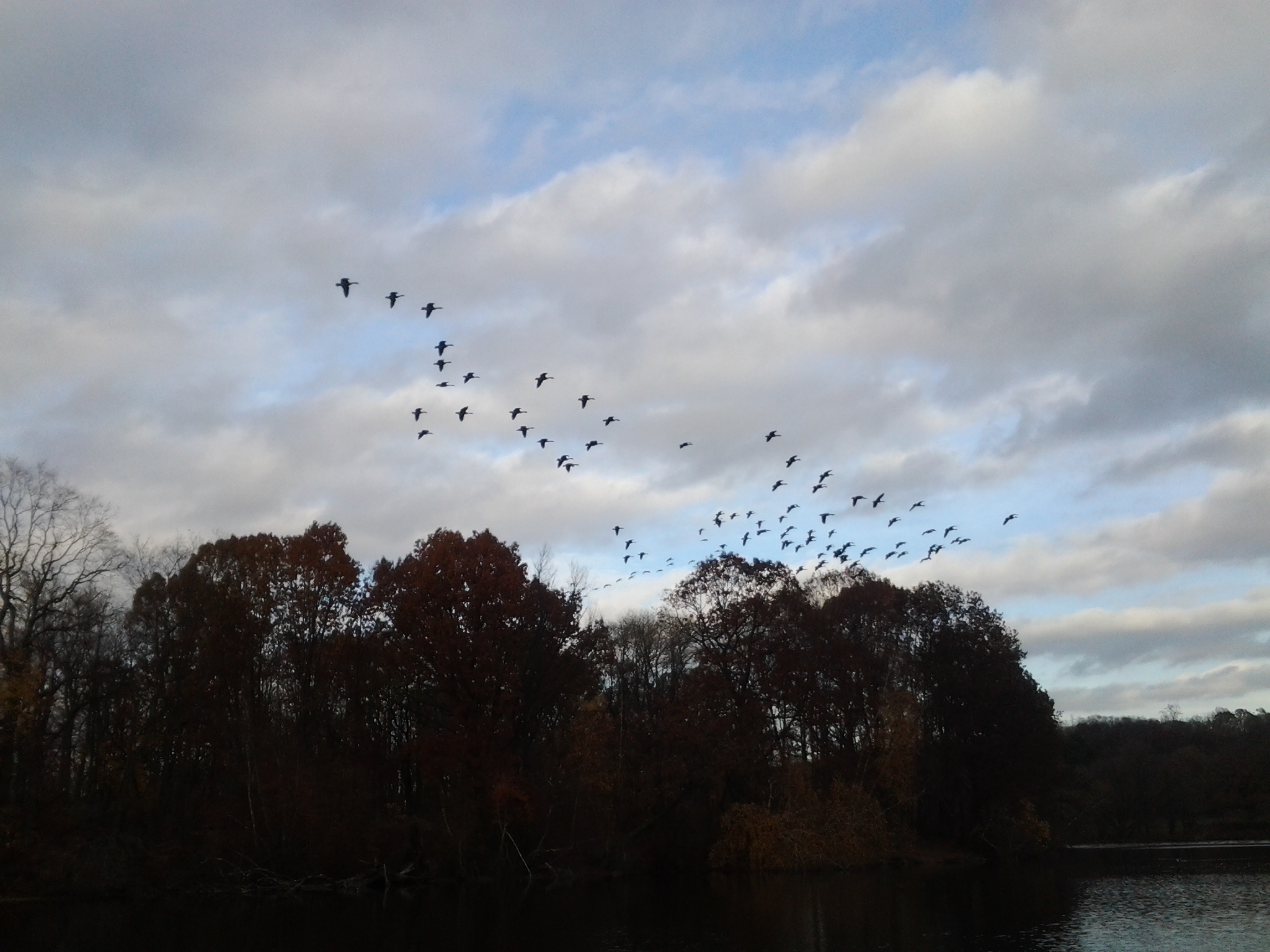
A northwest wind pushed a broken front of variegated gray cloud. The air became damp and just a hint of my steaming breath could be detected when I paused to watch and photograph a large flock of geese descend onto the lake.

Geese descending onto Van Cortland Lake. (photo taken 11 21 2013)

Geese descending onto Van Cortland Lake. (photo taken 11 21 2013)

With the nymph drawing a goose egg and direct sunlight fading, I decided to change gears and “cheat” – my term for using an Olive Woolly Bugger with a bead head. The pattern is so effective for trout, bass, and panfish in New York’s creeks and lakes that I only use it now when I want to save a day from ending fishless.

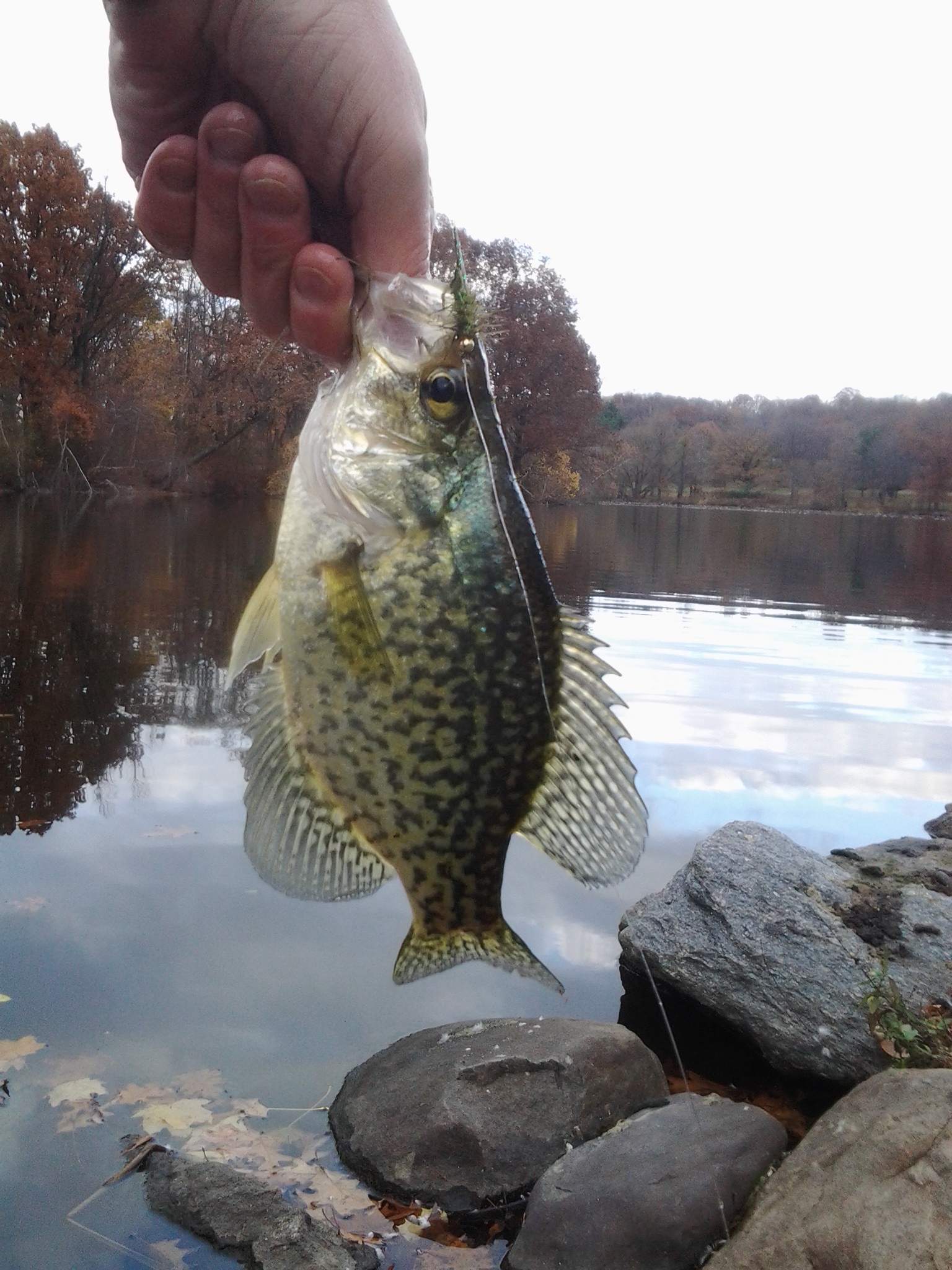
First cast . . . a slow, deliberate take, followed by several short, strong swims, brought to hand a silvery black crappie. The bright fish obliged me for photos before release into water I found to be much colder than expected; a temperature in the low forties.

Black Crappie in hand. (photo taken 11 21 2013)

Black Crappie in hand. (photo taken 11 21 2013)

Second cast . . . another strike.

Catching added to casting, I moved on from the open grassy bank adjacent to the city golf course and hiked around to the forested side opposite. There the Old Putnam Trail attracted maybe half a dozen joggers who passed through at a brisk pace. No other individuals, angling or otherwise, were seen or heard until I flushed an industrious black squirrel along with several gray ones, each with an acorn in its mouth.

Black Squirrel beside the Old Putnam Trail. (photo taken 11 21 2013)

Black Squirrel beside the Old Putnam Trail. (photo taken 11 21 2013)

Casting a fly around the branches looming above my head and sticking out of the water before me proved to be a chore in the half light of late afternoon. I lost one Olive Wooly Bugger with a bead head, but found another Olive Wooly Bugger without one hanging from a nearby bush gone bare. That find permitted me to call it even as a small flock of hooded mergansers swam off into the graying day. I left the lake to Orion, who would soon be hunting overhead.

Hooded Mergansers head into the marsh. (photo taken 11 21 2013)

Hooded Mergansers head into the marsh. (photo taken 11 21 2013)

– rPs 11 27 2013

Leave a Comment

One More

One More . . .

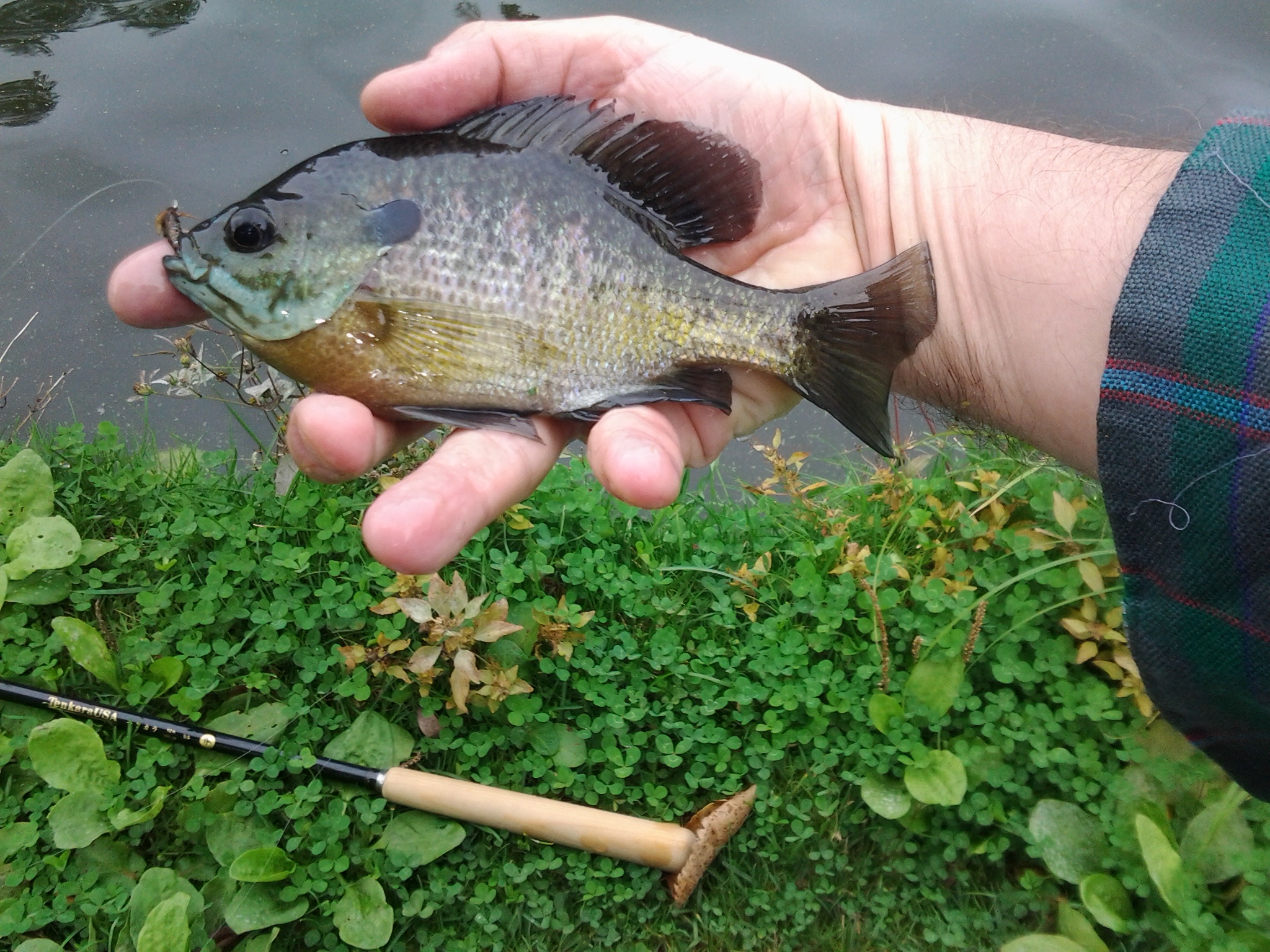
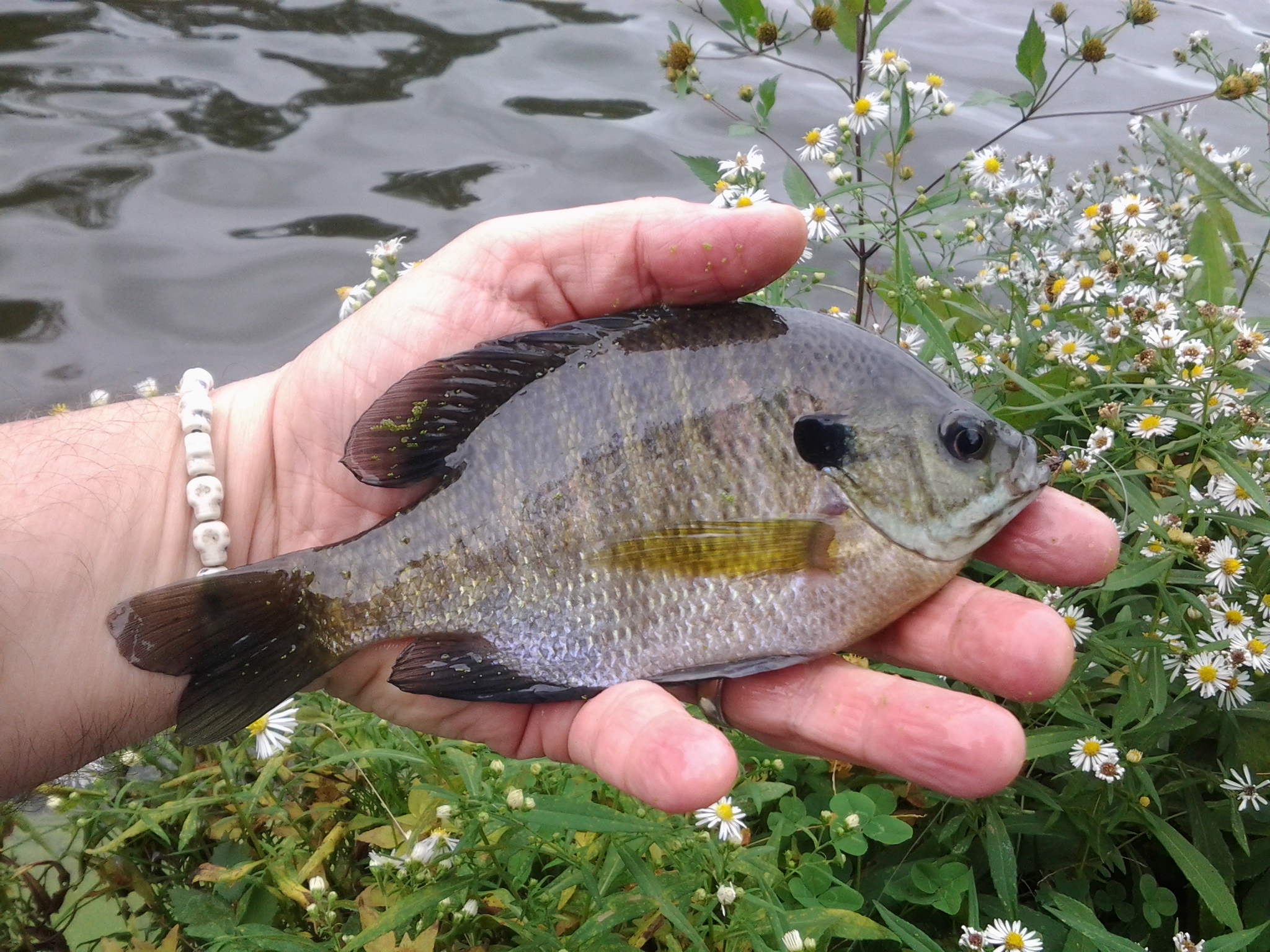
Tenkara is an excellent way to connect with bluegill in October. (photo taken 10 09 2013)

Tenkara is an excellent way to connect with bluegill in October. (photo taken 10 09 2013)

When the leaves are just about to turn and the asters are flush with their tiny daisy faces, there appears one more window of decent bluegill and largemouth bass fishing before the inconsistent angling of the cold months arrives. Ponds are pretty places at this time and the fish remain within the fixed range of tenkara equipment.

My fly shop coworker, Jesse Valentin, wanted to squeeze in one more outing this month before some necessary dental work. I happily accompanied him . . . to Harlem Meer. There I employed my technique of a large nymph, fished slowly and steadily, in and around the pond’s deeper areas. A size 10 Zug Bug brought two nice fish quickly to hand; I noted a slow lift, rather than twitches, teased these fish into striking.

Bluegill with Asters. (photo taken 10 09 2013)

Bluegill with Asters. (photo taken 10 09 2013)

A chilly wind from the northwest began to pick up as the sky turned gray after noon. Satisfied with the bluegill, I decided to experiment in my quest for a bass. I used a dropper loop to attach a size 6 Olive Flats Fly, a weighted pattern designed for bonefish and permit, yet its greenish tones and split tail make an excellent crayfish imitation.

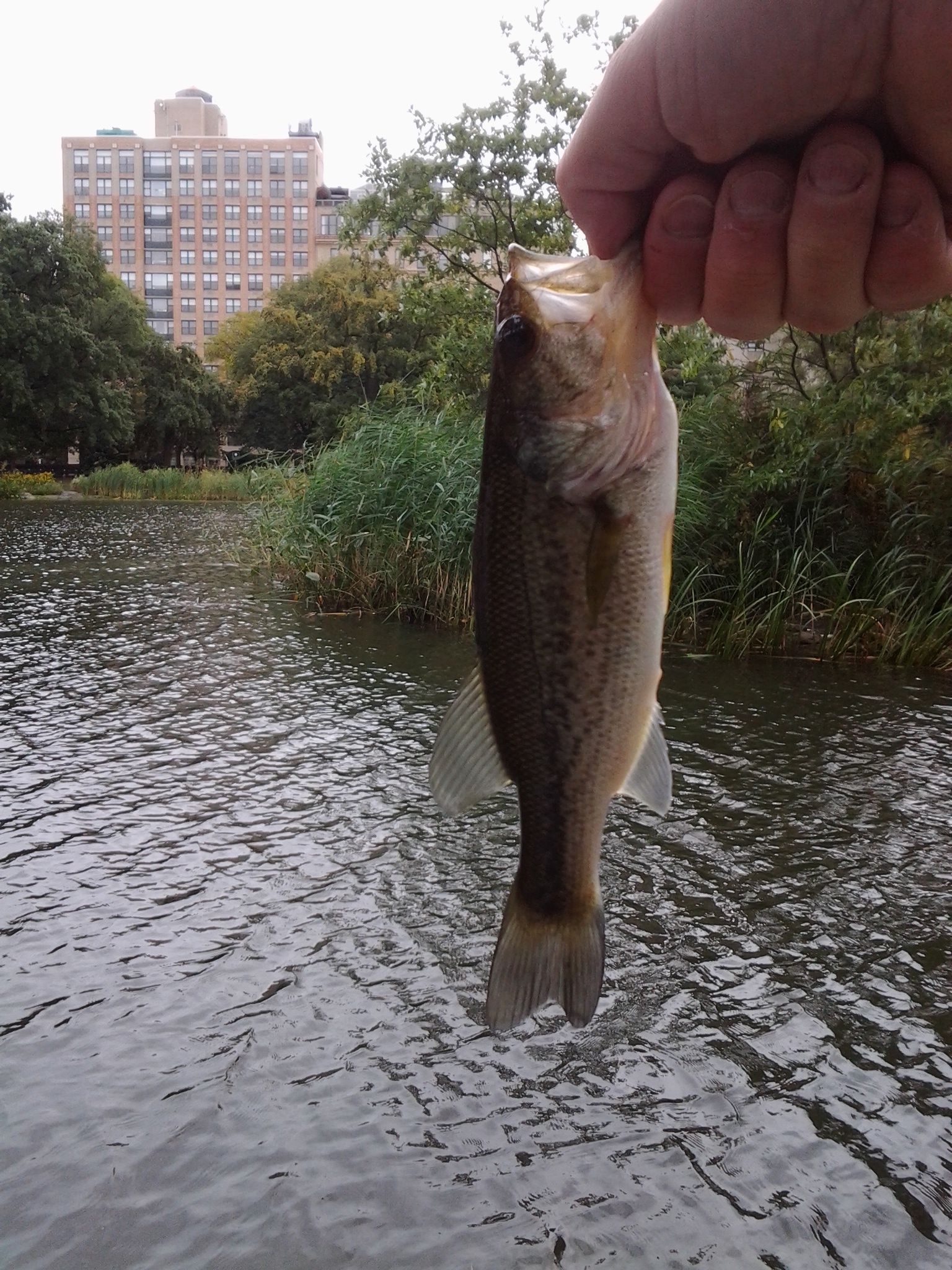
The extended length of my Ebisu model allowed me to precisely work the fly along the base of some reeds going brown where a flash of bright green connected with me. Three jumps later, a modest largemouth bass allowed itself to be brought ashore for an authentic urban angling photograph: a bucolic pond with a brick highrise standing in the background.

Bright Bass, Big City. (photo taken 10 09 2013)

Bright Bass, Big City. (photo taken 10 09 2013)

Jesse, for his part, caught a bass and a black crappie with one of the jigs from his own vise, so we both headed home happy, knowing we had seized the opportunity for one more easy, fish-filled day. The gray and brown months, the time when methodical angling in uncomfortable weather produces sporadic catches, arrives with holiday season, which begins today on Halloween . . .

Boo!

– rPs 10 31 2013

Leave a Comment

Belabored

Belabored . . .

French Creek and Wildflowers. (photo taken 09 03 2013)

French Creek and Wildflowers. (photo taken 09 03 2013)

Our household is in transition. Most of September has been spent dealing with real estate issues; a business as complex as the tips of a Spey line. Free time – fishing time – time fishing simply with one fly on a slip-knotted level line – has been swallowed up in the sudden way a largemouth bass inhales a popper floating on the surface of a pond.

My fishing, then, at least during this September, consisted of a few hours on the day after Labor Day; a sunny morning along a shaded length of French Creek in Pennsylvania’s Chester County.

The scene was pretty: late summer wildflowers like orange jewelweed in bloom; mushrooms glowing white amongst the leaf litter. A frog plopped into the water in front of me and swam to a little point of stone projecting out of the current.

Wet wading was easy for me, too, as I found that flow ran summertime low, but this hampered my recent desire to experiment with the large nymph. My attempts were foiled by a steady stream of hang ups along the rocky bottom.

I did catch sight of a few rises across a slow bend downstream. A size 16 BWO was sent across to explore the spot. Two redbreast sunfish quickly came to hand.

The BWO is a great dry fly pattern for the redbreast, the stream sunfish. (photo taken 09 03 2013)

The BWO is a great dry fly pattern for the redbreast, the stream sunfish. (photo taken 09 03 2013)

A fish on the line and in the net made the day a success. Time was progressing in earnest; I therefore kept moving to see what experience I could squeeze into the remaining hour or so at my disposal. This compelled me to hike upstream to a stretch I had not fished for two years. Here there are several deep runs interrupted by an exposed outcrop of cobblestones: wrinkled water ideally suited to fishing emergers and soft-hackles.

Wrinkled Water. (photo taken 09 03 2013)

Wrinkled Water. (photo taken 09 03 2013)

The white-tailed deer seem to like the soft moss around this spot as well. I flushed a buck and two doe as I approached the carpeted bank. Each deer took its turn to bound across the creek and into the trees. I followed them as far as the water.

Another frog’s antics entertained me as I knotted on a small Black X-Caddis emerger. This little fly has worked well for me when sent swimming across and downstream in low flows. One brassy flash I missed on the first cast was certainly the day’s brown trout. A pause followed; one necessary to recapture my rattled peace of mind. Once obtained, the target zone shifted to a deeply shaded seam that ran down the center of the creek. The pattern swung into a strong strike, like a bat meeting a baseball, quickly followed by an athletic jump that lit up the scene. The taker then surged straight toward my legs. The net once again came to my rescue as I maneuvered it into position to handle a large and very bright fallfish.

This fallfish jumped like a rainbow trout. (photo taken 09 03 2013)

This fallfish jumped like a rainbow trout. (photo taken 09 03 2013)

My cell phone chirped a few moments later. My wife had sounded the call to come back to the in-laws so we could have lunch before boarding the train back to Manhattan. I was happy to have had this time on the water, however brief, given how belabored by the business of life we have become.

– rPs 09 27 2013

Comments (2)

The Utility of the Net

The Utility of the Net . . .

A French Creek rainbow trout successfully landed - thanks to the net! (photo taken 05 2013)

A French Creek rainbow trout successfully landed – thanks to the net! (photo taken 05 2013)

Rarely do I fish with a net. There is no conscious reason; I simply find myself most often angling for fish small and easy enough to handle manually. Panfish are also handfish.

While sorting through a large batch of photos from the previous few months, I found the image of the netted trout above, and the story behind this moment returned to me.

Memorial Day weekend gave the time and French Creek in southeastern Pennsylvania provided the setting. The long weekend allowed my wife and me the ever more rare opportunity to slip out of New York City under the demanding noses of our respective work lives. The in-laws provided family, food, and for me, fly fishing, tenkara style.

Maryann wanted to sleep in on the morning of Memorial Day, but she did wake long enough to permit me to take along her L.L. Bean Pleasant River trout net. I sensed I might need it, as French Creek, like all freestone flows, holds more physical challenges to the landing of fish than a stillwater pond, and an encounter with trout, a fish much trickier to calm than black bass, would be a possibility.

A short stroll down a suburban road took me to the banks of the stream, which was quiet and empty of other anglers despite the bright holiday morning. A deep pool along an inviting bend in the stream above a flat bedrock run gave me a good starting point. There, on a Pheasant Soft Hackle, I caught a few small redbreast sunfish; an attractive and somewhat rare catch in this cold water

This French Creek redbreast sunfish added to the surrounding symphony of green and orange color. (photo taken 05 2013)

This French Creek redbreast sunfish added to the surrounding symphony of green and orange color. (photo taken 05 2013)

Wet wading eventually brought me several hundred yards downstream to the plane tree root jams I had fished the previous Christmas Eve. I had by this time landed a few silvery fallfish and knew the top prize, a trout or two battling my line and limber Ebisu tenkara rod, could very well be present.

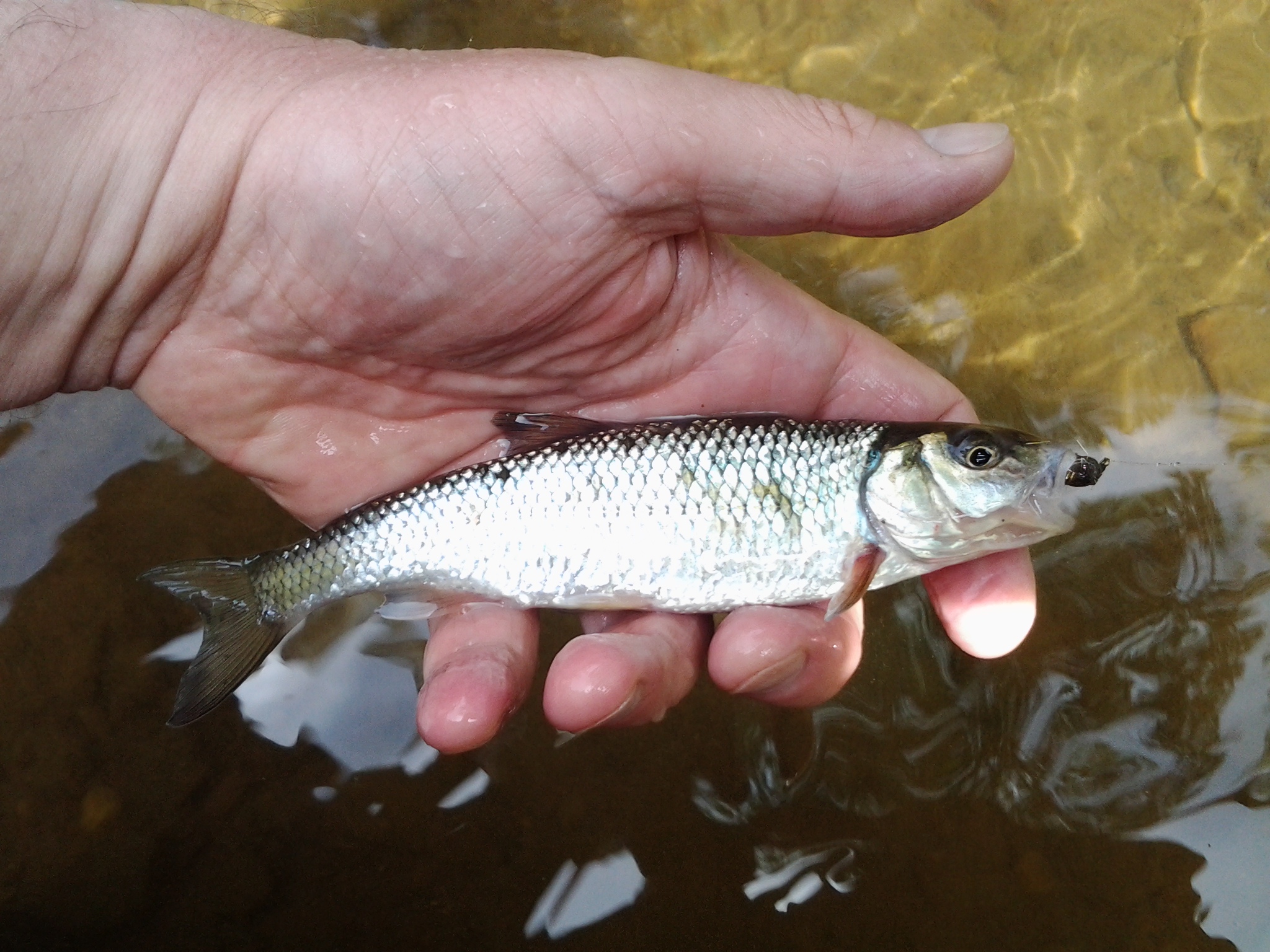
This French Creek fallfish fell for an X Caddis. (photo taken 05 2013)

This French Creek fallfish fell for an X Caddis. (photo taken 05 2013)

I was not disappointed. My little Hare’s Ear paused during its second swing, snatched aggressively near the second batch of roots. Stiff resistance and a bent rod replaced the meditative mending of line. A sizable trout directed my attention upstream, where the water broke in a half jump, and then another.

At last, I thought, my net might see some action!

The lanyard sounded as I successfully gripped the handle and brought down the net toward the fish. Another, heretofore unheard tone, also now resonated. The rod tip began to scrape against the low tree canopy overhead. The length of the long rod touched limb, forcing me even lower as I bent backwards, leading the fish toward the mesh of the net. The sight of me so engaged must have resembled a circus contortionist.

The big rainbow eventually allowed itself to be landed, and photographed, and gently released, thanks to the net. The utility of this piece of gear had again, in a very timely manner, made itself clear.

The tenkara angler and his net take a break. (photo taken 05 2013)

The tenkara angler and his net take a break. (photo taken 05 2013)

– rPs 07 31 2013

Comments (1)

Casting for Immigrant Species in Central Park

Casting for Immigrant Species in Central Park . . .

Harlem Meer on the day I fished with The New York Observer. (photo taken 05 24 2013)

Harlem Meer on the day I fished with The New York Observer. (photo taken 05 24 2013)

The story of the alleged snakehead in Central Park continues. Last week. Matt Kassel, a reporter from The New York Observer, contacted me and asked one question to which I answered an emphatic “YES!”

“Would you be willing to go fishing?”

We arranged to spend a gray and windy Friday angling beside Harlem Meer. We were in search of the northern snakehead in one regard, that being the story of this fish and how what I prefer to call an immigrant may have established a tenuous presence in the pond. The answer I posited involves another immigrant, one of the human fishmonger variety.

The two of us fortunately failed to catch a snakehead during our outing, but I did manage to coax two bluegills from the lake, which resembled lentil soup laced with cooked spinach on account of two unbroken days of torrential rains. My highlight of the trip was successfully guiding Matt to a healthy largemouth bass. Fishes caught, story set, we parted as new friends beside the Meer now bordered by a third immigrant, the delightful yellow flag, a wildflower mentioned in American literature as far back as Henry David Thoreau’s Walden.

Matt’s story, including several excellent photos by Observer staff photographer Fernando Gomes, appeared in the newspaper on Tuesday, May 28th. Here is the link to the online version:

Gone Fishin’: Casting for Invasive Species in Central Park

On the Bright Side: immigrant Yellow Flag (Iris pseudacorus) lines the bank of Harlem Meer. (photo taken 05 24 2013)

On the Bright Side: immigrant Yellow Flag (Iris pseudacorus) lines the bank of Harlem Meer. (photo taken 05 24 2013)

— rPs 05 31 2013

Leave a Comment

Earth Day 2013

Earth Day 2013 . . .

Prospect Park largemouth bass (photo taken 04 22 2013)

Prospect Park largemouth bass (photo taken 04 22 2013)

Today I took the Q train to Prospect Park in Brooklyn where I spent Earth Day fly fishing, bird watching, photographing wildflowers, and . . bagging and disposing of litter.

The phrase “use the resource” seems selfish when applied to parks and other outdoor spaces. I do not consume the outdoors, I interact with and help out when I can; today by bagging the loose plastic trash that has spread like a virus over the land during the last three decades.

The day encompassed an entire story I wish to take more time to detail later in the week. Let me just state here the bass fishing was excellent using variations on the Wooly Kebari fly pattern!

Happy Earth Day . . .

– rPs 04 22 2013

Comments (2)

A Few Hours on Christmas Eve

A Few Hours on Christmas Eve . . .

Exposed tree roots create an inviting target for tenkara casts during the winter months. (photo taken 12 24 2012)

Exposed tree roots create an inviting target for tenkara casts during the winter months. (photo taken 12 24 2012)

My 2012 fishing year, my first tenkara season, ended along the same water where it began: French Creek in southeastern Pennsylvania. My Christmas Eve had been planned from early afternoon onward – situated at the in-laws, gift wrapping, attending services, dining on a meal of seven fishes – which offered me one last free morning of trout fishing if I wanted it.

I did.

Silently I departed from a slumbering house after coffee and a cinnamon roll. Outside, the damp December air filled my lungs and legs with awakening. Frost crusted the grass as a thin overcast filled the still sky. Snow was in the evening forecast. The solunar table predicted a Major between nine and eleven a.m. Perhaps a few little caddis, as well as a few following Salmo trutta, might brave the morning calm along with me.

French Creek, just a few downhill minutes away on foot, flowed clear and low. Large knots of exposed oak and London plane tree roots broke the opposite bank every few dozen yards. These tangles can always provide some depth and holding lies where delineated pool and riffle structures are not present. A small Pheasant Tail nymph shortly found itself drifting by these pretzel patterns of wood.

My casts were smooth and hypnotizing. Chatty crows flew by and chickadees made friendly calls from nearby branches. One polite slate blue and white nuthatch appeared on a nearby tree trunk and softly said: “Hen. Hen. Hen.” in a way that resembled advice on where to cast.

The big take of the outing came soon after, slowly, more of a stop in the flow that felt at first like a flexible snag. A tree branch, submerged, must have hooked up with the pattern, I assumed. My response was a kind of lackadaisical pull back. The resistance pulled forth. When the back and forth symmetry abruptly turned into asymmetric animation, I realized the other end held a fish. A flash of bronze and silver flashed from below and then I was snapped off a decent brown trout. I was not used to the new 6x tippet material I had employed, or maybe my knot had frayed on a root.

Upstream called to me then. One large flat pool with some depth lay a few dozen yards above the bridge just in view through the brown web of bare trees. I hiked up to it, passed beneath the span on a narrow band of frozen mud. I then faced my athletic challenge of the day. I had to climb along a scree of red siltstone that is near impossible to navigate when the full growth of summer is present. I angled myself parallel to the steep side so a slip would simply land me hard onto the loose rock rather than on a neck breaker of a tumble into frigid water below. Tenacious thorned vine branches nagged at me as well, but I made it, climbing down to the water on a natural staircase of the red rock beside which a sapling bannister stood.

A natural staircase of red siltstone along French Creek. (photo taken 12 24 2012)

A natural staircase of red siltstone along French Creek. (photo taken 12 24 2012)

While I scanned for risers and contemplated the water’s sound and motion simultaneously, I heard rhythmical wind sounding from above. A great blue heron passed overhead with an audible flap of broad wings. Its prehistoric profile approached a series of power lines that stretched across the creek about twenty yards farther up. One of the cables must have been strung a few feet higher than the others. The big bird had to add an extra jump to clear the hump. Loud croaks followed, an ornery sound reminding me of any other pissed off commuter faced with an unexpected obstacle.

No risers appeared as the clock continued toward noon. I tipped my leader with a Gold-Ribbed Hare’s Ear nymph and swung it a few dozen times. No takers. I was pleased, though, to have had a few hours before the holiday that were removed from structured stress and inserted instead into the random natural world of wind in the ears and water before the eyes and the thought that my fly attached to a tenkara rod might present me with a Christmas gift of a trout. As it happened, I received a present even more grand – one of presence, pure and uncomplicated – one of happiness.

The view as I departed French Creek for the final time in 2012. (photo taken 12 24 2012)

The view as I departed French Creek for the final time in 2012. (photo taken 12 24 2012)

Yes, Happy Holidays.

— rPs 12 29 2012

Leave a Comment

A Late Autumn Tenkara Trick

A Late Autumn Tenkara Trick . . .

Harlem Meer in November: The fish are there . . . but where? (photo taken 11 12 2012)

Fish do not disappear. They are always there, somewhere within the course of a flow or the confines of a stillwater. A pond fed by a spring, or a manmade impoundment unconnected to a river or stream, supports fish in a fixed area, but at various locations according to the season. Think of the water as a three-dimensional space akin to a house with multiple rooms, each of which becomes the kitchen at a different time of the day, or the year.

When the leaves are mostly down and the shoreline reeds go brown, bass and bluegill tend to bunch up near points and drop offs. This type of cover is static, unlike that afforded by the cyclical growth of vegetation. The plant matter does remain as litter on the bottom and stalks along the edges, which give fish something other than shelter. What earlier in the year provided shade or a hiding place for the predator has become a source of nutrition for the prey. The beneficiary is a major fish food source and subject for a subsequent set of fly patterns: the nymph.

Fallow vegetation along a point on the water’s edge attracts nymphs, and by extension, gamefish. (photo taken 11 12 2012)

Fished slowly along a pond’s leaf-littered bottom, the nymph may be the very best fly fishing (and tenkara) trick available to the autumn-season pond angler. One particular retrieve works very well with the long tenkara rod and level line. The tactic takes a tenkara limitation and transforms it into an asset. Since tenkara anglers cannot strip in a flyline, or inch in a flyline, through guides, the solution is a long, slow lift to simulate a nymph leaving the bottom. Pulses and other incremental retrieval motions are not necessary, and in fact would only interfere with the best presentation. What is needed is patience and resilient shoulder muscles. Once the cast is made, and time taken for the nymph to settle on or near the bottom, what follows is a very slow, very steady, vertical lift of the rod arm that takes into account the crawling pace of insect larvae. Reliable patterns include: Hare’s Ear, Pheasant Tail, Prince, Zug Bug, even the Copper John, in sizes 10 through 14.

Evaluation day came when I met my coworker Jesse Valentin on a sunny November Monday off from the fly shop. We were lucky to enjoy a free day at Harlem Meer during one of the last periods of jacket and sweatshirt weather. The sun was gold, the sky pale blue, the surrounding trees brown, holding just a scattered few leaves that resembled little flags rippling in the damp breeze. He chose to work the edges with a spinning rod and jig pattern. I knotted on a size 14 Olive Hare’s Ear. Each of us worked our lure slowly, methodically. The Hare’s Ear scored first with the bluegill.

This bluegill pounced on an Olive Hare’s Ear nymph during the middle of November and in the middle of Manhattan. (photo taken 11 12 2012)

Jesse connected with a small largemouth shortly thereafter. We were both now on the board and eager to keep moving, working the banks. He pulled ahead, as I was putting my tenkara slow nymphing trick to a serious test. I scored a passing grade of sorts  when my own rod bent to the strong dives of a largemouth bass.

Largemouth bass like the slow nymph, too! (photo taken 11 12 2012)

While I cannot yet submit this tactic for inclusion into the tenkara canon, I do stand by late-autumn nymphing for stillwater bass and bluegill, and believe the tenkara rod to be the best vehicle. The only drawback to this type of slow fishing is the ironic quickness of a day’s passage at this time of year. Jesse and I had barely moved beyond the initial euphoria of our back-to-back bass when the sun dropped behind the trees, the wind increased, and the cold came out to tell us to head for home.

– rPs 11 28 2012

Leave a Comment

« Newer Posts · Older Posts »
Design a site like this with WordPress.com
Get started