Posts Tagged Manhattan

Year’s End, Prospect

Year’s End, Prospect

Prospect Park Lake Brooklyn, 12 29 2014

Prospect Park Lake
Brooklyn, 12 29 2014

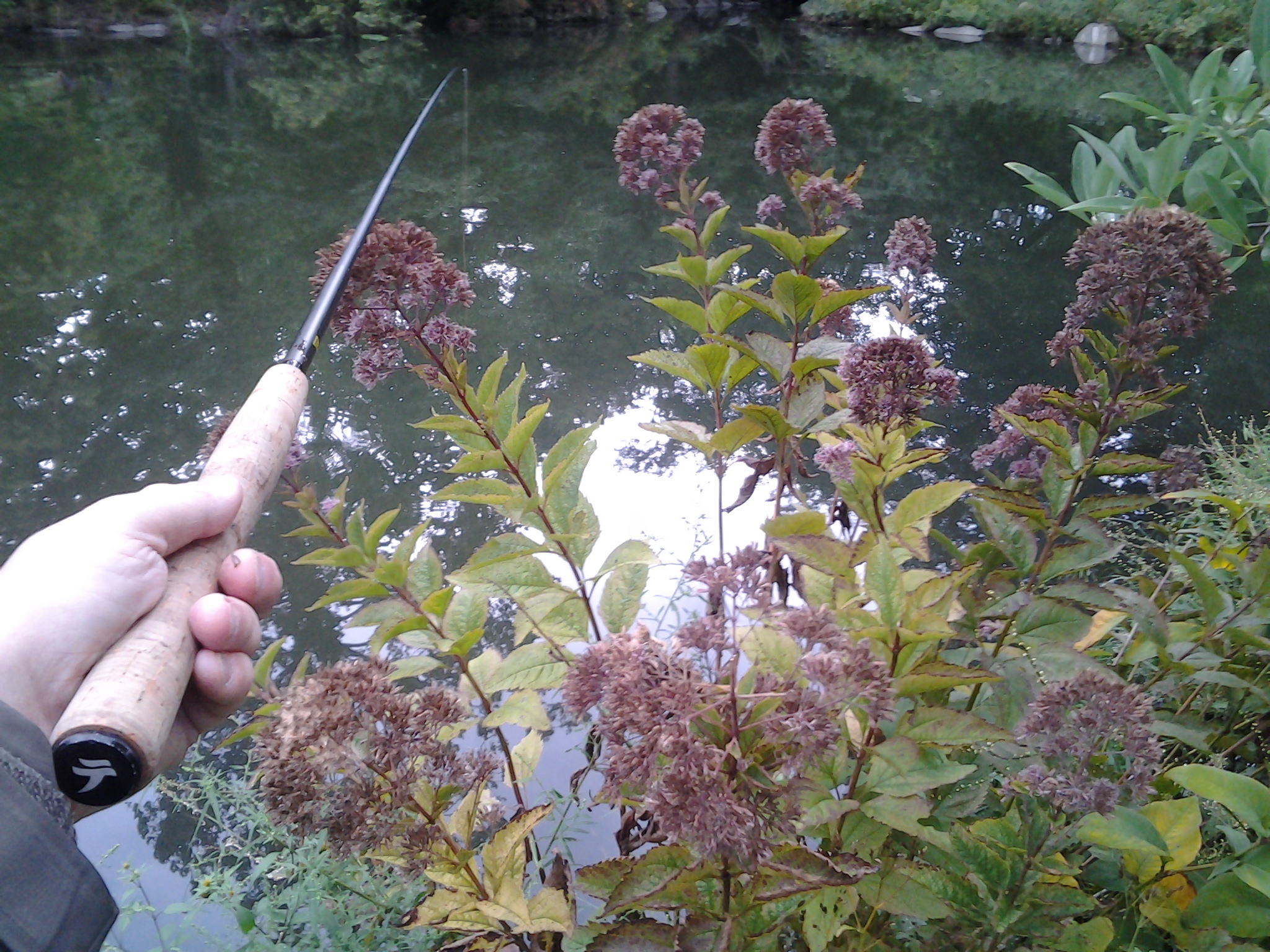
Vapor Trails imbued with sunlight fill a blue sky on some December days. One last one above the temperature of 40 degrees Fahrenheit beckoned me to follow through on one final item of outstanding tenkara fishing business: Taking my Tenkara USA Yamame rod for a test around Prospect Park Lake in Brooklyn.

Brooklyn . . . Of course. I had to go there at least once in 2014. Completion of mission vital to my own authority added a pinch of incentive as well. Prospect Park had not seen my traditional tapered line all season. The Bronx, Manhattan, as well as Queens have all been noted as has fishing the Hudson’s New York Bight’s salt adjacent to Staten Island. Four, not all five, boroughs in total, the count found wanting a major one of New York City’s destinations: Prospect Park Lake.

The omission appears even odder considering Brooklyn’s coolwater lake has the highest notoriety for catch and release bass fishing. For nine months of 2014, I have fished hard, in and around town in between serving as a guide to new gear at an urban fly shop. My first catch of a bass happened as early as the final week of winter in March. Trips in between then and now included meeting the saltwater papio of O’ahu, Hawaii. I had been to Brooklyn a bunch of times for friends and culture. Time then to go fishing there as well at the eleventh-and-a-half hour of the year.

One of my own pioneering tenkara trips took place along a portion of Prospect Park Lake’s asymmetric circumference. The lake has over a span of years drawn me and several of my companions together in search of fish on the fly. Earliest spring and fullest summer have been experienced, never winter.

The cold day squeezed between Christmas and the New Year began bright and breezy, qualities that made the prospects look challenging in all ways but my own confidence. I knew, just knew, some kind of fishing would present itself if I maintained the kind of endurance and mental focus I must exhibit to complete a cross country run along a bright and breezy Hudson River waterfront.

Conditions lakeside enforced an immediate variation on my use of line. My traditional tapered lines were set aside in deference to Level Line attached to a much longer tippet of finer 6X. Unfocused invisibility can be seen as obvious given cold lake water’s clear visibility. Water temps in the high thirties Fahrenheit discourage green plant life, and the recent season’s remains now rest brown and settled. Prospect Park’s water and its column become a more translucent body skirted by shores of cattails, trees limbs, and stone and mortar wall.

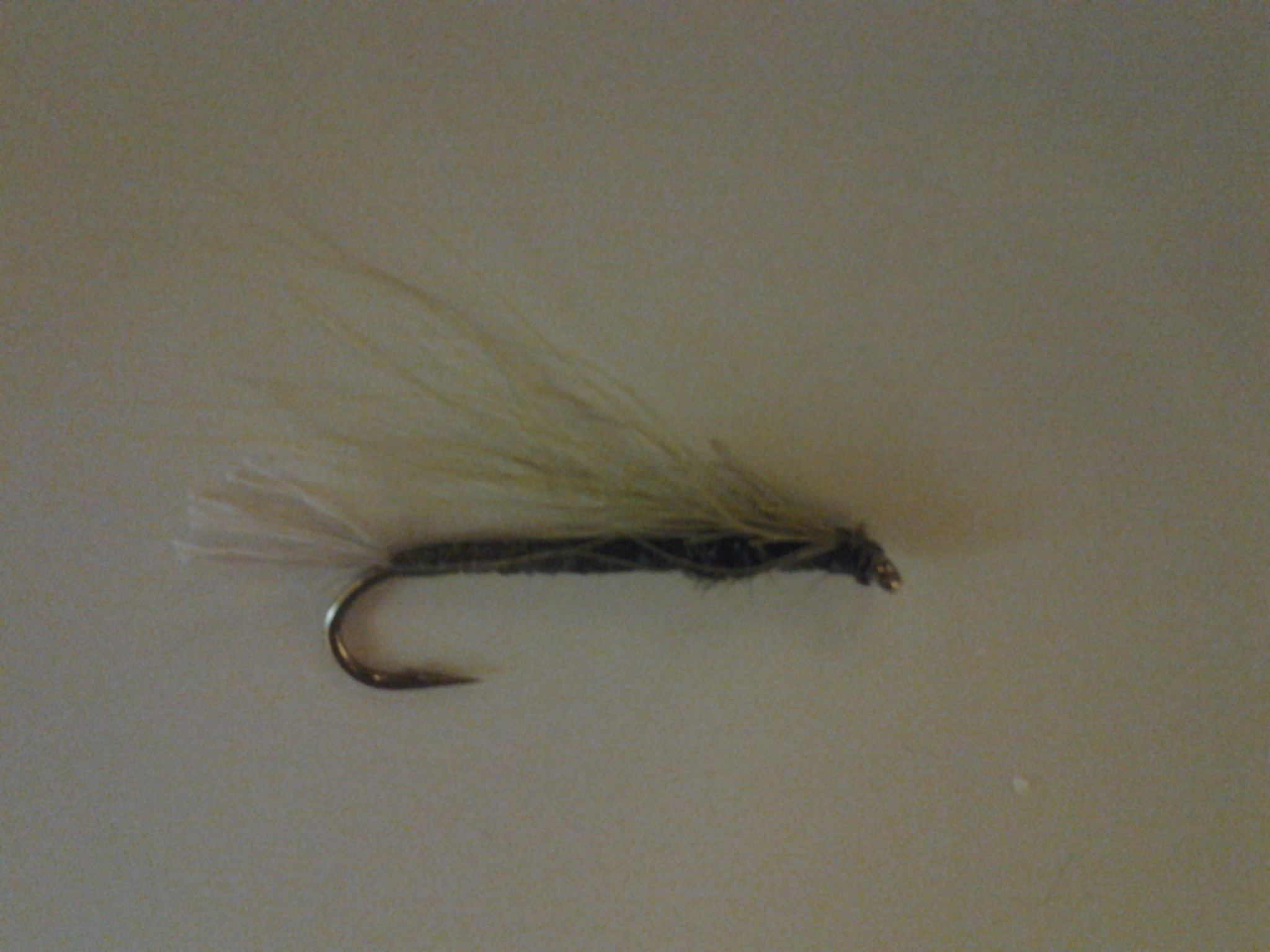
Large nymphs work to lure fish during the cold season. Leaf litter offers ample residences for the dobsonfly among others. Whether it be a Kebari americana like The Prince, Zug Bug, your own variation on the theme, or the all-inclusive Woolly Bugger, unweighted or beaded patterns are effective. More important may be presentation. Some strip in a nymph when stillwater fly fishing. Fair the approach may be, as well as a Leisenring Lift customized to your speed theory, or a sustained swimming action that takes advantage of an unweighted fly pattern’s buoyancy . . .

The Undulating Microtug

I grinned when the technique met a take. Connection to a fish had first to endure several persistent hours of casting in and around some brisk breaths of air off the water. Coldweather tenkara this was. No topwater action was on deck. The kebari patterns were a dice roll that occupied my mind: Olive Dobsonfly, The Prince, Zug Bug, and my own Grey Wet Wool Nymph described in my second book, Small Fry: The Lure of the Little. Sizes ranged between 6 and 10.

Coldweather Tenkara (12 29 2014)

Coldweather Tenkara
(12 29 2014)

What changed during the day was the wind. Air and lake calmed during the last hour of daylight. I finished with an Olive Woolly Bugger tied by steelheader Stephen Kasperovich of Sewickley, Pennsylvania. He is adept also when angling for yellow perch, the fish that turned my fading prospects at Prospect into a grand form of fishing finale.

His pattern uses a very soft chenille body matched with an undulating saddle hackle. Several seconds after I began to swim the Olive Woolly Bugger, a fish met the fly and connected. Several runs of ten feet and head shakes bent the Yamame and played me before I lifted a perch in net from the water.
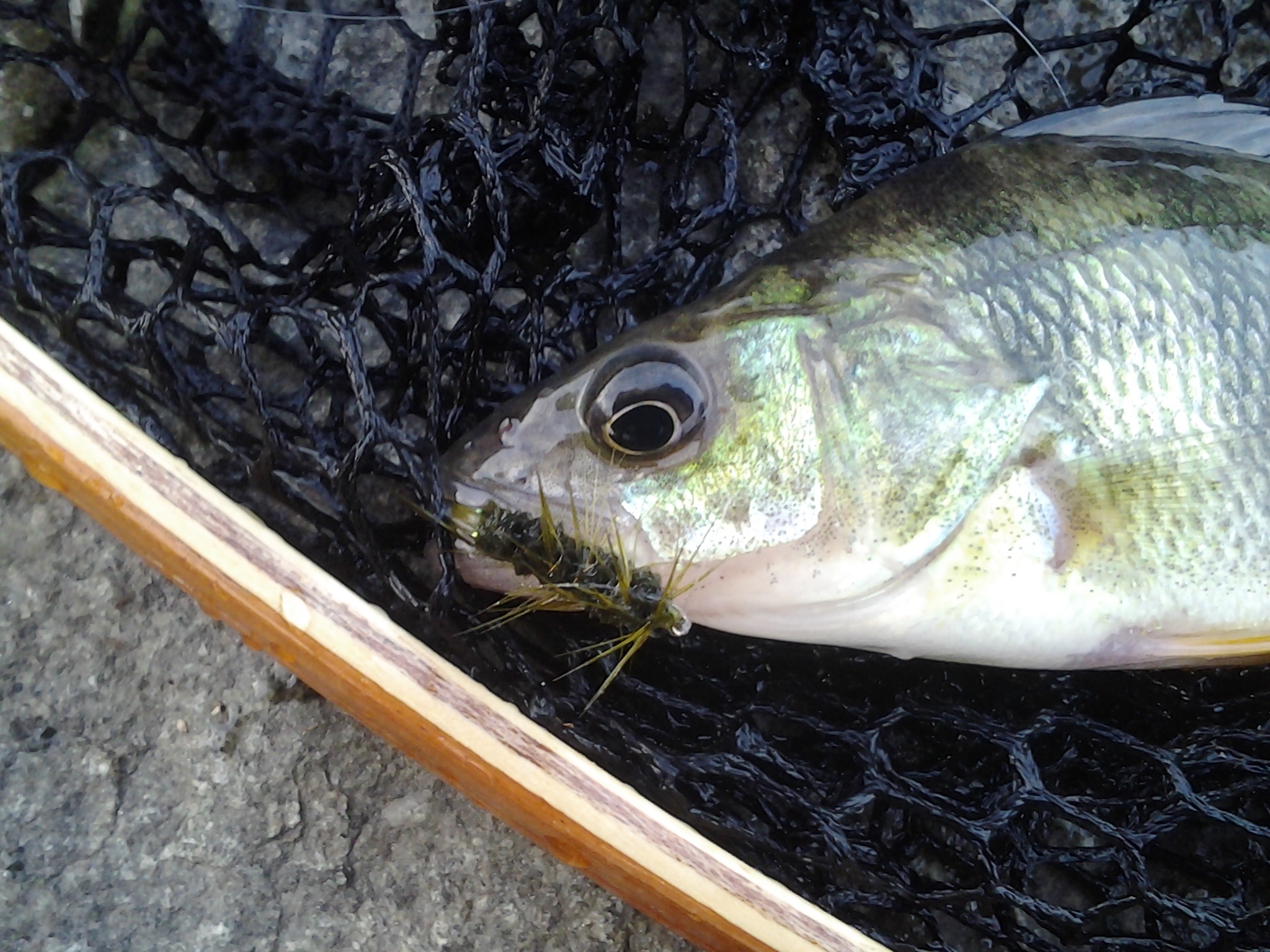
Yellow Perch (Olive Woolly Bugger by Stephen Kasperovich)

Yellow Perch
(Olive Woolly Bugger by Stephen Kasperovich)

Perca flavescens has been encountered before both at Harlem Meer and Van Cortlandt Park Lake during late August and September. The species is a popular quarry for ice fishers, making its presence and activity understandable on the calm end of this cold day. Several more perch followed, although not in a metronomic fashion one might associate with a large school. Each fish had to be worked, had to be coaxed, into striking. The hinge of the entire experience was again a willingness to put full thought into full motion forward. Full cast and retrieve with a focus on the fly at the end of the Level Line. Any slow swimming retrieve using wrist action combined with a lift can take tenkara fishing into catching. The other factor may well be that I found a spot holding some fish at prime time: the short span of minutes that can make up a wintertime bite.

Yellow Perch in Net

Yellow Perch in Net

Bird life communed on and around the lake. American coot, Fulica americana, plied the calm water and called at dusk in the manner of gas passing out of either end. Strange, mildly humorous, a sound like belching farts almost quite nearly contradicts the bird’s conservative plumage, which may bring to mind a solemn clergy’s robes.

Bird in View (American Coot)

Bird in View
(American Coot)

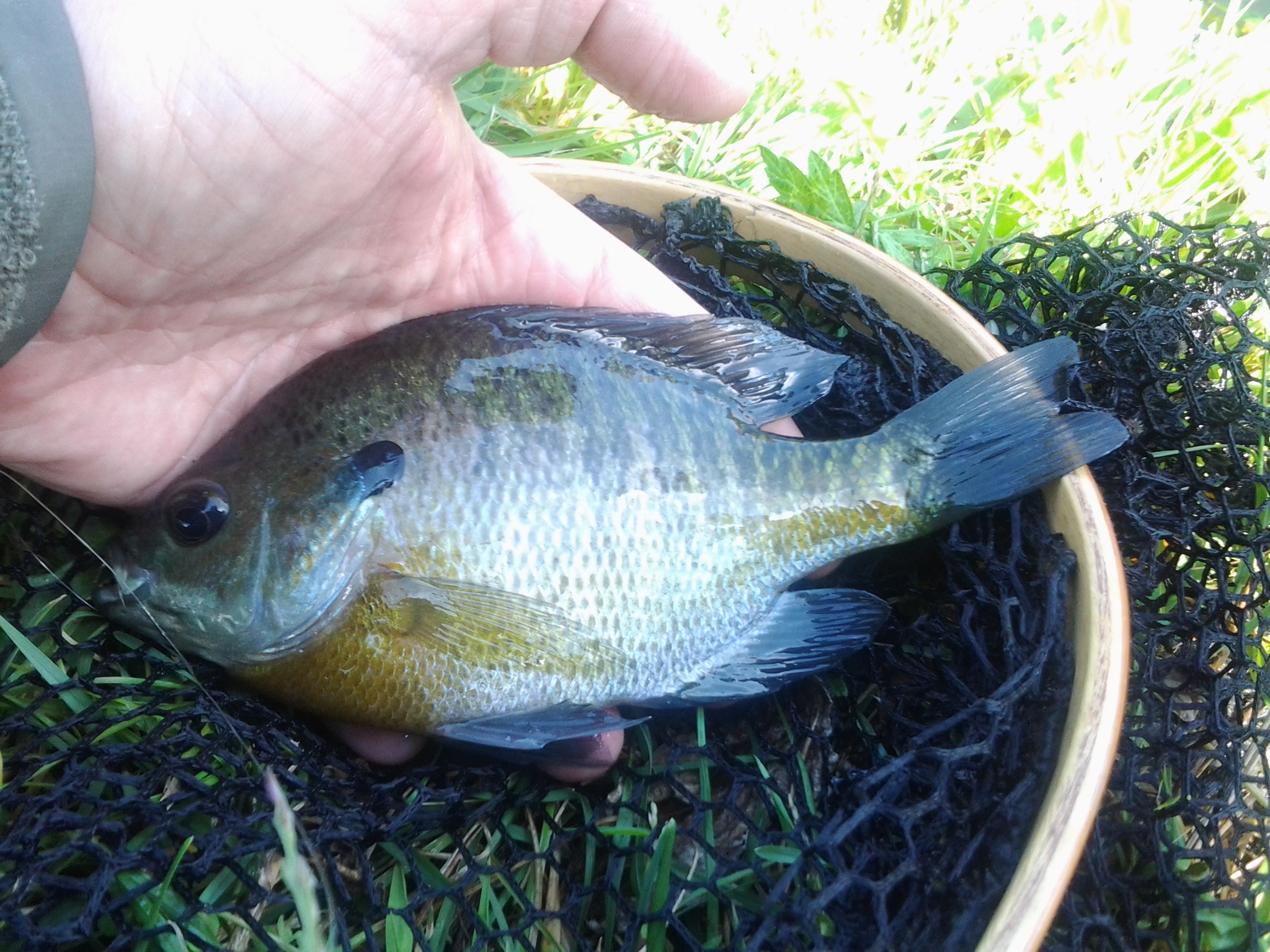
The day’s final sunlit moments brought a final yank transmitted down to the grip of my Yamame. The strategy of the competitor changed. Now a tight, circular fight, at net’s end my heavier opponent turned out to be a very round bluegill dressed in a pale purple sheen with olive details and black chain link bars twisted and reminiscent of the double helix. Bluegills can be a rare encounter after the spawning bed period. Even small waters may find a bluegill population strangely reticent despite a circumscribed space. I felt more than pleased to call this fish my final catch and release of the year.

The Final Fish (Bluegill)

The Final Fish
(Bluegill)

Red skies at sunset reminded me of a poem from my collection of poetry, museum of buildings: poems

Across the bridge I’m crossing
Lay the city bathed in sunset.

At the end of this “last day of December” the trees rather that the tower blocks were tinted.

Sunset (12 29 2014)

Sunset
(12 29 2014)

Farewell, Tenkara Fishing, 2014

The Year’s End

– rPs 12 30 2014

Leave a Comment

Gone Fishing, Gift Giving

Gone Fishing, Gift Giving . . .

Happy 5th Anniversary!

Happy 5th Anniversary!

The deciduous trees are mostly bare now. Gingko and Norway Maple gold covers the hillside grounds and park places as the oaks alone hold onto rustling brown leaves. Cross country runs and hikes to and from local fishing spots have been giving gifts of time and rhythm to compose creative words.

During this same time, my second book, Small Fry: The Lure of the Little, has reached 5 years of age and remains in print. Here is a brief synopsis from the catalog page of The Whitefish Press:

http://www.whitefishpress.com/bookdetail.asp?book=87

Meanwhile, my first book, Philadelphia on the Fly, prepares for its 10th anniversary next year. The fact the book has stayed in print as an active seller gives testament to the importance of place in creative writing. When writing fish stories, a specific place often gives a reader added incentive to read:

Readers in return give incentive to render experience in words, although the act of writing can be an addicting pleasure in itself. I do have a few stores with a tenkara theme in the works. Progress continues as well on Little Hills: a novel. Special times pass when the flow is brisk and clear, when writing about fishing can be as fun as a good day along the water. Yes, even when one is not casting a fly pattern to fish, one can be “Gone Fishing” in the broader sense.

(Nearly) Ten Years Later . . .

(Nearly) Ten Years Later . . .

— rPs 12 03 2014

Leave a Comment

Novel Tenkara

Novel Tenkara . . .

Hudson River Sunset 11 2014

Hudson River Sunset
11 2014

Tenkara infuses writing with rhythm. The result can be, sometimes, a longer form for pure soulful entertainment:

8.

. . . He heard a crow, birds seen as conspicuous black spots adorning the cooler bare branched times. The call from above, the coal black guest from the nest perched attentive on the center point of the house’s gabled third floor. Bird in interaction rocked up and down a few times and spoke again.

“Smart-ass bird! Are you cheering me on, or laughing at me?”

“Caw-Caw-Caw,” the crow replied.

*** *** ***

. . . He took out his frustration by reeling in as hard as he could without knotting up the line. Such little private protests were all he would muster. He was too timid to show anger. Petey was a valuable shield against bullies. Let Petey lead; they shared other fun.

Once, without Petey, he missed school bus and had to wait for PAT Transit to take him down the long inclined face of the hill. A kid his age but bigger, cloaked in a long, untucked white shirt, appeared from behind a parked van:

“Hey! Catch this!”

Football flew forth in his direction. Young Robert, stalled in thought, cringed a bit and stubbed his left index finger in fending off the hammer ball.

“I’m a basketball player,” he yelled in his defense, which he followed with the first and only passable spiral pass of his life. The other kid caught his ball.

All was cool until a Saturday afternoon, when on his way to Center Arcade, he found himself sweating at the same bus top. This time he heard first the sound of a hard ball bouncing on pavement. A pause followed the kid’s appearance from behind another, different van:

“Hey, Basketball Player.”

Rubber burned. Young Robert ran, thus beginning his secured future as a cross country player.

Hudson River Sunset 11 2014 (photo by Maryann Amici)

Hudson River Sunset
11 2014
(photo by Maryann Amici)

– rPs 11 24 2012

Postscript: (excerpts from Little Hills: a novel by ron P. swegman)

Leave a Comment

Football Helmets and Fall Fishes

Football Helmets and Fall Fishes . . .

The Reach of Tenkara (photo taken 09 2014)

The Reach of Tenkara
(photo taken 09 2014)

The night game of summer has moved on to new rules played in the daylight. Rain may pass through, and the reopening of the sky brings good time to go outside and fish. When the dark does descend, quickly and almost cold, home calls as the nostalgia door opens to college year memories or past seasons, some of national championship caliber.

Part of my own continued education in life experience has been set amidst a geography where home waters caress manes of watercress. There trout abound. Other neighbors on the stream, offered perhaps a polite wave from a fly fishing undergraduate, have included names of Harvey, Humphreys, and Meck and a Gordon, too, among many others; my constant sense of the eastern provincial in America stays connected, centered on a Pennsylvania county as well as five boroughs of New York City.

Neighbors of the urban angle abound also and some distant shores have been or shall be explored alone and together with even more others. Before such diversions, the sharpened focus on a single bass, any bass, remains first in line.

Largemouth Bass (photo taken 09 16 2014)

Largemouth Bass
(photo taken 09 16 2014)

Bass season is again back in session.

Temperatures drop to fifties and sixties Fahrenheit. Sunlight remains bright, often unfiltered, but days of rippled gray skies do pass. Rain remains brief unless it’s a hurricane trailing through for four to five days. Ponds again begin to clear and darken. A frosting of bright duckweed foots cattails and pickerel weed. Slow presentation with a long horizontal reach, a natural fishing problem for tenkara to tackle and bring to quick resolve, can take a kebari to the bass level (a multifaceted pun too compelling not to intend).

The largemouth and smallmouth bass alike, after striking your pattern in a singular fashion near the water column’s bottom, bring fast reactions to the top. This athleticism has had a portion of its antecedence come from the fish’s own daily hunting. Black and blue damselflies, measured in inches, still pass time in the air. Nymphs that resemble such varieties in various stages of development swim and crawl throughout a still water. Bluegill fry swim in small schools, too. Bass can be lured when these larger naturals are mimicked by an equal kebari tied to a generous tippet matched with a Level Line or a Traditional Tapered.

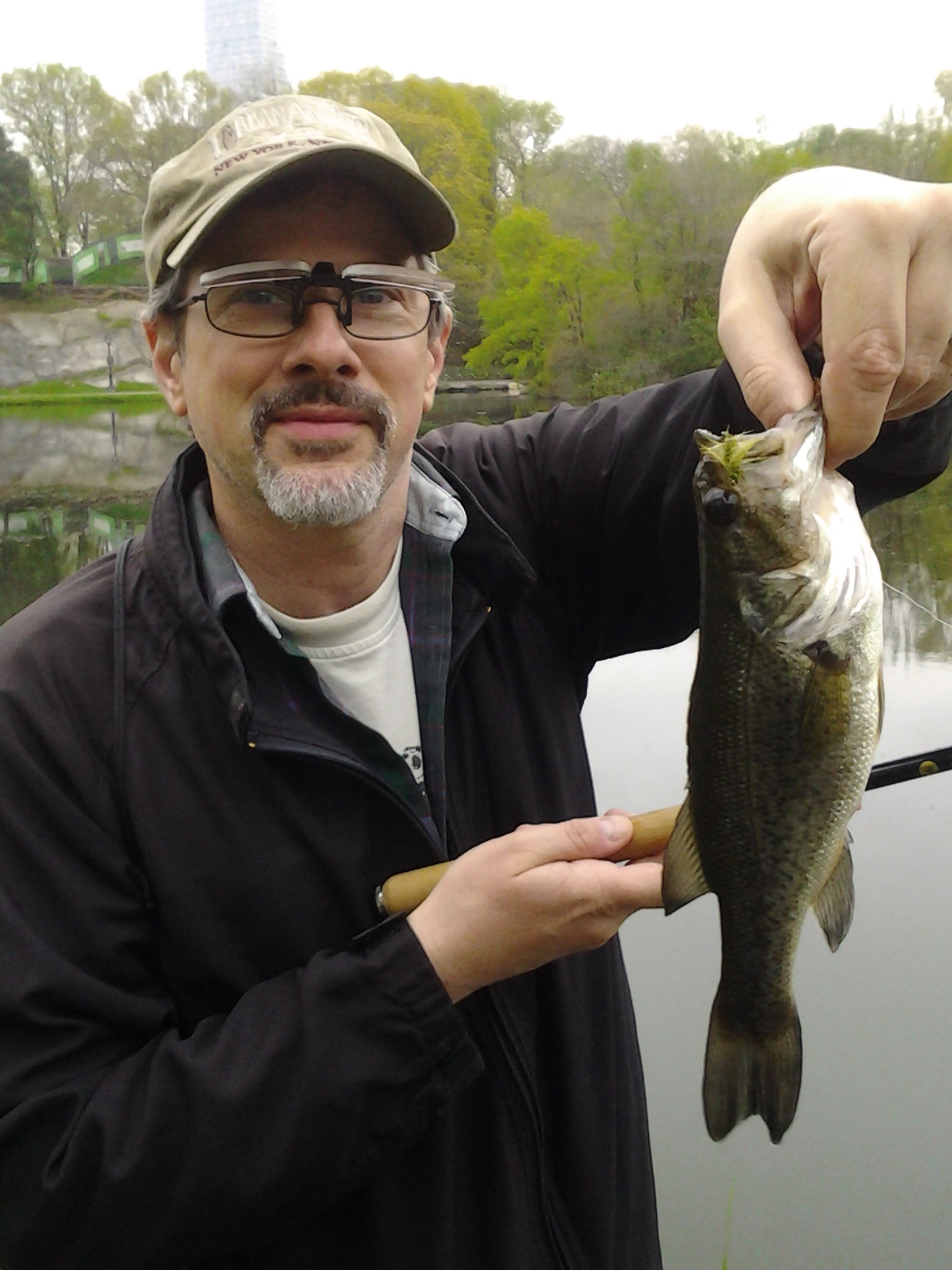
A largemouth, hooked on such a kebari of size 8 or 10, may jump three times and roll on each leap skyward. Size varies by location. Any fish that is perhaps best sized to a September zucchini may be noteworthy to big fish fans.

Smaller fish – dill pickle bass and slab bluegill – still insist on being counted. Vigorous takes by a quarter pound fish inhales the pattern deep in the mouth, doubles the perceived strength of pull during breaking sprints, which brings added utility to the longer tippet with its greater capability for stretch.

Be mindful to bring clamps with a few inches of reach. To release a bluegill hooked so deeply, first fold the fish’s spiny dorsal fin down with the inside of your wet fingers, grip the fly with the teeth of the clamp, twist as far as necessary as a slight downward push on the pattern is made. This most often dislodges the hook with minimal penetration of the fish’s interior. Most small fish will thrust voluntarily from hands placed low over the water and depart with a resounding and reassuring splash.

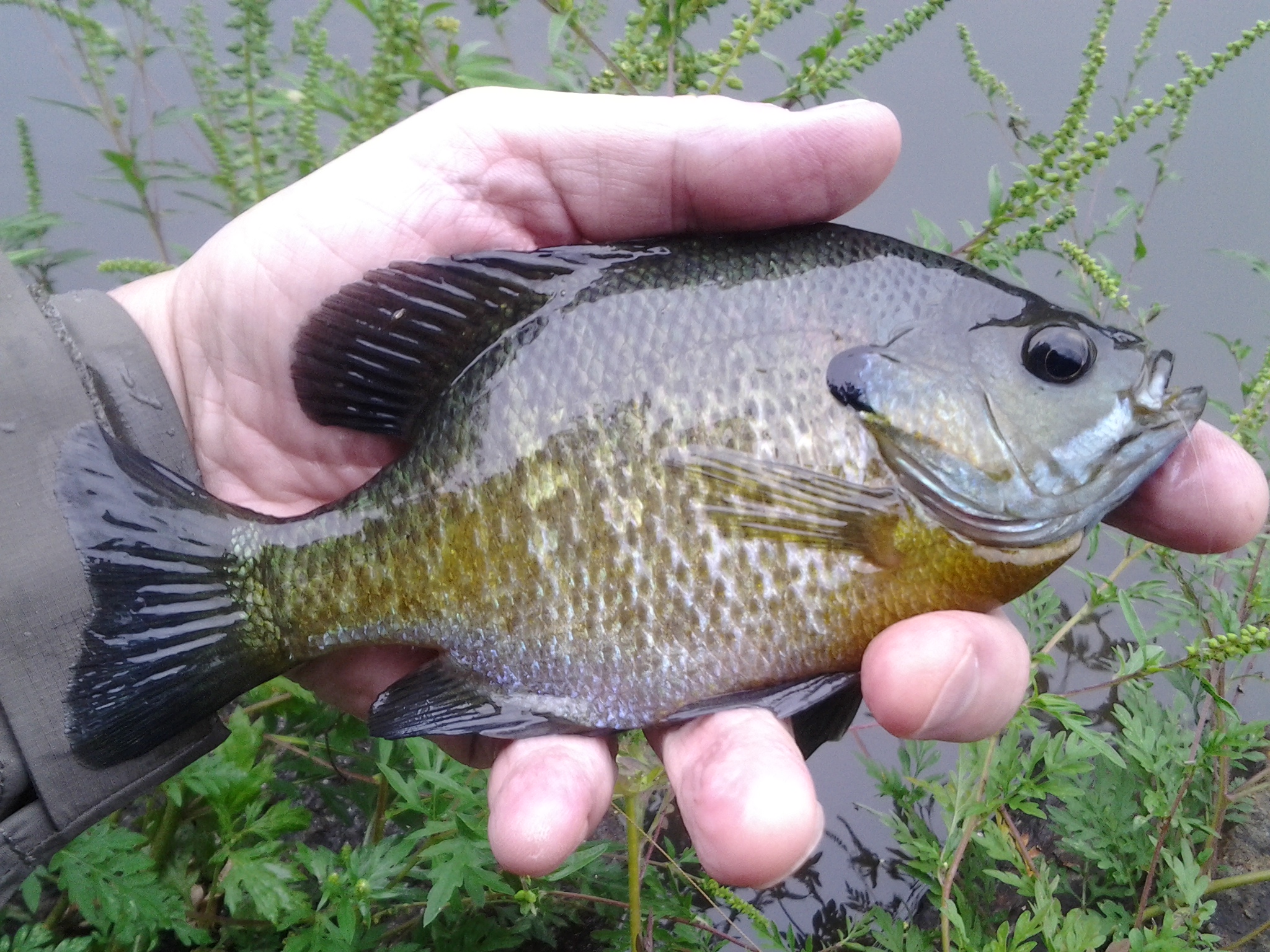
A net facilitates the unhooking of an autumn bright bluegill. (photo taken 09 16 2014)

A net facilitates the unhooking of an autumn bright bluegill.
(photo taken 09 16 2014)

Orange Jewelweed and pale purple clusters of New York Ironweed border many New York stillwaters by late September. The green of leaves has acquired a more yellow cast. Some bluegills exhibit similar rusted or buttered bellies below strong barred sides. The bass remain silvered and green with a distinct black lateral band. Colored patterns all that would fit on a football helmet with ease.

The Football Helmet Bass (photo taken 09 2014)

The Football Helmet Bass
(photo taken 09 2014)

– rps 09 24 2014

Postscript: Read more about the damselfly and dragonfly at Backyard and Beyond here: http://matthewwills.com/2013/08/07/lilypad-forktail/

And here: http://matthewwills.com/2013/05/31/dragonfly-pond-watch/

Comments (1)

Tenkara Any, Any

Tenkara Any, Any . . .

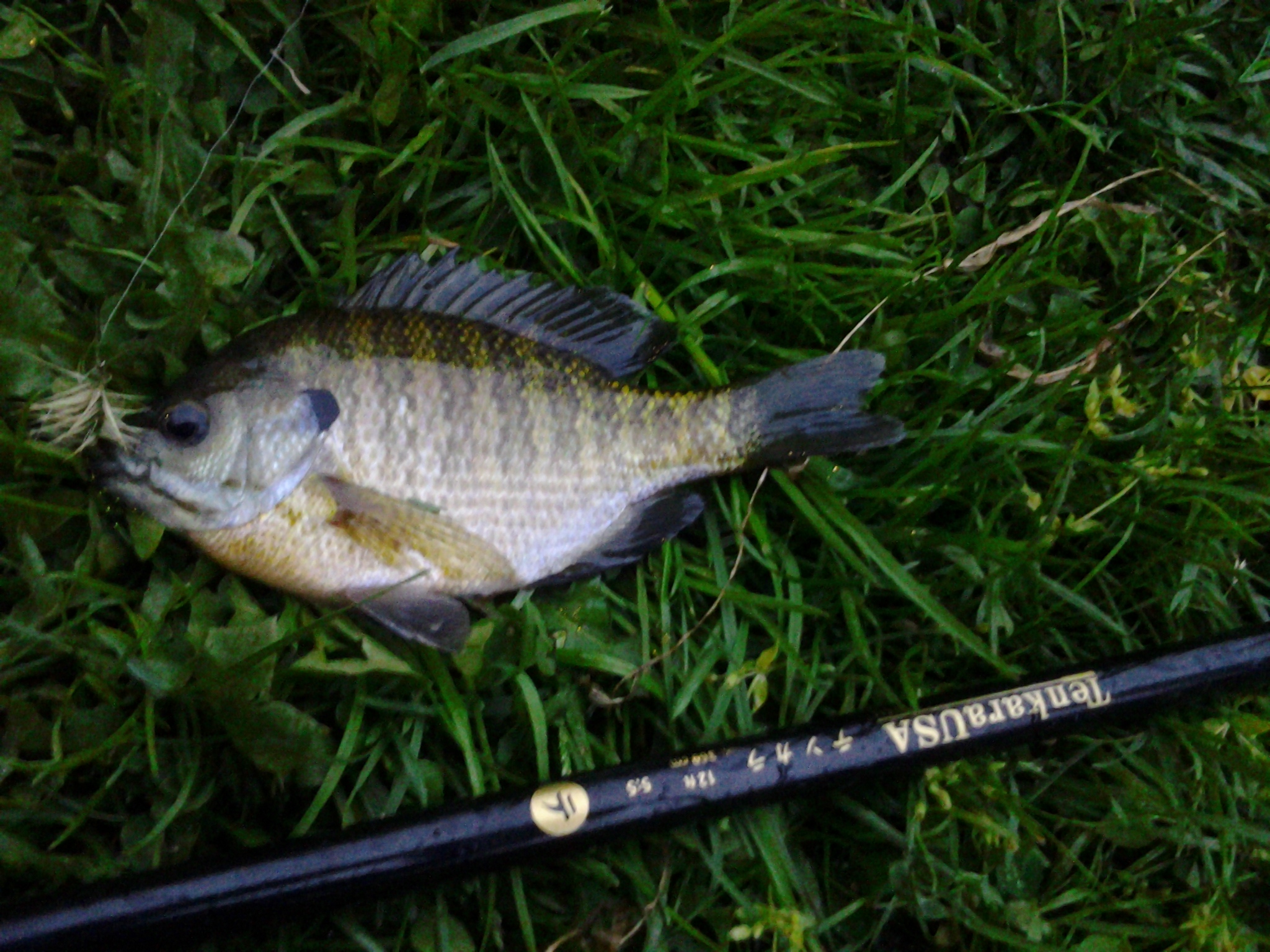
August in NYC 1:  Bluegill Male (photo taken 08 2014)

August in NYC 1:
Bluegill Male
(photo taken 08 2014)

My ultimate life raft kit shall henceforth include always a tenkara rod, kebari, and the tackle pictured in “On the Water, On Line” weeks earlier. Saltwater casts from an inflated raft will lure lifesaving sashimi sustenance. Extended alpine accident withdrawal may be sustained by mountain trout or swamp panfish. Universal tool is tenkara.

During the good times, the catch remains best when made a repeatable encounter.

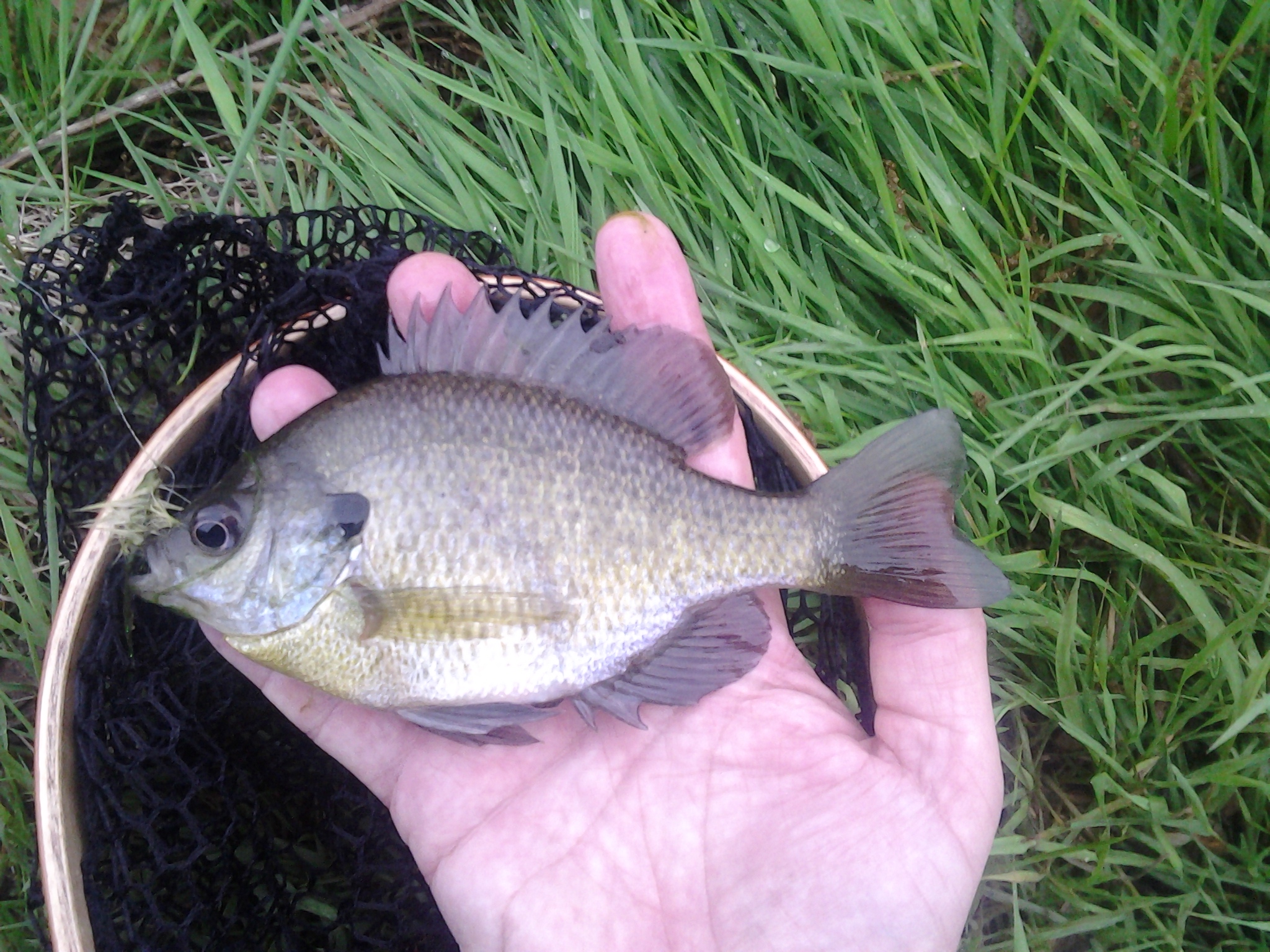
August in NYC 2: Bluegill Female (photo taken 08 2014)

August in NYC 2:
Bluegill Female
(photo taken 08 2014)

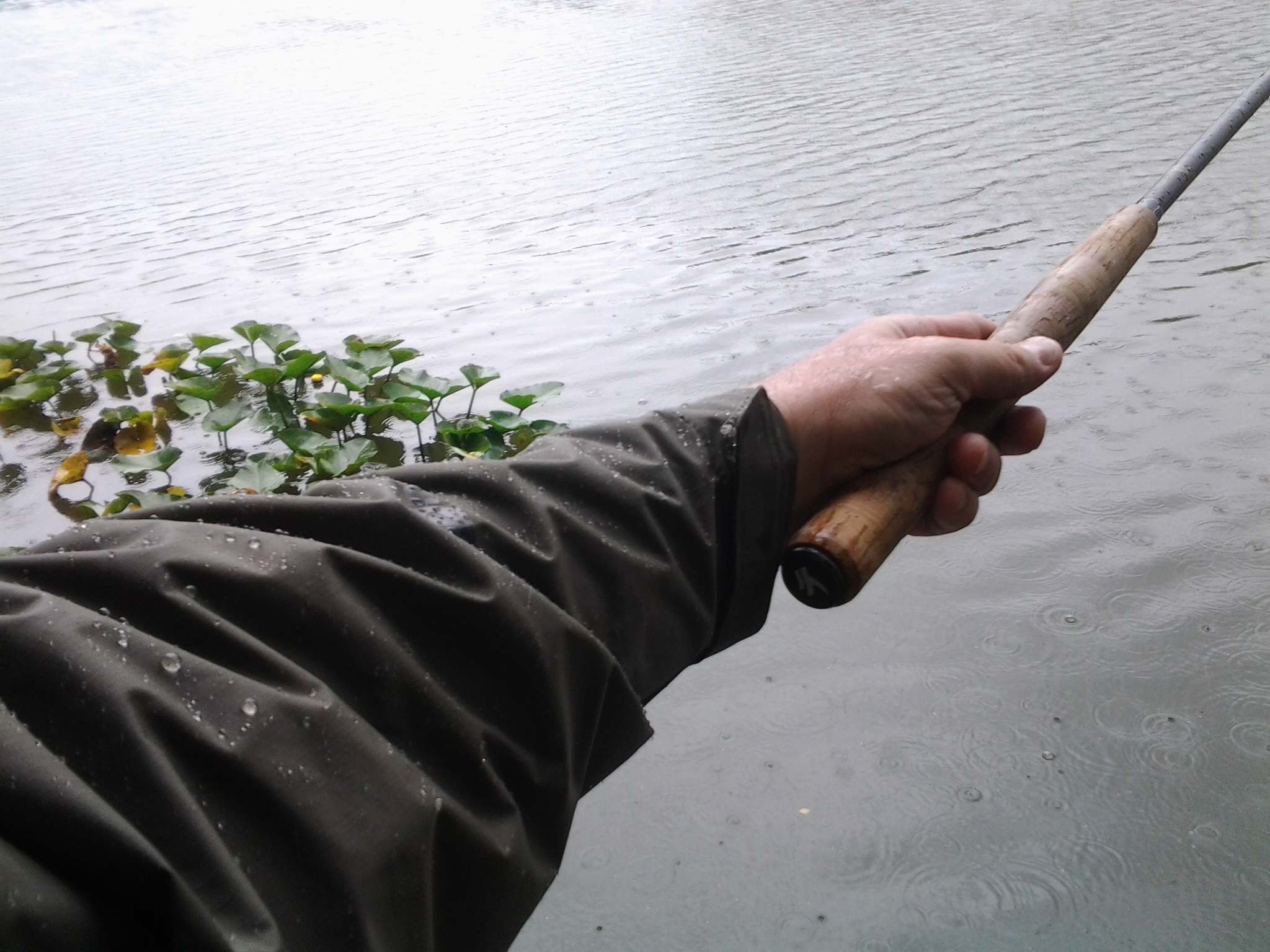
Rain may fall. Good. Fishing better then is my usual state of play when best embraced by a wading jacket.

Padded Rain

Padded Rain

Tenkara Any . . . Time, Any . . . Where.

Yamame at Rest

Yamame at Rest

As for the necessary Kebari, that is one field, universal . . . in scale, in choice.

Any ideas?

– rPs 08 27 2014

Comments (1)

The Salt on the Level

The Salt on the Level . . .

Hudson River High Tide (photo taken 07 2014)

Hudson River High Tide
(photo taken 07 2014)

The Salt. I have been trying, toying in earnest, to infuse my tenkara with diversity through variety in waters flowing and still, freshwater and . . . salt.

The Salt; Saltwater: Some older classics of the printed literature hold titles such as “Dock Fish” in which a sense of history can be linked to the facet of the sport perhaps best named saltwater panfishing. During this second decade of the 21st Century, add the urban angle in Manhattan, USA, and that offers two fishes of note: black sea bass (Centropristris striata) and bluefish (Pomatomus saltatrix), in particular the yearlings known regionally as “snappers” (pronounced “snappas”).

The Black Sea Bass

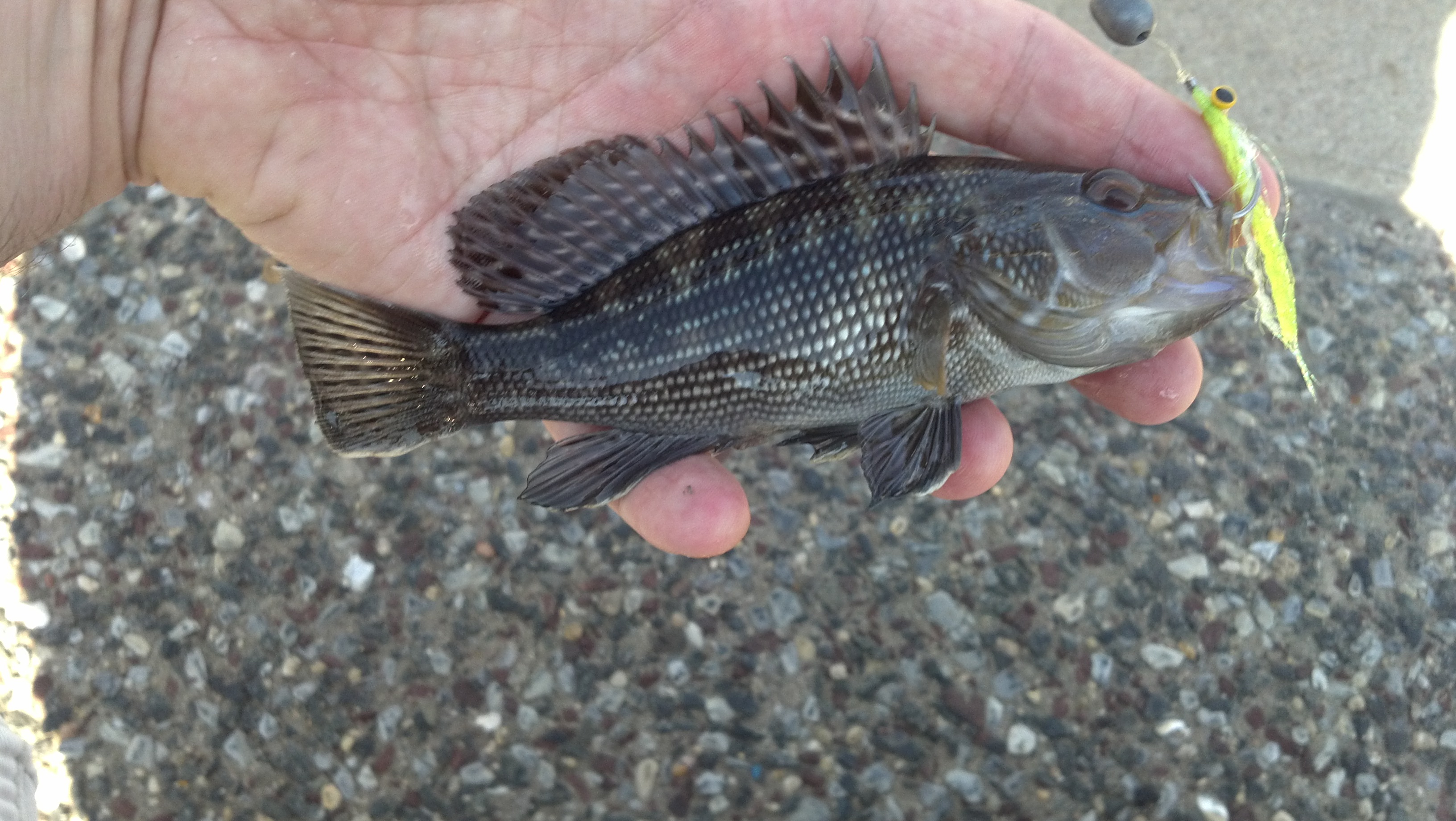
Black Sea Bass (photo taken 07)

Black Sea Bass (photo taken 07)

The black sea bass (those I have lost and caught and released) on the tenkara rod have coerced me to believe this is a saltwater sporting equivalent to the green sunfish found in freshwater streams. Previously I extolled on the green sunfish. The black sea bass is just as worthy.

The black sea bass is by classification a grouper, a smaller one, hardier to cold temperatures, a member of the family more well-known by its southern relations that range in color, pattern, and in size up to a 70s fly Volkswagen beetle.

The black sea bass exhibits broad shoulders, a flank thickness like the green sunfish, dressed in pearled black scales that hold an iridescence that glows bright blue around and along the lateral line. Vermiculation of a similar color resembles that of the green sunfish. The size encountered off my Manhattan dock(s) range from six to twelve inches. Only the very few largest are potentially one in the hermaphroditic phase, an interesting fact of this fish, which sets in at around specimens of ten inches or longer, in weight reaching eight to ten pounds.

Fish take a fly firmly and quiver shake in resistance. Bright weighted streamers, a chartreuse variety of Cllouser, can be cast, sunk, twitched on a line twelve feet in length supplemented by a leader of similar length tipped by the fly. Such a pattern on a swing with slow pulses of the wrist will take fish during one or two parts of a tide, often on incoming, but not always. One certainty, speed up the presentation of the fly to be intercepted by another hard hitter.

The Bluefish

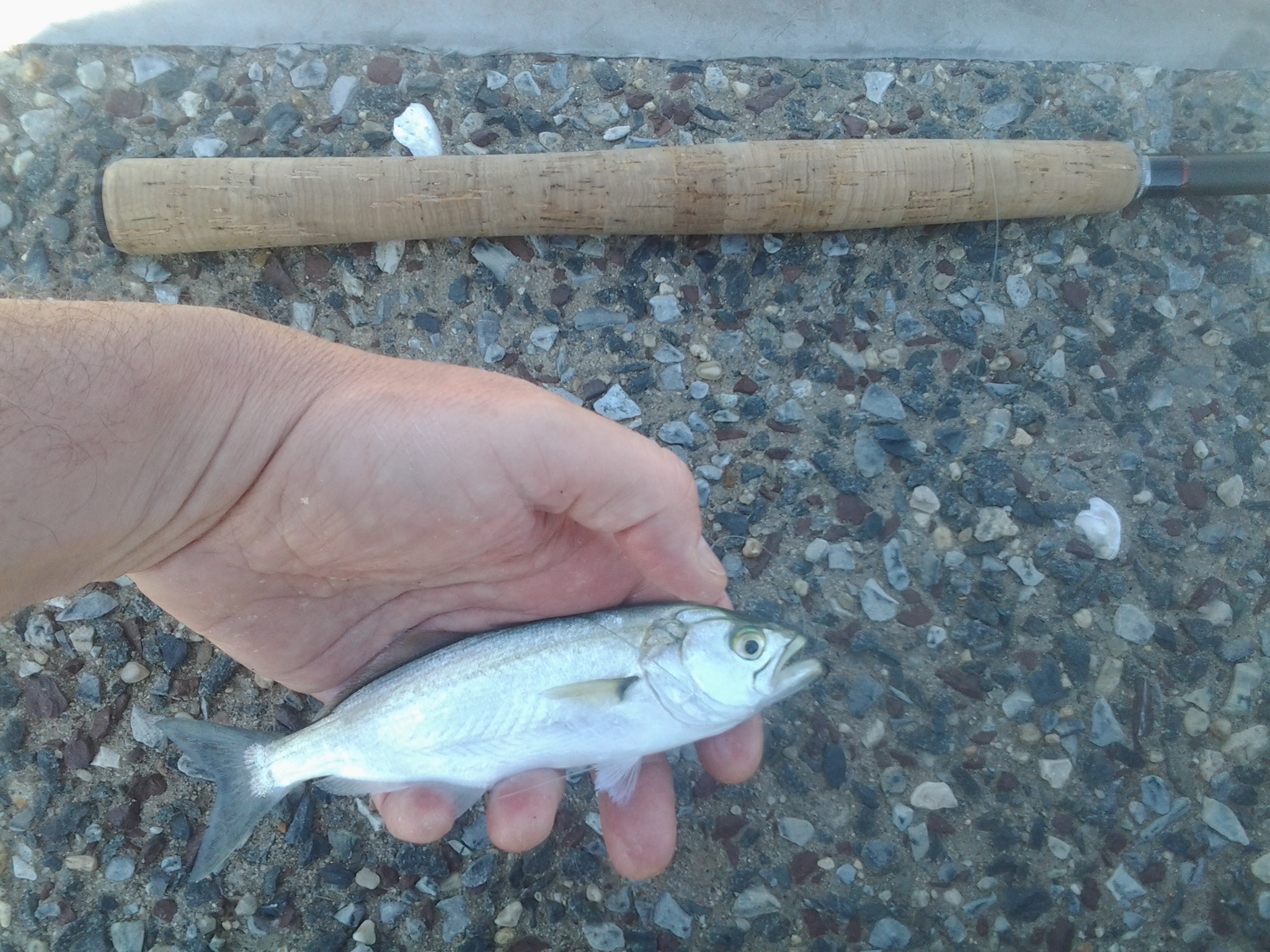
First Fish! (photo taken 07 2014)

First Fish!
(photo taken 07 2014)

Closer to the surface cruise little toy soldier pods of juvenile bluefish chasing fry and rainbait schools. The schools of bluefish cutting baitfish like class come in and go out on quick waves that rarely last longer than two caught fish. Several hours of fishing will provide one half dozen waves of two minute bites on most occasions.

There also are changing skies to contemplate and inquisitive tourists, in between, plus a smorgasbord of aviation and ship sightseeing.

Fly patterns remain consistent with those best for the black sea bass. Simple half-and-half Clouser patterns tied for skinny water. Cinderworm patterns are normally ignored, although any dartible streamer of white can do. Sizes 6 through 8 are small enough for the tight-lipped bite of both fishes.

Hooks require a line. Level Line, not traditional tapered, is advised to be used. The Salt. I attach twelve feet to a small swivel and add a straight leader of monofilament in 5 or 6 lb. test. I want the leader to be breakable in case I hook into a piling of wood; an admittedly occasional hazard.

Hudson River Low Tide (photo taken 07 2014)

Hudson River Low Tide
(photo taken 07 2014)

Close fishing to the docks works best when peak tides and solunar tables meet. Check predictions on the website Tides4Fishing and study saltwater access nearest you. Tenkara may work on croakers and bergalls and many other fishes of The Salt that can fit into a pan if you force them, by hook.

Panfish, or Handfish? (photo taken 07 2014)

Panfish, or Handfish?
(photo taken 07 2014)

– rPs 07 25 2014

Postscript: Tides4Fishing http://www.tides4fishing.com/

Leave a Comment

Happiness

Happiness . . .

Green Sunfish along a New Jersey road. (photo taken 07 10 2014)

Green Sunfish along a New Jersey road. (photo taken 07 10 2014)

That little brook beside the road, a scene repeated across this globe creased by moving water. My most often wonder as a child until now is what may swim toward the artificial fly within this flow or that flow.

This one, near Passaic, New Jersey, poured forth in runs shin deep along the green edge of a Jazz Age duplex neighborhood bordered by a small park. This run of preserved water flowing through a garden city urban setting offered up on a sunny July afternoon a final treasure, finality found in a firm belief:

One Rod. One Line. One Fly.

One Fish!

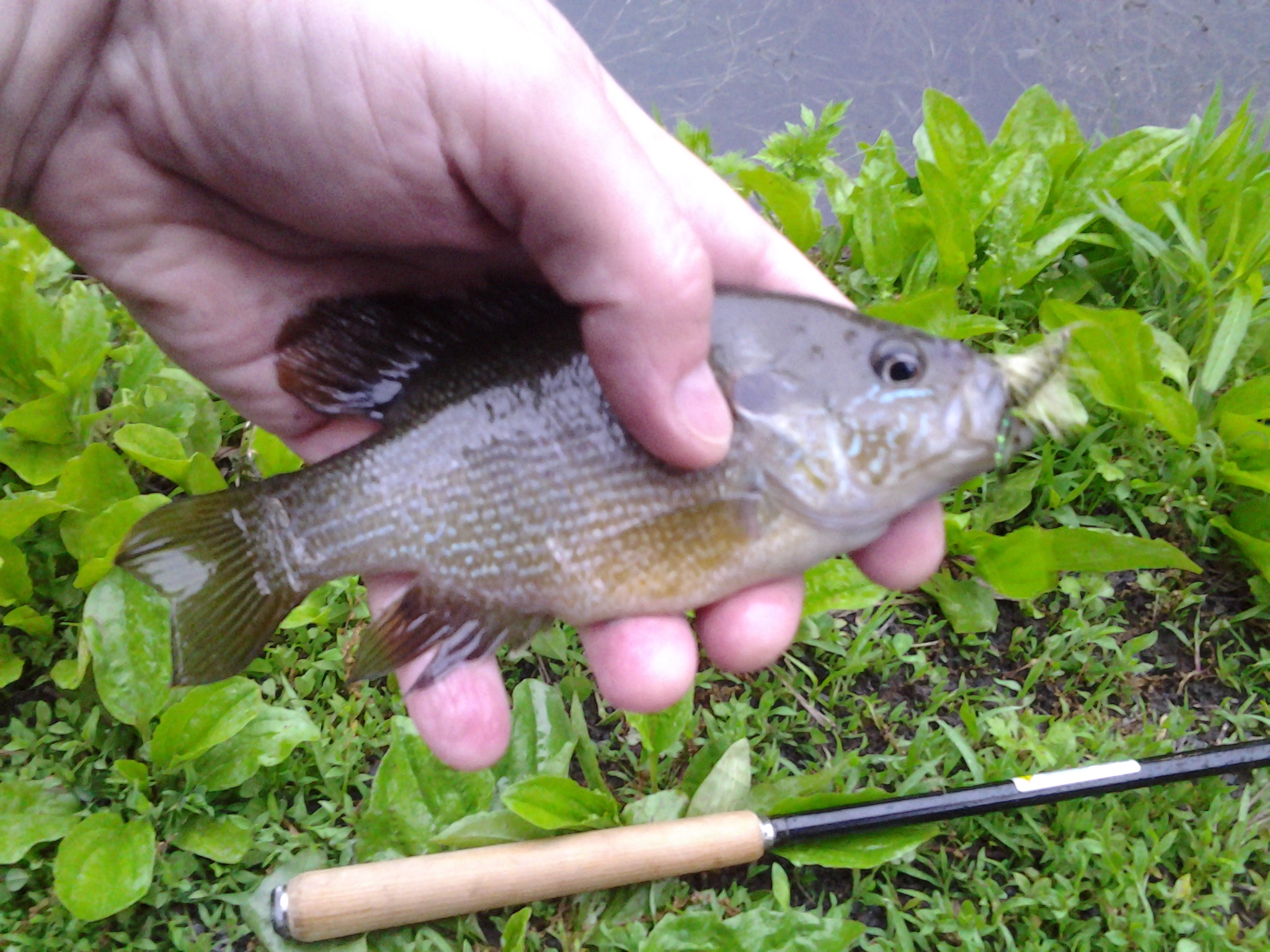
Green Sunfish, Lepomis cyanellus, is my favorite freshwater tenkara tackling opponent that does not fall under the separate heading of Salmonid.

Lepomis cyanellus, the fins of this fish often exhibit a commonality with the east coast’s native char, Salvelinus fontinalus. Both fish possess rusty fins edged precisely in white.

The mouth of the green sunfish, like the rock bass and the redbreast sunfish, presents an elongated jaw like the largemouth and the smallmouth bass. Coloration, in addition to the fins, may exhibit barred or mottled jade. Sky blue vermiculation often decorates the cheeks and pronounced jawline.

I dedicated an entire chapter to the green sunfish in my most recent book, Small Fry: The Lure of the Little. One included claim of experience included the observation this species will take the wet fly when swung or pulsed beside submerged ledges of rock. Stretches of this little back alley run runs deeper along a smooth rounded ledge, casting shade at high sun and the rest of the day throughout. New Jersey bedrock: carved by water.

Additional shade here is often provided by Norway Maple trees. This introduced species, a popular planting during earlier generations, holds broad leaves that can cast a lush cover of shade over a city sidewalk and its parallel greenway brook. Numerous green sunfish dared forth from the ledges under tree shade cover and savaged passing offerings with the voracity of brookies swarming a floating beetle pattern just as it lands on a foothill creek flanked by hemlocks.

The length of the two fish runs in parallel fashion, ranging between three and eight inches in small streams. A plump green sunfish of six inches marks my personal best so far caught and released from this Passaic-area creek. This fatness counts in the strength department. The rounded green sunfish body holds more bulk against a tenkara rod’s tenderer, Lillian-tipped, rod tip.

Between dapping and pocket picking between banks set ten feet apart, successful narrow casts can be made. I practice my bow and arrow here, too. A careful bow flip can land beneath the branches where frequently a larger brooding fish often holds. Tenkara rods cover this variety of water well.

Outings spent in intense fishing, green sunfishing in a tight quarter, will leave most anglers exercised after a summer day’s length. Happiness comes from the experience, perhaps accompanied by ice cream with a fishing amigo, with which one enjoys also a cooling sunset. Fireflies began a cold, incandescent dance beneath the tree canopies as Sol submerged behind cumulus cloud and the tree line standing behind living city water.

A tenkara lesson learned with the green sunfish pointing the way.

Happiness.

– rPs 07 14 2014

Leave a Comment

Gray and Green

Gray and Green . . .

Bluegill and Ebisu (photo taken 05 15 2014)

Bluegill and Ebisu (photo taken 05 15 2014)

Weather patterns vary by season and region. One consistent to spring in New York, New Jersey, Connecticut, and Pennsylvania is a stretch of about three weeks between late April and the middle of May. I call these the gray and green days when the trees bear pastel leaves and flowers under an overcast gray sky that gives forth a fine mist or scattered light showers. This is a time dominated by water, cool temperatures, clean air, and the palpable smell of earth.

Ponds become stage center for a community of living things during these salad green days. Cattails, phragmites, and pickerel grasses have reached halfway to maturity and stand about knee high. The yellow flag has not yet begun to bloom, although the dandelions on the surrounding lawns now blend golden blooms with pale gray spheres of seed. Wakes in the shallows could be a turtle surfacing for a breath, or bluegills and bass sprinting below, preparing to construct beds for spawning.

The overriding dampness will normally keep most people engaged in indoor activities. The angler, however, and this angler for certain, becomes compelled to go forth and fish as often as possible.

Tenkara equipment provides an ideal tool here and now. Between the edge of the flooded grass and the mats of pondweed starting to form at pond center often resides a strip of open water varying between five and thirty feet in width. Here fish can even be seen for sight casting chances at times. The long telescoping tenkara rod easily reaches over the shoreline vegetation and the limber nature of the pole allows accurate fly placement along the near and far edges of the plants where aggressive panfish and cruising bass swim in abundance.

Tenkara fishing along a pond edge. (photo taken 05 08 2014)

Tenkara fishing along a pond edge. (photo taken 05 08 2014)

Evenings tend to produce the best fishing. The stillness that often settles after the day allows for more accurate casting and also the opportunity for topwater action using dry fly patterns (Deer and Elk Hair Caddis) and panfish poppers (Foam Gurglers and Rubber Leg Spiders) . Two recent visits to my local waters have produced some good catches, including:

Bluegill

(photo taken 05 15 2014)

(photo taken 05 15 2014)

Green Sunfish

(photo taken 05 15 2014)

(photo taken 05 15 2014)

Largemouth Bass

(photo taken by Tony Panasiti 05 08 2014)

(photo taken by Tony Panasiti 05 08 2014)

The gray and green days have about another week or two left in them before brighter, warmer weather arrives. Go forth and fish if you have the time.

– rPs 05 16 2014

Leave a Comment

April Light

April Light . . .

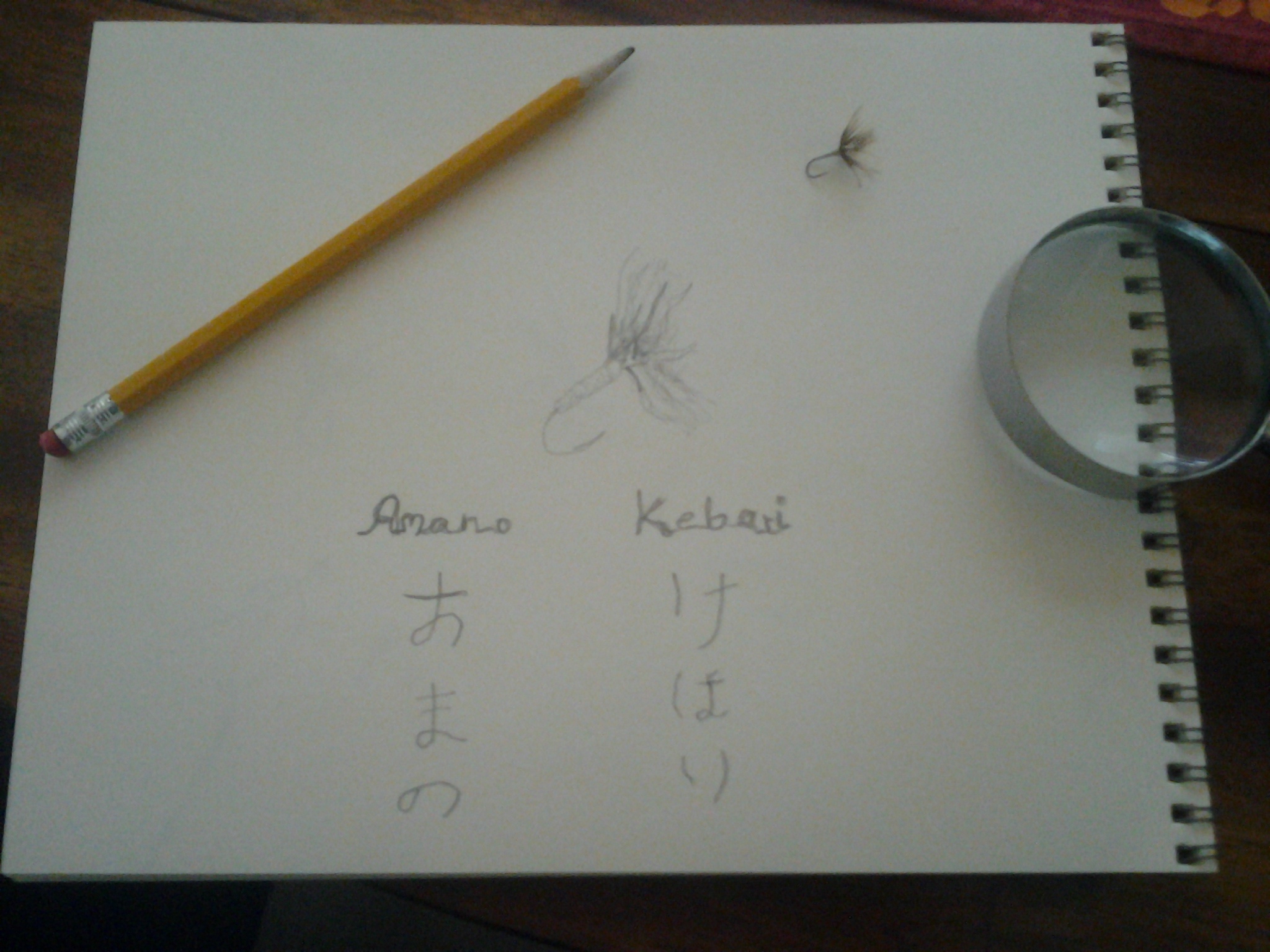
A Portrait-in-progress of an Amano Kebari (photo taken 04 28 2014)

A Portrait-in-progree of an Amano Kebari
(photo taken 04 28 2014)

May in Manhattan may start as predicted; beginning with cool rain.

The eye finds light labor and mind thinks how to work out images in contrast in two dimensions. This time the one color wrought shades gray: the gray that some years gives May as much abundant green as there is on this day of April light.

Clear, bright, today refracted sun sets the pencil in motion with an Amano Kebari portrait in repose on paper.

Just sketchin’ . . .

– rPs 04 28 2014

Comments (1)

Harlem Meer, Blue Again

Harlem Meer, Blue Again . . .

Free at last: Harlem Meer without ice.. (photo taken 03 21 2014)

Free at last: Harlem Meer without ice.. (photo taken 03 21 2014)

The wind was up. The sun set the high cirrus aglow. Harlem Meer reflected deep blue and, occasionally, bare trees. Rippled, the winded surface did not deter the birds. Canada Geese, Mallard Ducks, and Hooded Megansers all utilized the resource. I found myself, too, with colleagues Fergus and Jesse. We three angled urbanely for an entire Friday.

The water was clear and dark, free of weed. Only the bottom, where we worked our offerings, hinted at the ragged rooted bases of plants yet to rise.

I decided to employ one of my own finished fly patterns:

The Green Guarantee; a bucktail streamer

Green Guarantee: bucktail version.

Green Guarantee:
bucktail version.

Recipe:
Size 6 hook
030 wire for weight
Deer hair for tail
Olive floss for body
Peacock herl for thorax
6/0 Green thread for wrapping

ATURAL DEER HAIR, OLIVE FLOSS, PEACOCK HERL, and OLIVE BUCKTAIL.

Where others using conventional fly fishing outfits and ultralight spinning outfits failed, tenkara succeeded. One fish fell for the delicate dance of the pattern. The limber tenkara tip had provided again.

Crappie as long as your pine handle: Tenkara USA Ebisu and a black crappie. (photo taken 03 21 2014)

Crappie as long as your pine handle:
Tenkara USA Ebisu and a black crappie. (photo taken 03 21 2014)

First black crappie of 2014

The day’s fishing ended on a silent moment. We three stood abreast and watched, as time lapsed in front of us, the bend of a cove letting go the last of its lock of ice.

Harlem Meer, blue again.

– rPs 03 31 2014

Comments (1)

« Newer Posts · Older Posts »
Design a site like this with WordPress.com
Get started