Posts Tagged New York

On Parade

On Parade . . .

Green Guarantees (c. 2015)

Green Guarantees
(c. 2015)

Green Guarantee

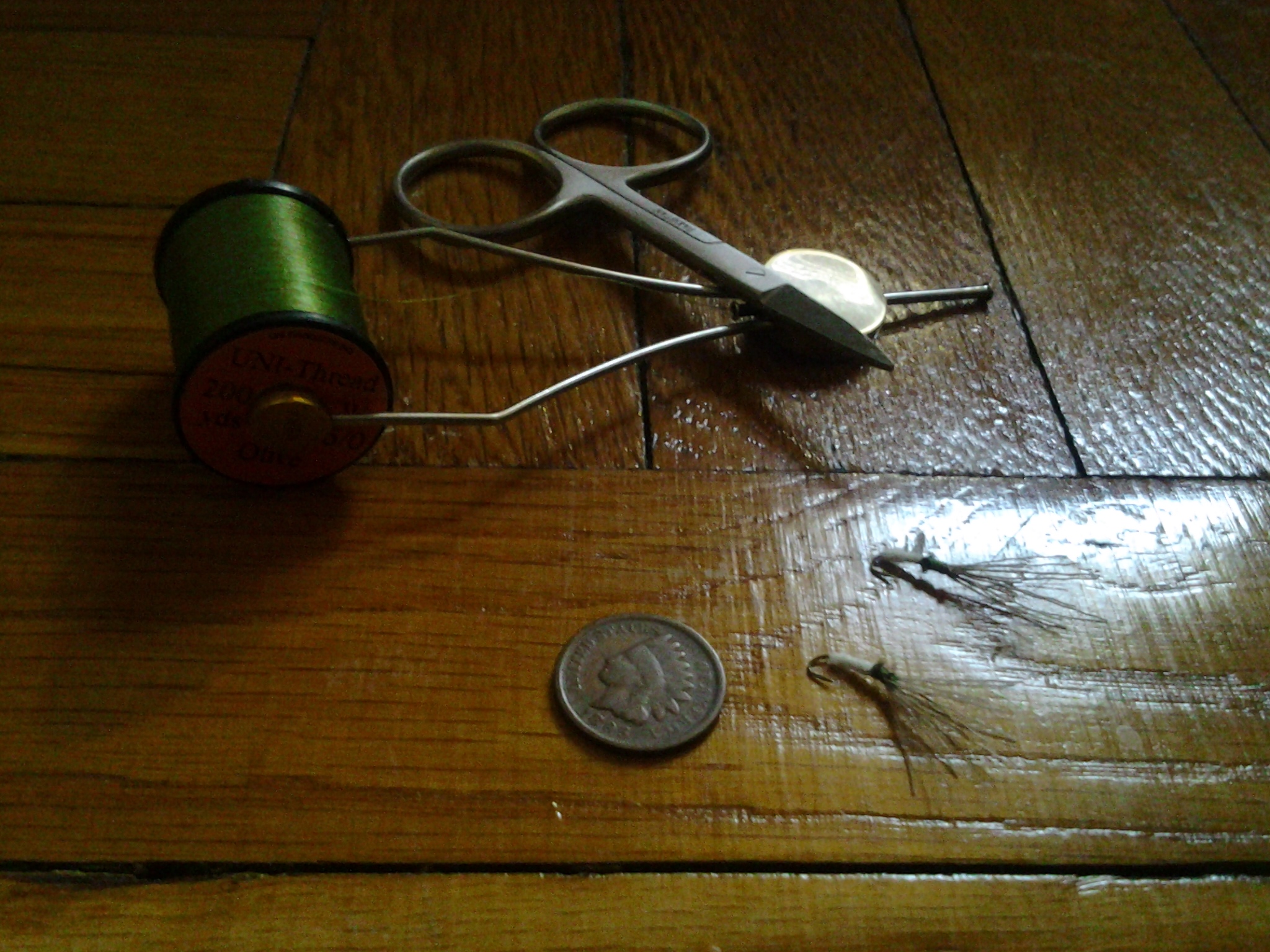
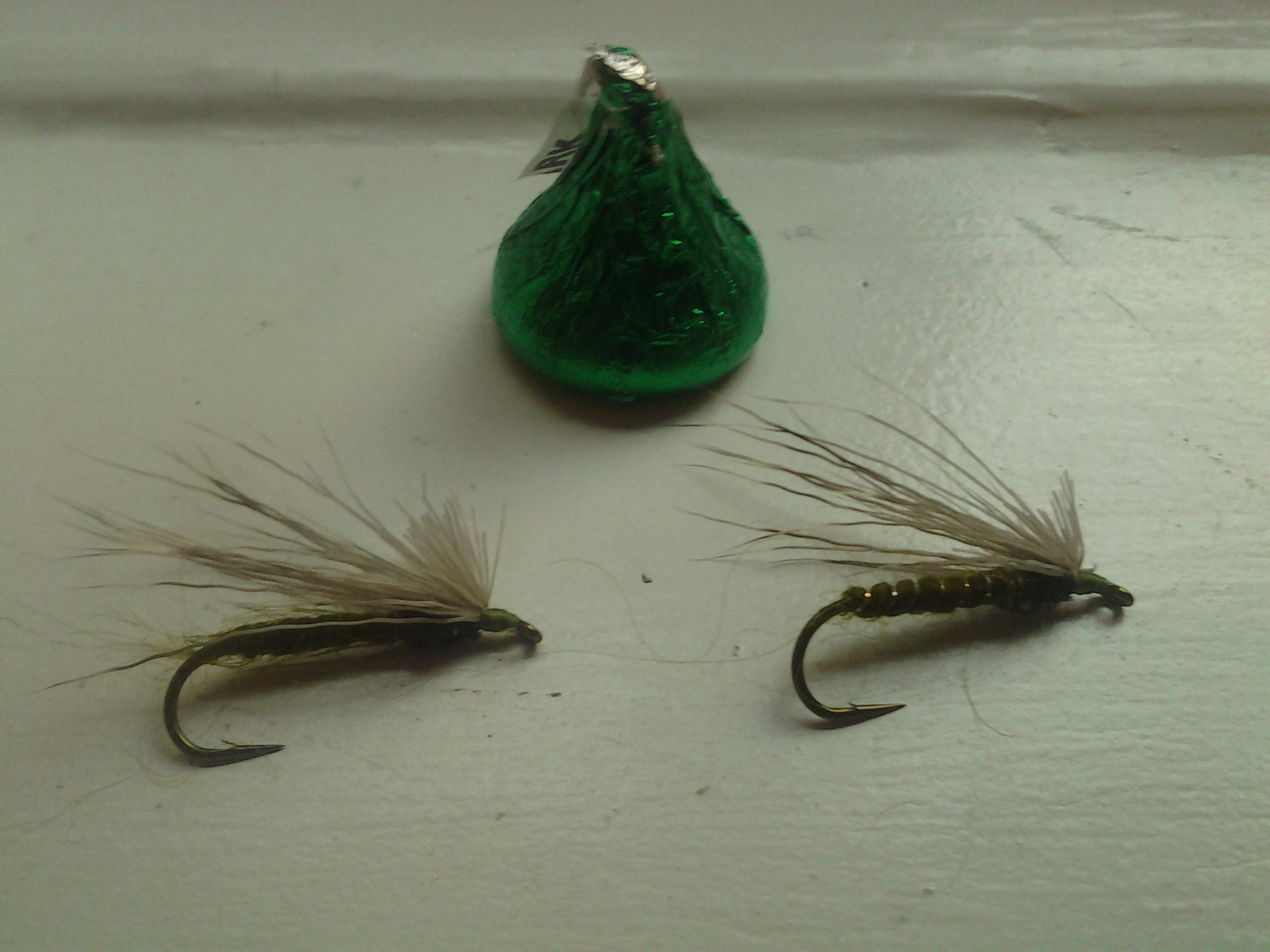
Color conveys the general feel of this fly pattern. Warm in a rustic and pastoral way. Of course, fishes. The small shiner or chub minnow here meets adequate imitation. Unweighted, this one serves well under the controlled twitch of a tenkara rod along seams of current following fast water. Weighted, this pattern oriented forward can dart along submerged walls of stone or weed. Most of the freshwater fishes find such presentations interesting.

— rPs 03 17 2015

Postscript: You can read more about the Green Guarantee in my second book, Small Fry: The Lure of the Little. Links to online purchasing options are available on the tool bar to the right of the screen. Or visit the website of The Whitefish Press: http://www.whitefishpress.com/bookdetail.asp?book=87

Leave a Comment

Bare Months Bluegills

Bare Months Bluegills . . .

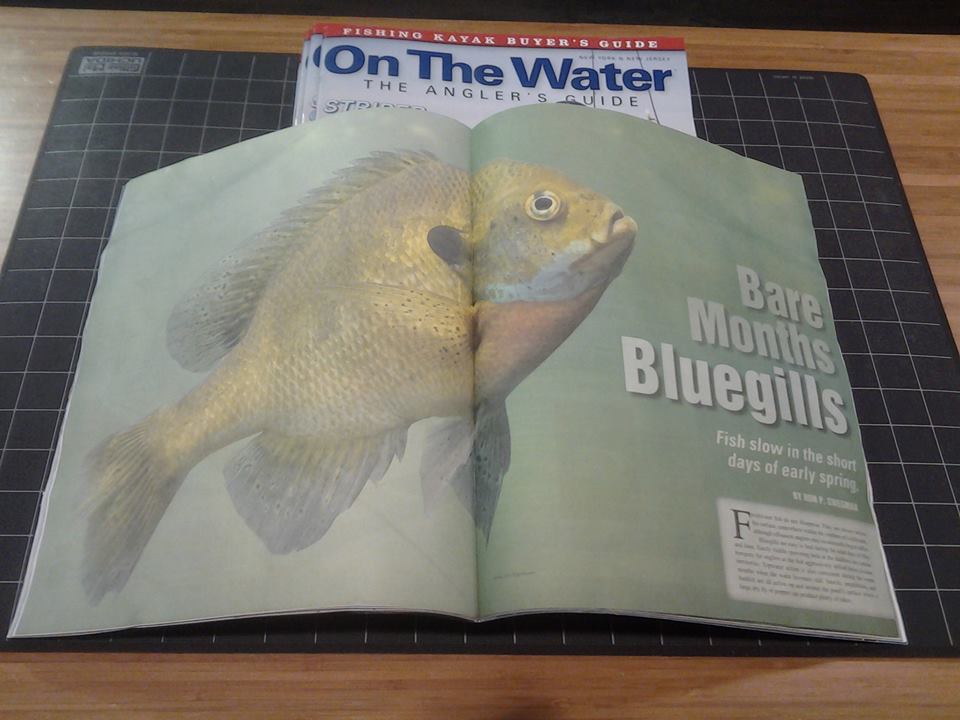
Bare Months Bluegills by ron P. swegman On the Water 03 2015

Bare Months Bluegills
by ron P. swegman
On the Water 03 2015

The March 2015 issue of On the Water features my story “Bare Months Bluegills”

Bluegills can be difficult to find and fish for during the bare months, those slivers of time when the ice may be off the water and leaves are still off the trees. Elements of conventional and tenkara fly fishing are included in the piece. My personal tenkara pond fishing technique, which includes elements of high stick nymphing and the Leisenring Lift, are described along with useful nymph patterns that can coax reticent panfish to strike.

— rPs 03 09 2015

Postscipt: The website of On the Waterhttp://www.onthewater.com/

Leave a Comment

For Short

For Short . . .

Theodore Gordon and Deer Hair Cahill Sakasa Kebari (photo taken 03 01 2015)

Theodore Gordon and Deer Hair Cahill Sakasa Kebari
(photo taken 03 01 2015)

“Deer Hair Cahill Sakasa Kebari”

Testaments of all faiths have in their spirit the sense of a letter from one to another. Letters “Of and To” are “For and From” as well. A blog in a sense is such a form. When standards are held up, when the focus is on a subject rather than an “I,” a post can be a literary act of sharing with conviction most commendable.

The level of Art is reached at times in any endeavor. The epistolary word, being of high standard, demands much from an author to become Art. Theodore Gordon’s mayfly patterns are canonical, so is his correspondence with G.E.M. Skues and Frederic W. Halford, written when he was nestled in the ‘kills of New York, read still a century after composition.

Gordon remains a compelling figure for contemplation when engaged in the sport of fly fishing and the craft of fly tying. Readers now are individuals never to be connected to the man in real time or place in the physical sense. We may never fish with him, although tethered we are by Gordon’s active mind talking from the page printed in his own careful words.

Gordon and his thoughts on the artificial fly are well known. Another fly fisher of New York, Daniel Cahill, goes more unsung, perhaps for the simple reason he did not write, although his surname stands attached to another of the canonical Catskill patterns. He was a brakeman for the Erie Lackawanna railroad and a fly tier during the late 19th Century. His Light Cahill and its variants, a staple imitation of the pale Stenecron (Stenonema) mayfly, endure as surely as those of Gordon, although the man’s actual voice, from mouth or page to ear and mind, may be silent.

Gordon and Cahill, mayfly and trout: all four have combined along one tenkara path to form a pattern I find works when trout fishing during the warm months of May through August. Shaded runs, a calm evening, or when the sun lets go of the water during the middle of a morning. A trout rising at such a time on a ‘kill might find such a basic pattern effective fished wet or dry.

I combined the deer hair I have kept close this tying season with 6/0 olive, tan, black, or white thread and bodies of yarn, feather, floss, tinsel necked with a standard peacock herl thorax. One with an angora rabbit fur body resembles a very impressionistic Light Cahill.

Deer hair is employed for the hackle rather than feather. This is a sakasa pattern, one that holds a Japanese traditional tenkara hackle orientation. The trick with deer hair folded forward is to retain a soft and parse head, which I half hitch at the rear base of the hackle. Scissors, bobbin, and thread are all the tools most necessary. Visual aids, if or as needed, of magnification 1.0 to 5.0 times can help on the details when hooks are on the smaller end. My preferred size for this pattern, based on satisfactory catch rates, is a 16.

“Has the pattern a name?” or “What do you call it?” has been asked. I reply in conversation: “(Swegman’s) Deer Hair Cahill Sakasa Kebari or Deer Hair Cahill Sakasa Kebari, for short.”

Recipe:
Size 14 to 18 hook
Angora Rabbit for Body
Peacock herl for thorax
Deer hair for hackle
6/0 thread for wrap

All the Tools Most Necessary: Tenkara Still Life (photo taken 03 02 2015)

All the Tools Most Necessary: Tenkara Still Life
(photo taken 03 02 2015)

Deer Hair Cahill Sakasa Kebari: a mouthful for fish . . .

– rPs 03 02 2015

Leave a Comment

New Beginnings, New Starts

New Beginnings, New Starts . . .
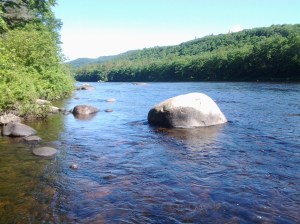
Hudson River Casting Platform (photo taken 06 22 2014)

Hudson River Casting Platform (photo taken 06 22 2014)

Summer Begins: “Schooled at Meadow and Hudson”

1.

Sounds like the subtitle infers something happened at the intersection of two streets. Sounds of people meeting and laughing interrupted by a sporadic clunk when and where some individual gets burned, yet learns street smarts.

The tenkara party continues to grow although, for me, the fishing fly life has become the quiet sport. The pupil piscator has been schooled at Meadow (Lake) and Hudson (River).

One spring June afternoon was made available and spent under sky around the brackish Meadow Lake in Flushing Meadows Corona Park, Queens. Stories from here, heretofore, had come conflicted between hearsay and a past issue of The New Yorker, dated August 22, 2005, which in part relayed one portrait of mi amigo, Edwin Valentin, in a quest with two other anglers for a caught, perhaps photographed, New York City snakehead on the deadline of a feature reporter.

My Snakehead Spring; I have lived through such times, too, experienced a parallel coincidence pair on a matter urban angling. I decided to inquire through my experience further. The 7 train left me a walk’s distance around the National Tennis Center and the grounds of the 1964 New York World’s Fair. The scene appeared clear, without the makeup of sunlight angle streams. The view appeared direct and in that bare way consistent under an unbroken nimbus cloud lid that did open near day’s end, eight hours later, when the sun set off in an electrum burst at the bottom of a darkening blue sky.
Nimbus Grip at Meadow Lake (photo taken 06 11 2014)

Nimbus Grip at Meadow Lake (photo taken 06 11 2014)

Windy this place remained, even after the last of the sun’s light. Barnacles encrusted a few pieces of old construction wood. These planks and a green great wall, a phragmite monopoly, walled in the water in all but a dozen tight places.

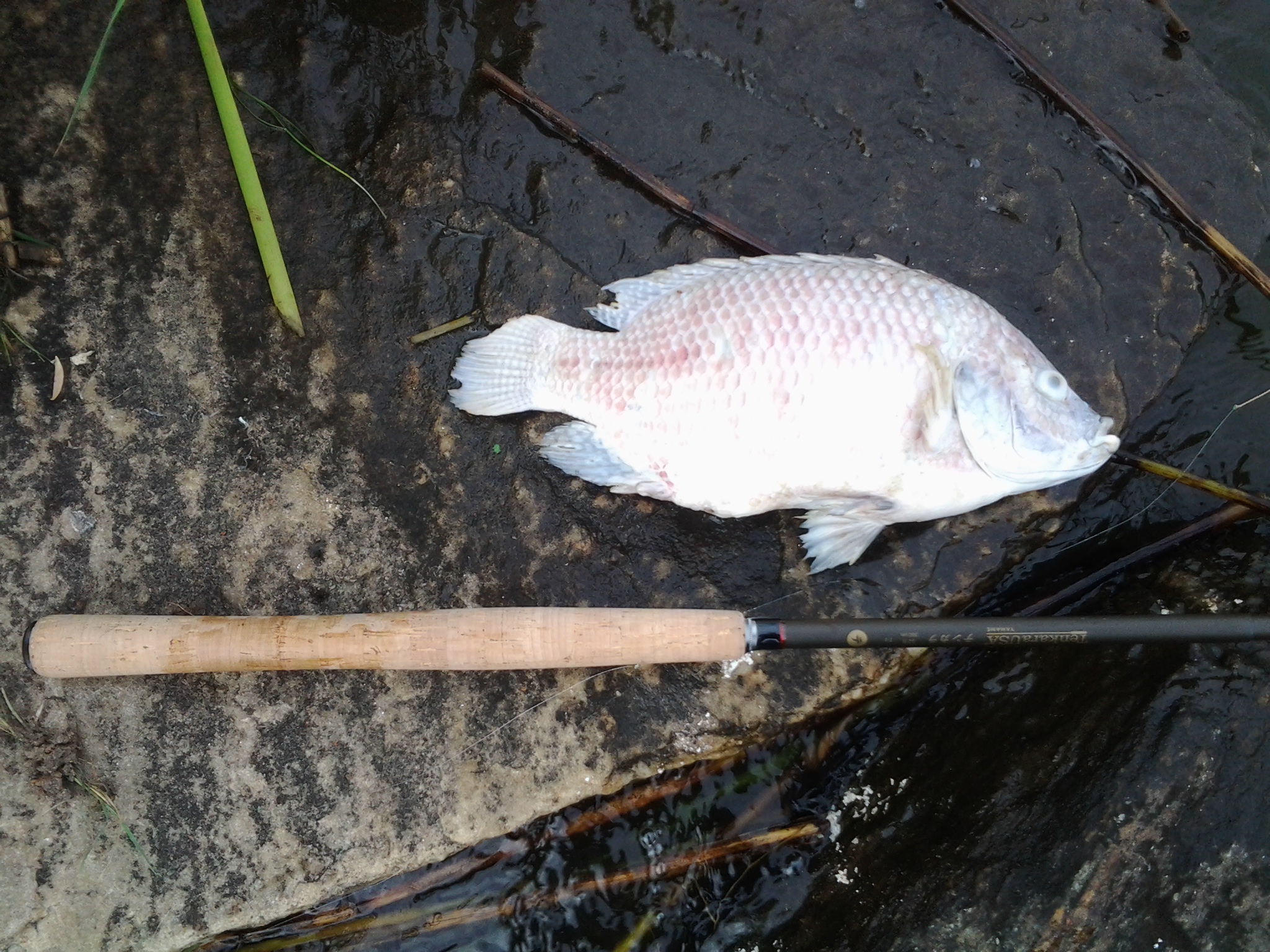
Snakehead? No, tenkara instead touched tilapia , , , one dead, a few living, seen grazing in the visible lake shallows along with carp of my favorite proportion; those the size of largemouth bass.

Yamame and Tilapia (photo taken 06 11 2014)

Yamame and Tilapia (photo taken 06 11 2014)

This is one salt lake that certainly merits more attention and shall receive more.

2.

The commercial fly life remains brisk. That’s where the block party has been going down. Tippet material, especially 6X, sells daily. I feel the standard tenkara 5X may be scaled down by one or two with most good fish played to satisfaction. Time and fish are all the necessities required to test such lines.

Two bright Sunday morning hours on the second day of summer did present a sole challenge within the wide, swift, Hudson River near Lake George.

A recalcitrant trio of brook, rainbow, and brown, this being one of the few areas in New York that possesses the potential for all three species netted on a given outing, felt near. A few glimpses of shadows defying current snaked under my sight. Was that first hang-up of a Peacock Herl Prince, the snag concluded below the water, near the cobblestone, without an explanation, actually a quick head snap of 6X under a trout take? The loose point of tippet returned clean snipped.

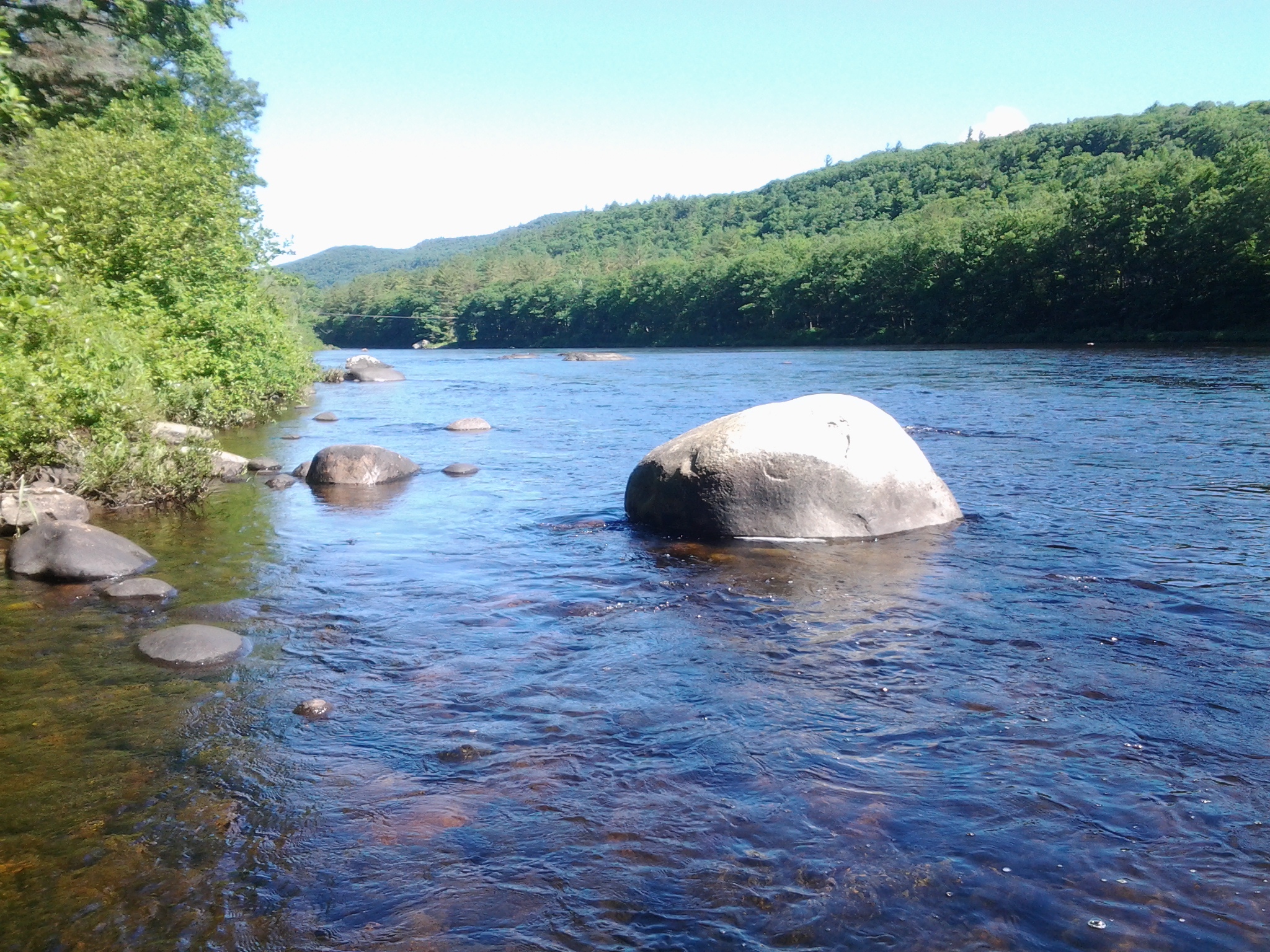
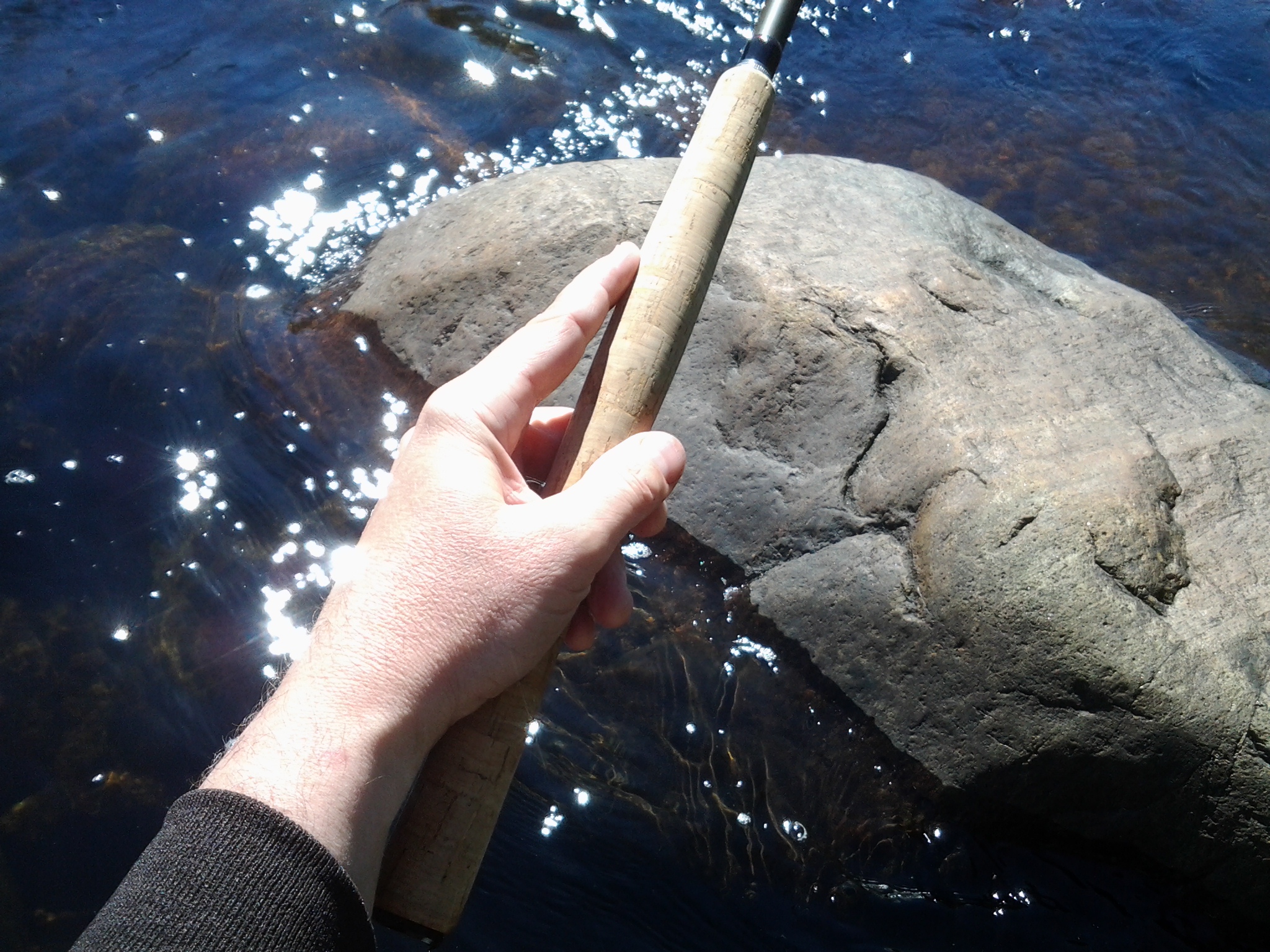
I did find the wading worthy enough for a staff. Without one, I somewhat stumbled up through a loose boulder garden. Plenty of slots and seams presented more prime soft hackle water than the time I had allotted to me. My best gave a few opportunities to hold the stick, high behind a granite monolith’s teardrop holding trout station, long enough for a short series of photos.
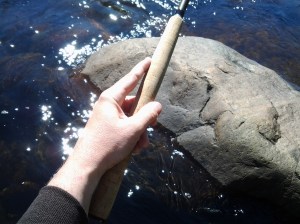
Bright Grip on the Hudson (photo taken 06 22 2014)

Bright Grip on the Hudson (photo taken 06 22 2014)

July Starts. “Tenkara Cameo”

Tenkara queries attract like minds. My July has been peppered with conversation several times a week with new faces on topics tenkara. Kebari practice remains close to the vise. There is time enough for deer hair and thread and the occasional bird feather. Peacock Herl is my A decoration. The wraps of iridescence are a pleasure; I never tire from the repetition, close knitted on a wet nymph fly hook.

Beginnings, some months, like this month, bear good news in the form of good press. Mid Atlantic Fly Fishing Guide, found complimentary in fly shops I have visited, gave me good news in the form of a cover appearance and a new story – “Brooklyn on the Fly” – on the pages of the new August 2014 issue. My Tenkara USA Ebisu rod makes two photo cameo appearances.
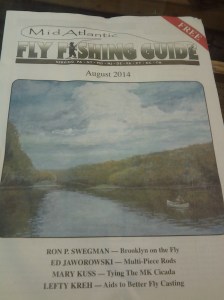
Mid Atlantic Fly Fishing Guide (August 2014)

Mid Atlantic Fly Fishing Guide (August 2014)

– rPs 07 09 2014
Leave a Comment

April: A Day; A Lake


April: A Day; A Lake . . .

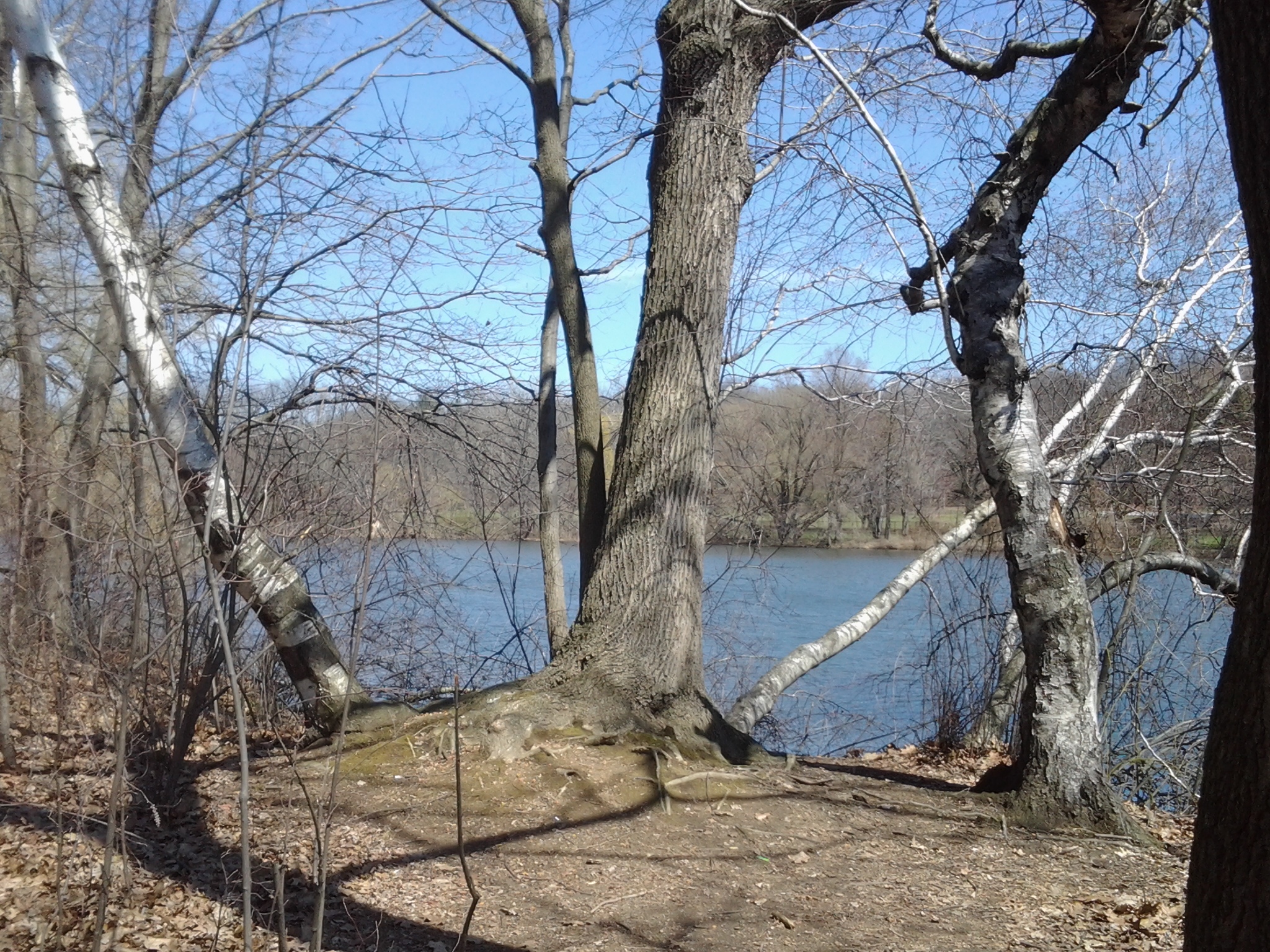
April: A Lake. (photo taken 04 10 2014)

April: A Lake. (photo taken 04 10 2014)

North of Manhattan I have fished several times in several locations. A fact may be the environment of a stillwater is more important than a place name. If you have a pond accessible in early spring, do fish tenkara there. You may catch panfish, bass, even perch and trout and pike, sized to the scale of the rod you choose.

Ebisu and I ventured into a brisk wind, cold, just not enough cold to put on my fingerless wool mittens. I knotted on a 4X length of tippet a weighted chenille pattern, olive in color, 10 in size, as well as later a classic size 12 Zug Bug nymph tied expertly by the folks at Umpqua. My new tool: a treat; a tapered, woven, 11 ft. Tenkara USA line dressed in a pale olive color.

Converted, instantly, instinctively I was to this line despite the wind level; it was obnoxious enough to make me laugh out loud with myself.

Clean and neat is the tapered line. Greeted I was, after four or five casts, by a modest largemouth bass sporting a clean and neat pattern. The fish met me during a slow Leisenring Lift beside some submerged sticks. Visibility was the best in a year as I would learn further, later, casting to carp on the lily pad flats.

I added a foot or two of Berkley Trilene green 10 lb. monofilament to absorb abrasion and to act as transition between the visible tapered line and the invisible tippet. A loop to loop between tapered line and transition is matched on the other end by a double eight knot on the transition and some kind of slip or clinch knot on the fine side.

Moss gone green; skunk cabbage and onion grass in sprout; red buds tipped the trees, all below a blue as clear sky. The wind remained generous. I learned to cast in step with it toward promising stick piles and boulder banks.

My number of chances at a carp on the flats equaled one. A fish of eight pounds to my eye passed by me bankside. I decided to spin. I pulled the lever, placed the sinking fly four feet in front of fish with a light and tight ripple following its swinging caudal fin. The fish swam on ahead on a singular mission of its own.

Flats Casting. (photo taken 04 10 2014)

Flats Casting. (photo taken 04 10 2014)

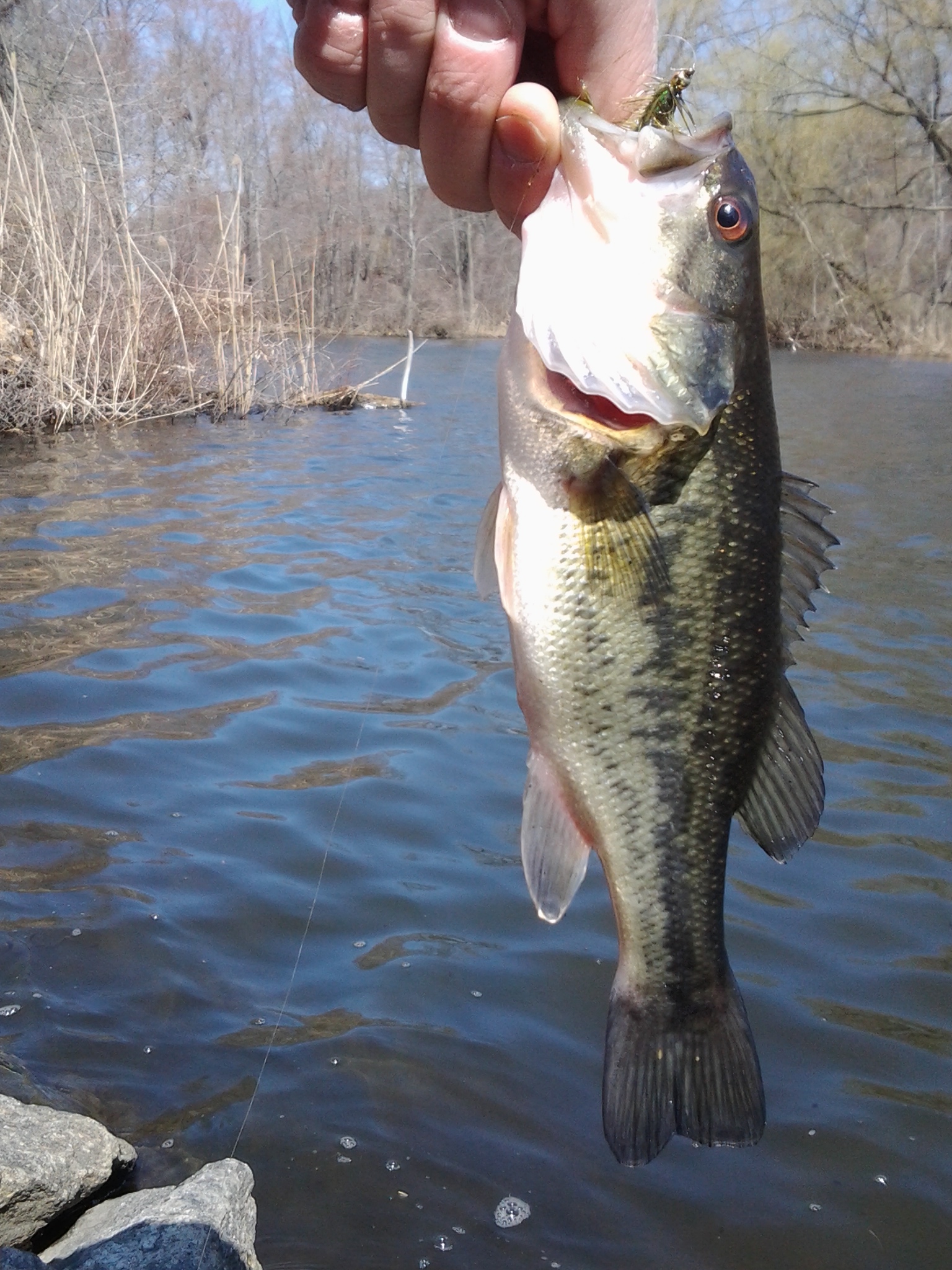
The second bass proved to be a miracle of play and patterning. A strike out of visual depth pulled tightly, approached the surface; its side rippled flashes metallic, resisting in equal the bending Ebisu. I had five or six feet of bank to each side, one occupied by a sunning turtle I did not want to disturb. I tiptoed behind the shell; our eyes together, as the rod doubled down like an extended arm wrestle.

My thumb, up, won a short photo session with a long fish; a female to my eye and understanding of fish profiles. Rare have I seen such clarity and splendor in the prominent black lateral line and bordering blotches. Each bass flank is a flag. This one remains high at full mast.

Largemouth April. (photo taken 04 10 2014)

Largemouth April. (photo taken 04 10 2014)

Open brush and dry phragmite stands around an adjacent pond’s perimeter afforded me a chance to ruminate on the catch. I cleared out a measurable amount of public plastic trash, which I disposed of later at a public can. Glass and metal do not disturb me so much as these materials, in moderation, weather better. Plastic, however, and batteries? The bits and pieces add up. Besides, you want your photos to look clean!

The equivalent of three rolls of film later, I found myself wrapping up in another manner. I rolled the tapered line onto its simple, effective dispenser. One golfer passing by announced to his other friends: “I wanna go fishing. I like to go fishing!”

I did.

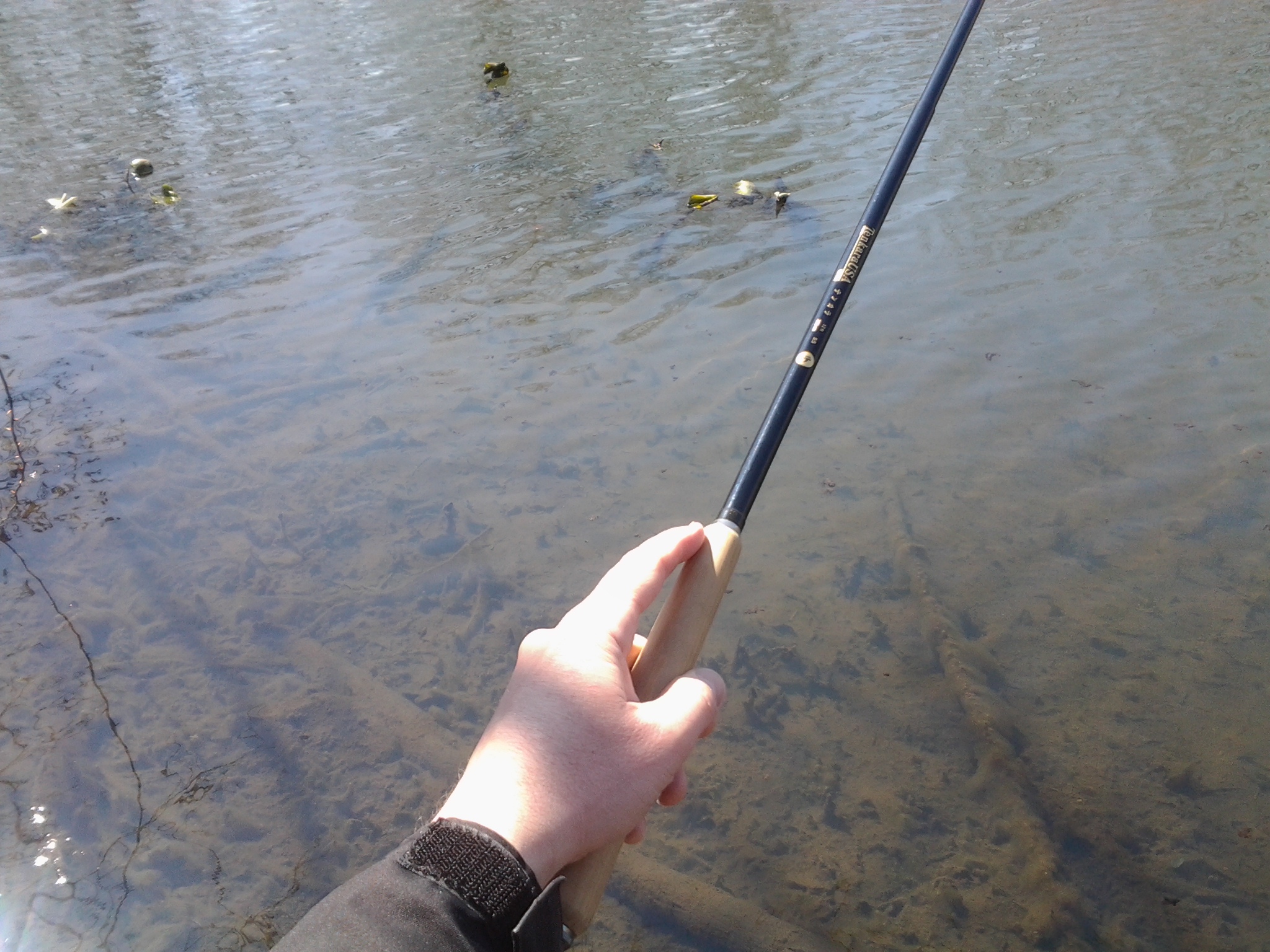
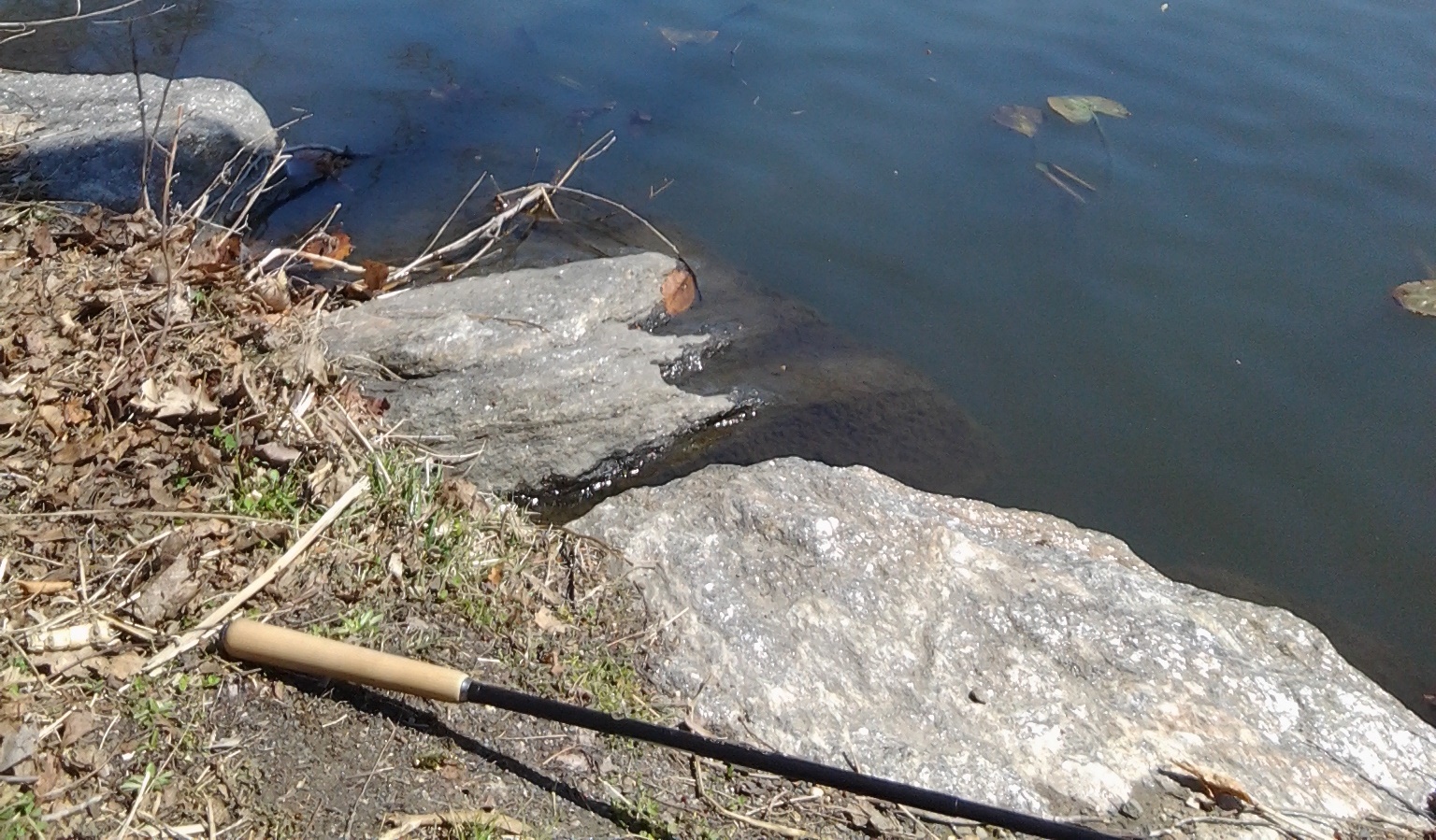
Ebisu Near Rising Pads. (photo taken 04 10 2014)

Ebisu Near Rising Pads. (photo taken 04 10 2014)

– rPs 04 11 2014

Leave a Comment

« Newer Posts
Design a site like this with WordPress.com
Get started