Posts Tagged Tenkara

Swegman on the Snakehead

Swegman on the Snakehead . . .

Today I was quoted in Marc Santora’s article regarding the alleged appearance of the snakehead fish in Central Park’s lakes. While not directly related to tenkara, the story does affect one of my Manhattan fishing destinations. Plus the inclusion of my “expert opinion” in The New York Times is an appearance worth mentioning. Here is the link to the article, which can be found in the City Room section:

“In Central Park, the Snakehead Fish Intrudes”

— rPs 04 30 2013

Comments (4)

Back in Hand

Back in Hand . . .

My Ebisu back where he belongs. (photo taken 04 29 2013)

My Ebisu back where he belongs. (photo taken 04 29 2013)

When a fishing tool is used hard, often, or both, some snafu has to be expected at some point. So it occured to me with my Tenkara USA Ebisu, although the problem did not involve wear or breakage – I somehow lost a segment and the handle screw cap in the field.

An email to Daniel Galhardo received a quick reply and a solution; send the rod to the repair center in Belgrade, MT. I found a Scotch mailing tube that fit the TUSA rod tube perfectly and mailed the package on April 19.

Today, ten (10!) days later – Ebisu is back in my grip! This has been, hands down, the best customer service I have yet experienced with any company.

Thank you, Daniel, John, and Tenkara USA!

– rPs 04 29 2013

Leave a Comment

Earth Day 2013

Earth Day 2013 . . .

Prospect Park largemouth bass (photo taken 04 22 2013)

Prospect Park largemouth bass (photo taken 04 22 2013)

Today I took the Q train to Prospect Park in Brooklyn where I spent Earth Day fly fishing, bird watching, photographing wildflowers, and . . bagging and disposing of litter.

The phrase “use the resource” seems selfish when applied to parks and other outdoor spaces. I do not consume the outdoors, I interact with and help out when I can; today by bagging the loose plastic trash that has spread like a virus over the land during the last three decades.

The day encompassed an entire story I wish to take more time to detail later in the week. Let me just state here the bass fishing was excellent using variations on the Wooly Kebari fly pattern!

Happy Earth Day . . .

– rPs 04 22 2013

Comments (2)

On the Eve of the Opener

On the Eve of the Opener . . .

20130331_184940

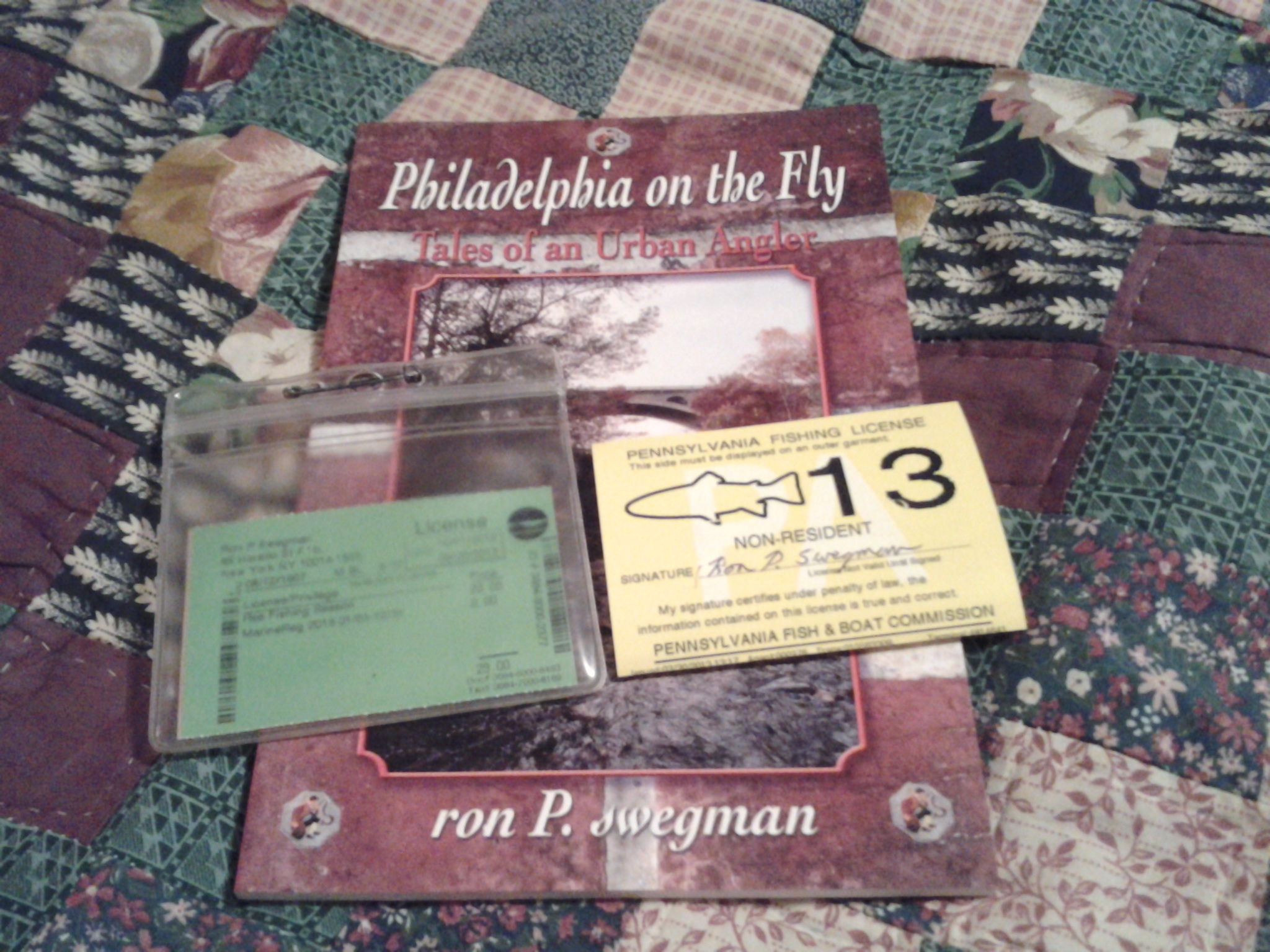
The start of the season for trout in Pennsylvania coincides with the Easter holiday weekend this year. Since I am here visiting the in-laws (who live just a few blocks from a trout stream), we took the time to purchase our annual non-resident licenses (with trout stamp). Tomorrow may be a cold and damp Monday, but with that extra day scheduled off, I would be an April fool if I did NOT go tomorrow!

— rPs 03 31 2013

Comments (1)

My “One Only” Fly

My “One Only” Fly . . .

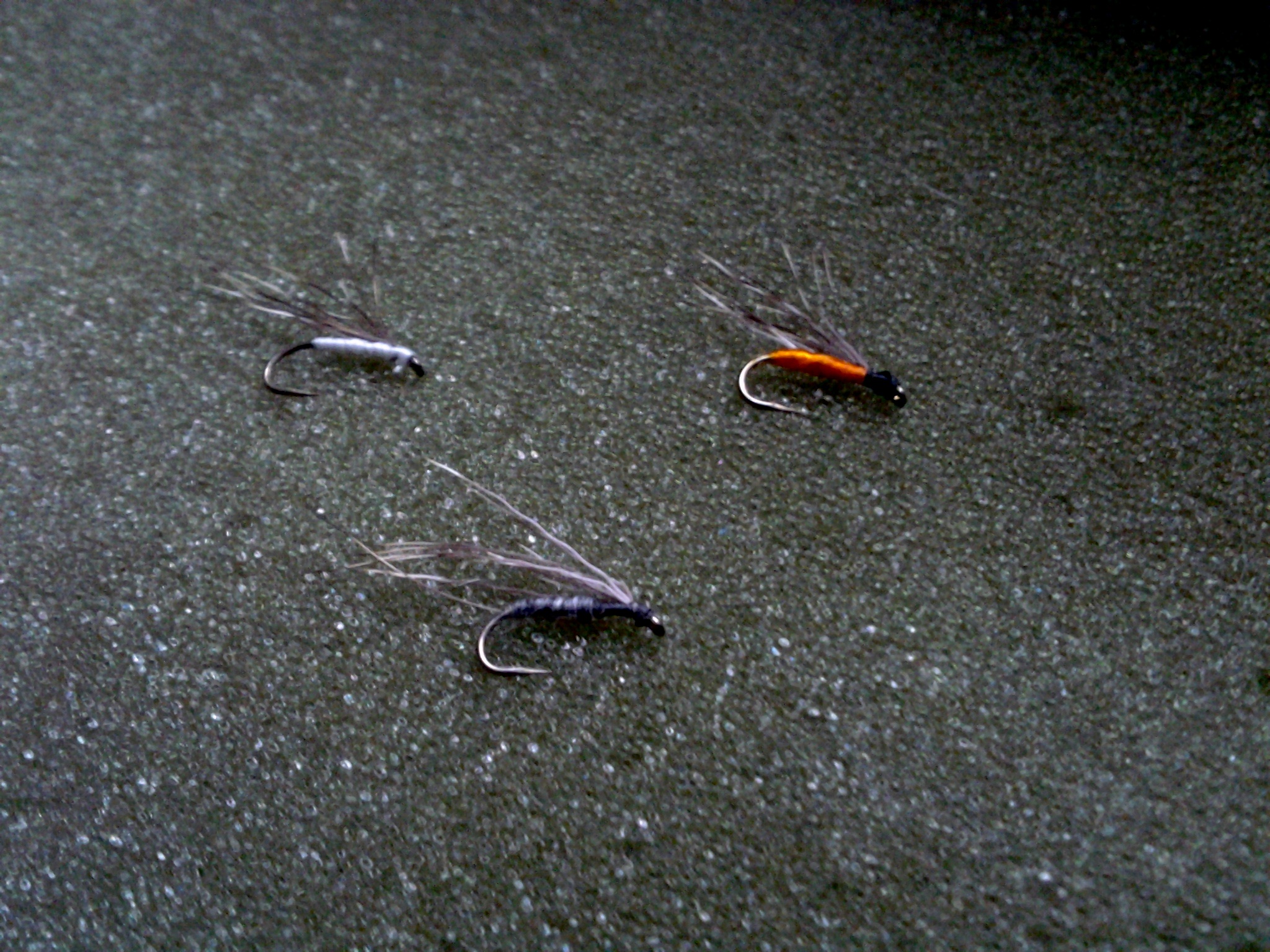
Three variations of my "one only" fly pattern: Deer Hair and White Thread; Deer Hair and Orange Floss; Deer Hair and Gray Wool. (photo taken 02 28 2013)

Three variations of my “one only” fly pattern: Deer Hair and White Thread; Deer Hair and Orange Floss; Deer Hair and Gray Wool. (photo taken 02 28 2013)

The pattern that has best served me well and best represents my tying philosophy is a simple hybrid of a soft hackle and micro streamer. I use a wet fly nymph hook in sizes 10 through 14, thread and floss or knitting wool for the body, and a sparse hackle of natural deer hair. These combinations carry the same silhouette: one short in the body and long in the wing. Very effective when twitched in still water, or hung in a stream’s current, I would choose this style as my “one only” tenkara fly if pressed to do so. The pattern has worked consistently in pond environments for panfish and has always helped me hook chubs, fallfish, and trout along coldwater freestone streams.

The General Recipe:

Hook: standard wet fly nymph, size 10-14
Thread: 6/0 thread
Body: 6/0 thread; floss; or baby ull knitting wool
Hackle: natural deer hair; or Hungarian partridge

– rPs 02 28 2013

Comments (1)

Winter Light

Winter Light . . .

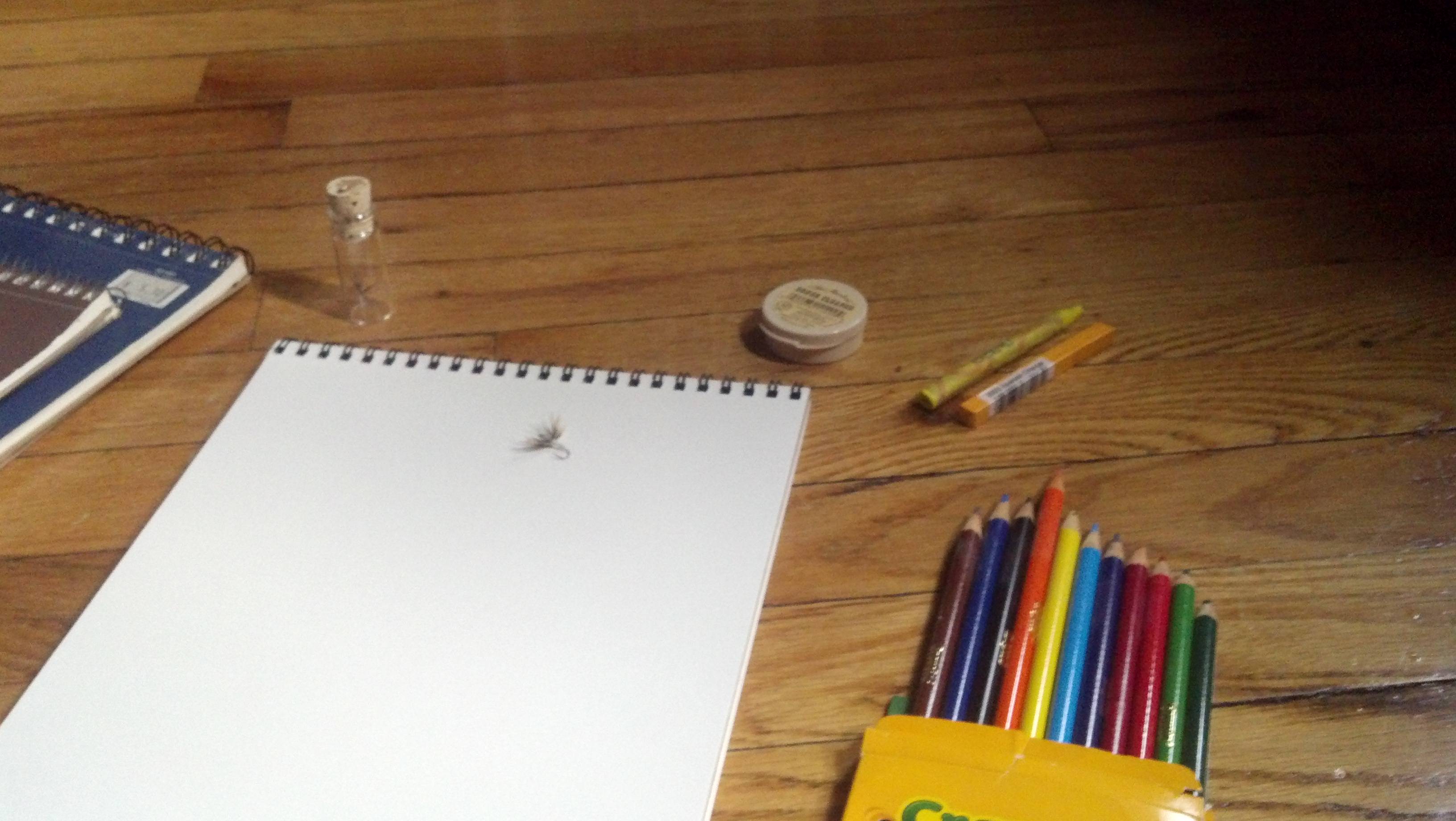
My art supplies assembled around the sitter; an Amano Kebari. (photo taken 01 29 2012)

My art supplies assembled around the sitter; an Amano Kebari. (photo taken 01 29 2012)

The art studio replaces the trout stream and bass pond when the white skies of winter fill my Manhattan rooms with a pale light perfect for my drawing method. Today is such a day. I assemble my materials on the floor, assume the zazen position, and commence to document the fly pattern and the unique shape of its shadow during the given illustration session. The result, if I am successful, shall be a unique portrait. Today’s sitter: the Amano Kebari . . .


– rPs 01 29 2012

Comments (1)

A Few Hours on Christmas Eve

A Few Hours on Christmas Eve . . .

Exposed tree roots create an inviting target for tenkara casts during the winter months. (photo taken 12 24 2012)

Exposed tree roots create an inviting target for tenkara casts during the winter months. (photo taken 12 24 2012)

My 2012 fishing year, my first tenkara season, ended along the same water where it began: French Creek in southeastern Pennsylvania. My Christmas Eve had been planned from early afternoon onward – situated at the in-laws, gift wrapping, attending services, dining on a meal of seven fishes – which offered me one last free morning of trout fishing if I wanted it.

I did.

Silently I departed from a slumbering house after coffee and a cinnamon roll. Outside, the damp December air filled my lungs and legs with awakening. Frost crusted the grass as a thin overcast filled the still sky. Snow was in the evening forecast. The solunar table predicted a Major between nine and eleven a.m. Perhaps a few little caddis, as well as a few following Salmo trutta, might brave the morning calm along with me.

French Creek, just a few downhill minutes away on foot, flowed clear and low. Large knots of exposed oak and London plane tree roots broke the opposite bank every few dozen yards. These tangles can always provide some depth and holding lies where delineated pool and riffle structures are not present. A small Pheasant Tail nymph shortly found itself drifting by these pretzel patterns of wood.

My casts were smooth and hypnotizing. Chatty crows flew by and chickadees made friendly calls from nearby branches. One polite slate blue and white nuthatch appeared on a nearby tree trunk and softly said: “Hen. Hen. Hen.” in a way that resembled advice on where to cast.

The big take of the outing came soon after, slowly, more of a stop in the flow that felt at first like a flexible snag. A tree branch, submerged, must have hooked up with the pattern, I assumed. My response was a kind of lackadaisical pull back. The resistance pulled forth. When the back and forth symmetry abruptly turned into asymmetric animation, I realized the other end held a fish. A flash of bronze and silver flashed from below and then I was snapped off a decent brown trout. I was not used to the new 6x tippet material I had employed, or maybe my knot had frayed on a root.

Upstream called to me then. One large flat pool with some depth lay a few dozen yards above the bridge just in view through the brown web of bare trees. I hiked up to it, passed beneath the span on a narrow band of frozen mud. I then faced my athletic challenge of the day. I had to climb along a scree of red siltstone that is near impossible to navigate when the full growth of summer is present. I angled myself parallel to the steep side so a slip would simply land me hard onto the loose rock rather than on a neck breaker of a tumble into frigid water below. Tenacious thorned vine branches nagged at me as well, but I made it, climbing down to the water on a natural staircase of the red rock beside which a sapling bannister stood.

A natural staircase of red siltstone along French Creek. (photo taken 12 24 2012)

A natural staircase of red siltstone along French Creek. (photo taken 12 24 2012)

While I scanned for risers and contemplated the water’s sound and motion simultaneously, I heard rhythmical wind sounding from above. A great blue heron passed overhead with an audible flap of broad wings. Its prehistoric profile approached a series of power lines that stretched across the creek about twenty yards farther up. One of the cables must have been strung a few feet higher than the others. The big bird had to add an extra jump to clear the hump. Loud croaks followed, an ornery sound reminding me of any other pissed off commuter faced with an unexpected obstacle.

No risers appeared as the clock continued toward noon. I tipped my leader with a Gold-Ribbed Hare’s Ear nymph and swung it a few dozen times. No takers. I was pleased, though, to have had a few hours before the holiday that were removed from structured stress and inserted instead into the random natural world of wind in the ears and water before the eyes and the thought that my fly attached to a tenkara rod might present me with a Christmas gift of a trout. As it happened, I received a present even more grand – one of presence, pure and uncomplicated – one of happiness.

The view as I departed French Creek for the final time in 2012. (photo taken 12 24 2012)

The view as I departed French Creek for the final time in 2012. (photo taken 12 24 2012)

Yes, Happy Holidays.

— rPs 12 29 2012

Leave a Comment

A Late Autumn Tenkara Trick

A Late Autumn Tenkara Trick . . .

Harlem Meer in November: The fish are there . . . but where? (photo taken 11 12 2012)

Fish do not disappear. They are always there, somewhere within the course of a flow or the confines of a stillwater. A pond fed by a spring, or a manmade impoundment unconnected to a river or stream, supports fish in a fixed area, but at various locations according to the season. Think of the water as a three-dimensional space akin to a house with multiple rooms, each of which becomes the kitchen at a different time of the day, or the year.

When the leaves are mostly down and the shoreline reeds go brown, bass and bluegill tend to bunch up near points and drop offs. This type of cover is static, unlike that afforded by the cyclical growth of vegetation. The plant matter does remain as litter on the bottom and stalks along the edges, which give fish something other than shelter. What earlier in the year provided shade or a hiding place for the predator has become a source of nutrition for the prey. The beneficiary is a major fish food source and subject for a subsequent set of fly patterns: the nymph.

Fallow vegetation along a point on the water’s edge attracts nymphs, and by extension, gamefish. (photo taken 11 12 2012)

Fished slowly along a pond’s leaf-littered bottom, the nymph may be the very best fly fishing (and tenkara) trick available to the autumn-season pond angler. One particular retrieve works very well with the long tenkara rod and level line. The tactic takes a tenkara limitation and transforms it into an asset. Since tenkara anglers cannot strip in a flyline, or inch in a flyline, through guides, the solution is a long, slow lift to simulate a nymph leaving the bottom. Pulses and other incremental retrieval motions are not necessary, and in fact would only interfere with the best presentation. What is needed is patience and resilient shoulder muscles. Once the cast is made, and time taken for the nymph to settle on or near the bottom, what follows is a very slow, very steady, vertical lift of the rod arm that takes into account the crawling pace of insect larvae. Reliable patterns include: Hare’s Ear, Pheasant Tail, Prince, Zug Bug, even the Copper John, in sizes 10 through 14.

Evaluation day came when I met my coworker Jesse Valentin on a sunny November Monday off from the fly shop. We were lucky to enjoy a free day at Harlem Meer during one of the last periods of jacket and sweatshirt weather. The sun was gold, the sky pale blue, the surrounding trees brown, holding just a scattered few leaves that resembled little flags rippling in the damp breeze. He chose to work the edges with a spinning rod and jig pattern. I knotted on a size 14 Olive Hare’s Ear. Each of us worked our lure slowly, methodically. The Hare’s Ear scored first with the bluegill.

This bluegill pounced on an Olive Hare’s Ear nymph during the middle of November and in the middle of Manhattan. (photo taken 11 12 2012)

Jesse connected with a small largemouth shortly thereafter. We were both now on the board and eager to keep moving, working the banks. He pulled ahead, as I was putting my tenkara slow nymphing trick to a serious test. I scored a passing grade of sorts  when my own rod bent to the strong dives of a largemouth bass.

Largemouth bass like the slow nymph, too! (photo taken 11 12 2012)

While I cannot yet submit this tactic for inclusion into the tenkara canon, I do stand by late-autumn nymphing for stillwater bass and bluegill, and believe the tenkara rod to be the best vehicle. The only drawback to this type of slow fishing is the ironic quickness of a day’s passage at this time of year. Jesse and I had barely moved beyond the initial euphoria of our back-to-back bass when the sun dropped behind the trees, the wind increased, and the cold came out to tell us to head for home.

– rPs 11 28 2012

Leave a Comment

Little Pond, Large Bass

Little Pond, Large Bass . . .

An inviting autumn scene in the Croton Watershed. (photo taken 10 24 2012)

Small ponds hold deep potential for tenkara anglers on the hunt for large bass, especially in autumn when resident sunfish head for deeper water. With the sunnies bedding down for the colder months, and out of the feeding area, a gray fall day can offer the most focused largemouth bass fishing of the year. A long, limber, tenkara rod can be used to work the shoreline, along the weedline dropoff, where mature bass tend to cruise the dark water in search of a few last bites.

A green Matuka, fished slowly so its feather and fur could undulate in the microcurrents, proved this to be true during an October outing around a little country pond somewhere within the Croton Watershed in Westchester County . . .

Maryann Amici holds one of several largemouth bass we caught from a tiny pond in Westchester County north of New York City. (photo taken 10 24 2012)

Perhaps a foot of water lay above the submerged weeds of this pond. There are many openings in and amongst this type of plant growth where largemouth bass will hide, waiting to ambush a baitfish, crayfish, or nymph. Throughout this season the fixed length of the tenkara level line has allowed me to cast more accurately into this environment because I am working with, rather than against, the physical limitations of the tenkara tackle. I feel like I am shooting a narrow arrow rather than casting a wide net. The happy result is greater consistency in placing the fly over the target – and the fish – a situation that increases the number of direct encounters and, on a good day like this day, solid hookups with large bass.

– rPs 10 31 2012

Leave a Comment

Grand Slam in The Bronx

Grand Slam in The Bronx . . .

Welcome to The Bronx! (photo taken 09 11 2012)

Just one of the five boroughs of New York City is situated on the mainland of the United States. The Bronx holds this distinction as well as a somewhat checkered reputation. Crime reports often vie for headlines beside the successes of its favorite sons: the New York Yankees.

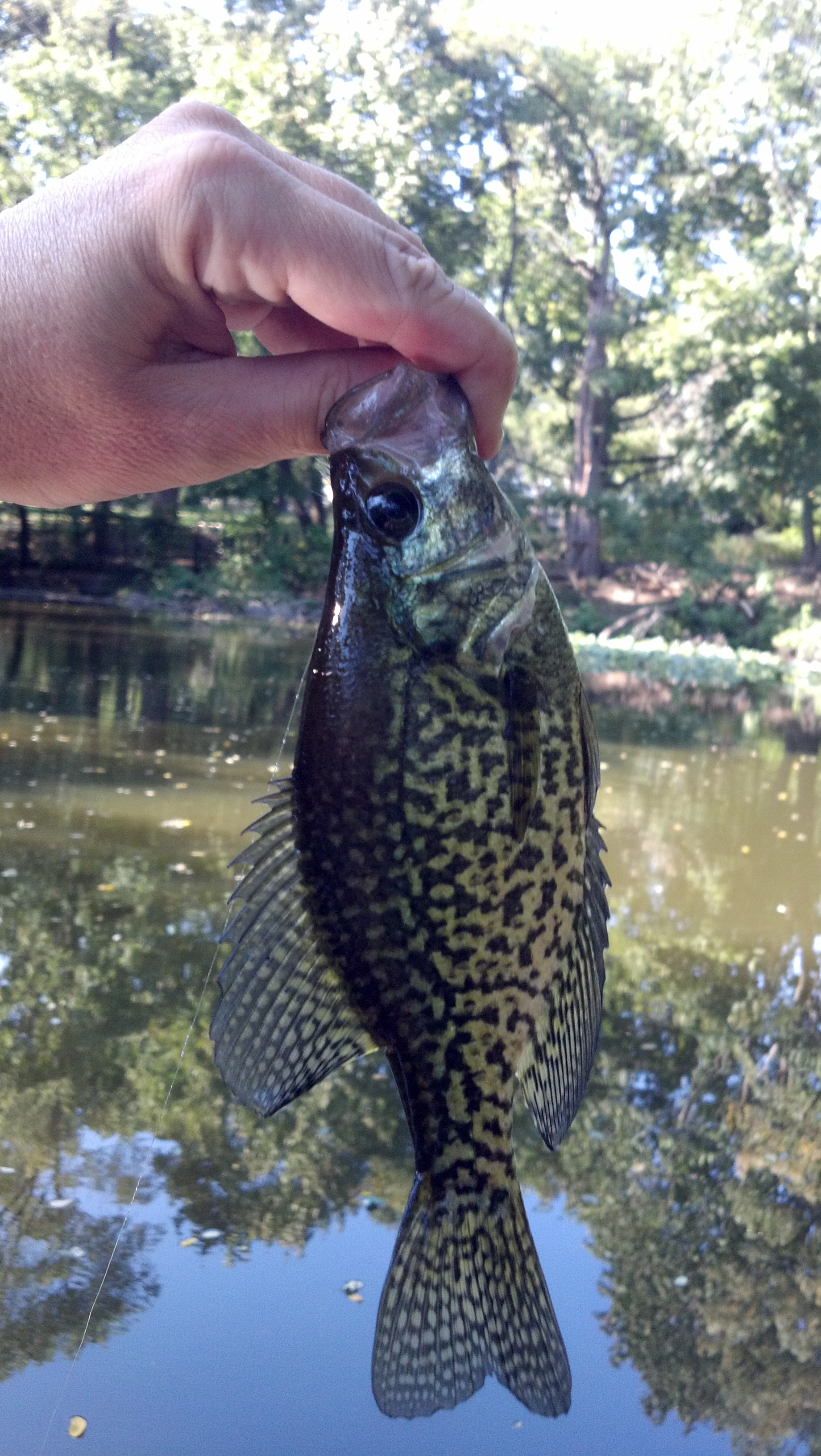
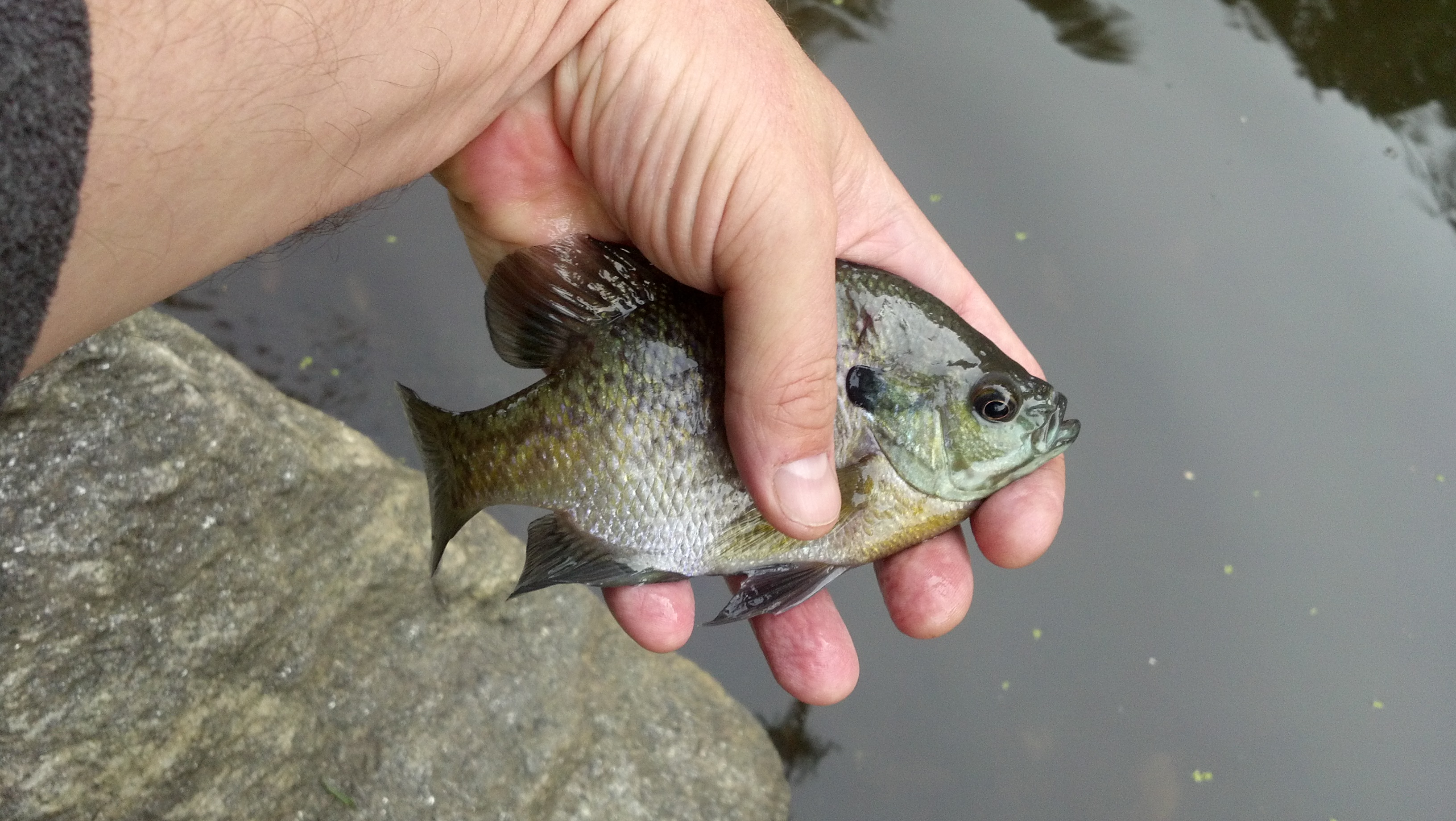
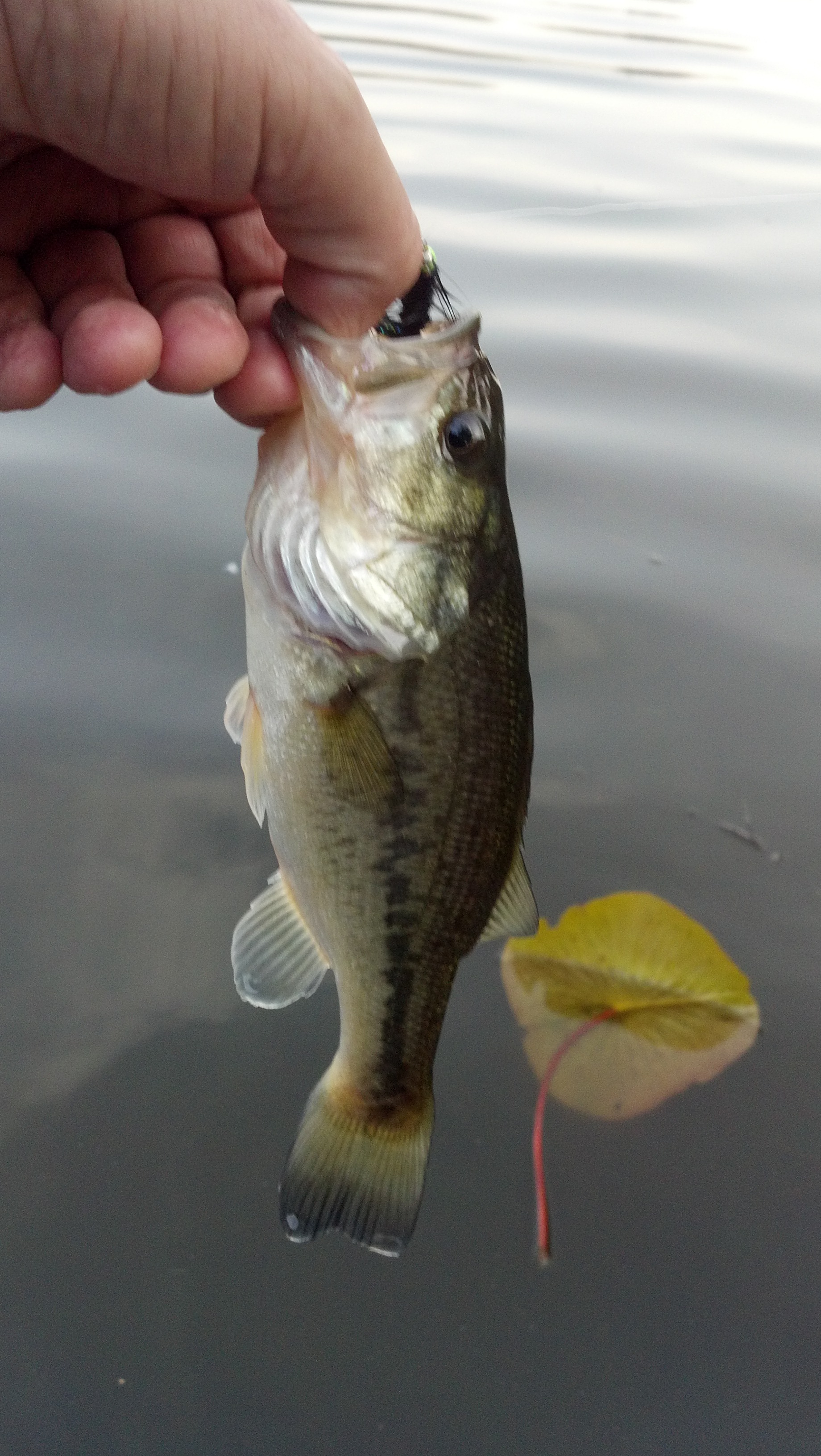
The borough has its more quiet, bucolic, and unspoiled corners out of the media spotlight. Of these, Van Cortlandt Park is perhaps The Bronx at its best: 1,146 acres of green space, including the nation’s first public golf course and a freshwater lake that sustains black crappie, bluegill, largemouth bass, and yellow perch.

I paid two visits to the park this September. A leisurely ride to the end of the 1 train’s line leaves one off at 242nd Street. From there I hiked in about five minutes under a canopy of sweetgum and oak trees, through a short wetland trail, to the western shore of Van Cortlandt Lake. Fed by Tibbett’s Brook, a meandering flow full of lily pads, the lake was formed when this waterway was dammed by Frederick Van Cortlandt, son of Jacobus Van Cortlandt, in 1699. The surrounding park, once a mix of uncut forest and grain fields, was sold by the family to the City of New York in 1888. The fields became parade grounds, a public golf course opened in 1895, and the lake, long and narrow, remained a prominent geographical fixture for surrounding trails popular with cross-country runners.

The sign points the way . . . (photo taken 09 25 2012)

This month I fished the lake’s edges and discovered the joys of tenkara in the lily pads. Casting a fly-tipped tenkara level line provides much greater accuracy and fewer snags (and lost patterns) than a conventional fly rod matched with floating fly line. The reason, as I perceive it, is that a long rod and short line offers more control and less room for error than a short rod and long line. The spaces between the pads are usually tight and overhanging tree cover is often present. Tenkara threads the eye of this needle with a combination of less line, less extraneous motion.

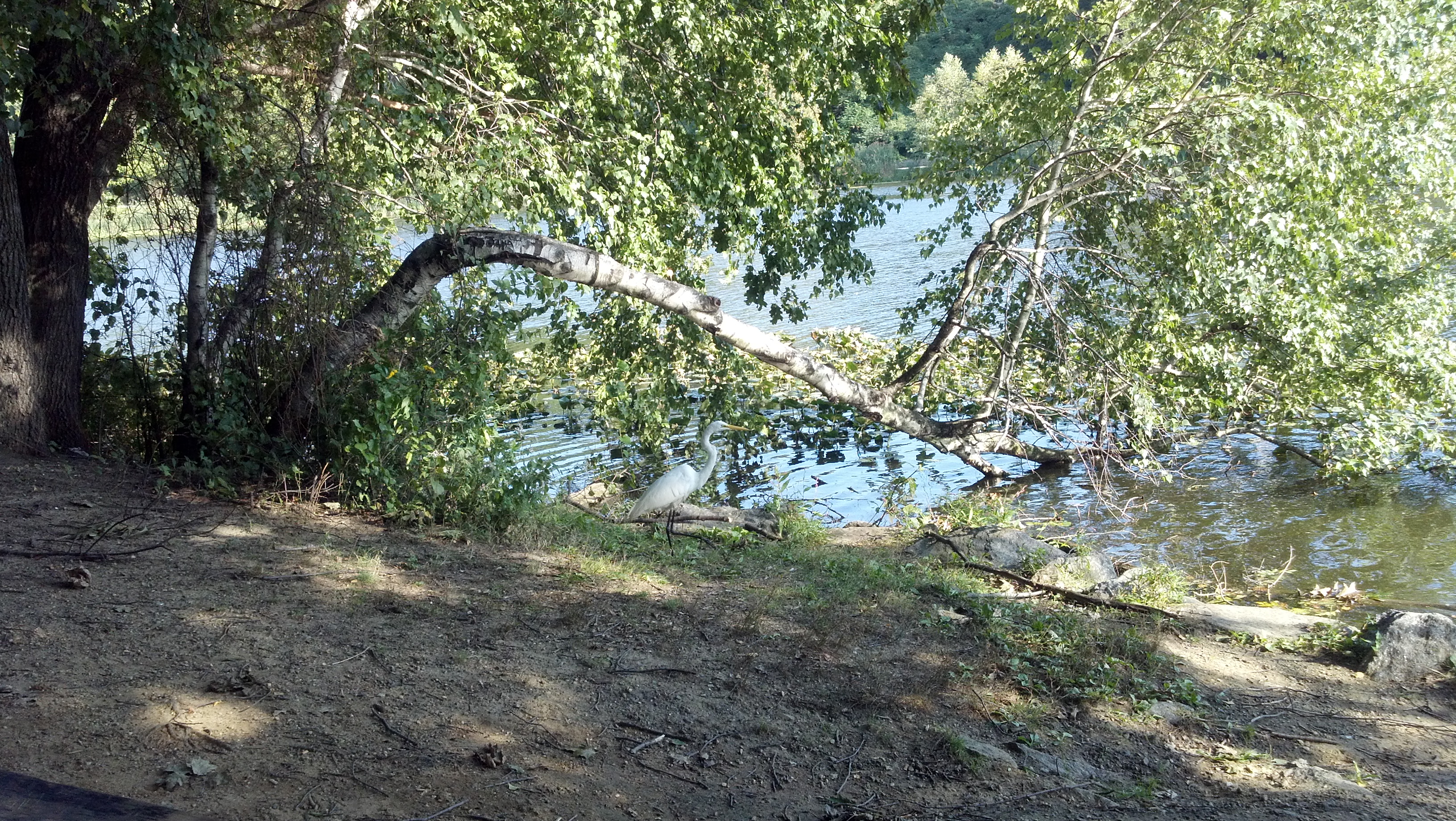
As I fished, I could tell I was on the right path here. I spotted a great blue heron, a green heron, a great egret, and a kingfisher all at work. My feathers were bound to a hook, but in the presence of these well-preened anglers, I knew fish had to be present.

The end result of my exploration and experimentation drew me back to baseball. As the Bronx Bombers continued to race the Baltimore Orioles for sole possession of first place in the eastern division of the American League, I enjoyed my own fall classic in the form of an angling version of the grand slam – a four species outing – including:

Black Crappie . . .

(photo taken 09 25 2012)

Bluegill . . .
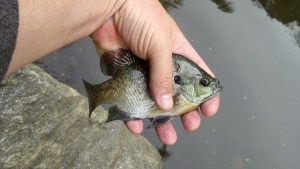
(photo taken 09 25 2012)

Largemouth Bass . . .
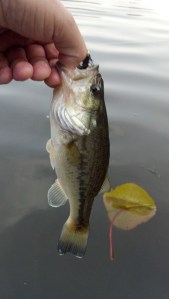
(photo taken 09 25 2012)

. . . and Yellow Perch. To my frustration, just as with the golden shiner at Harlem Meer earlier in the year, I failed to seal the deal with a photo of the perch. Fish photography, while angling solo, remains a challenge for this tenkara advocate. I admit I still need work on the second leg of the “Catch, Photo, and Release” tripod, but I have covered the four bases, the four game fish of Van Cortlandt Lake, thanks, in large part, to tenkara.

An egret urban angler. (photo taken 09 25 2012)

– rPs 09 29 2012

Postscript: To learn more about the history and ecology of Van Cortlandt Park, visit the website of the Van Cortlandt Park Conservancy by following this link:   http://vcpark.org/

Leave a Comment

« Newer Posts · Older Posts »
Design a site like this with WordPress.com
Get started